

Understanding the statute of limitations on debt in Louisiana is essential for anyone navigating financial obligations in the state. Louisiana uses a unique legal framework called "prescription" rather than the term "statute of limitations," but the concept serves the same purpose: limiting how long creditors can legally sue you to collect outstanding debts. Whether you're managing medical bills, credit card balances, or personal loans, knowing these time limits can help you make informed decisions about your financial future and protect your rights when dealing with debt collectors.
What Is the Statute of Limitations on Debt in Louisiana
Louisiana's prescription laws establish specific timeframes during which creditors and collection agencies can file lawsuits to recover debts. Once this period expires, the debt becomes "time-barred," meaning creditors lose their legal right to sue you for payment. However, it's important to understand that the debt doesn't disappear-you still owe the money, but collectors cannot use the court system to force you to pay.
The Louisiana Legislature provides the statutory framework that governs these prescription periods. Unlike many states that use common law principles, Louisiana follows a civil law tradition derived from French and Spanish legal systems, which creates distinct categories and timeframes for different types of obligations.
How Prescription Differs from Statute of Limitations
While most states use "statute of limitations" terminology, Louisiana's prescription system operates under Civil Code provisions that may seem unfamiliar to those relocating from other states. The functional outcome remains similar: both systems create deadlines for legal action. Understanding this distinction matters when researching your rights or consulting with legal professionals who specialize in Louisiana consumer law.
Timeframes for Different Types of Debt
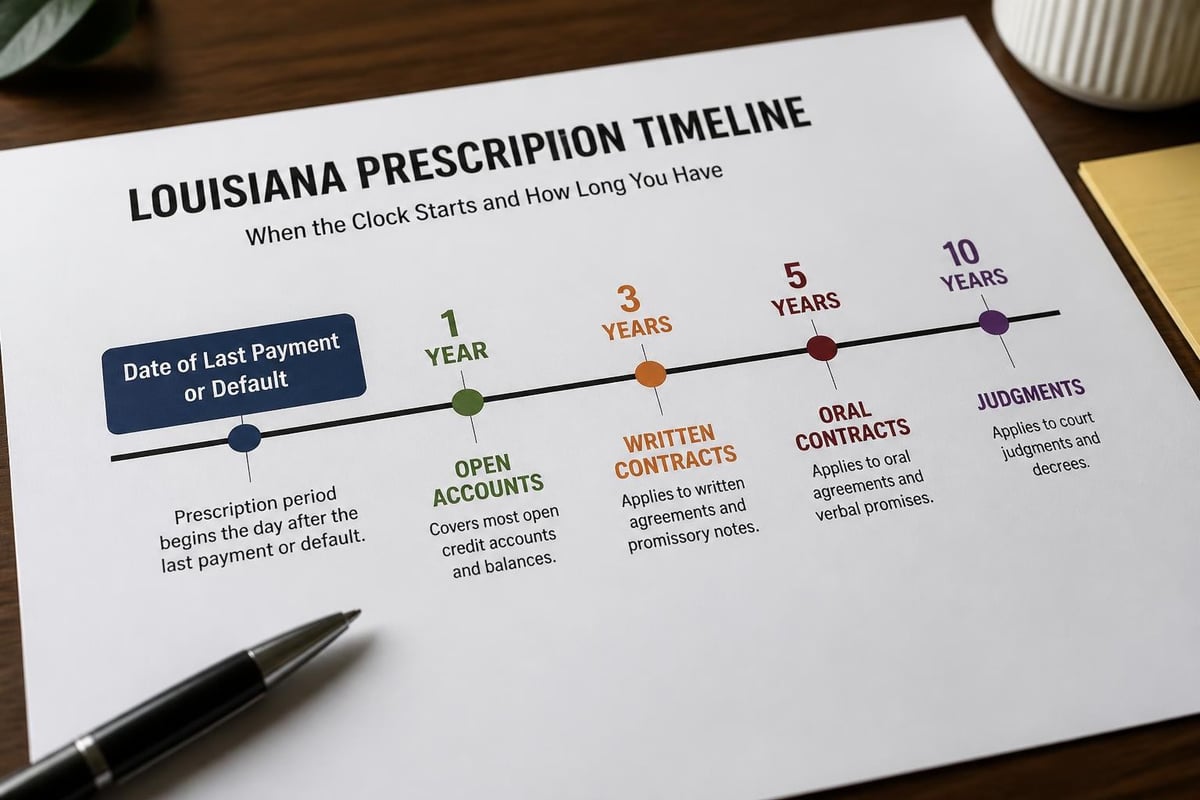
The statute of limitations on debt in Louisiana varies significantly depending on the type of obligation you owe. The state categorizes debts based on whether they arise from written contracts, oral agreements, or specific types of transactions. Understanding these categories helps you determine where your particular debt falls and how long creditors have to pursue legal action.
Written Contracts and Credit Agreements
Most consumer debts fall under written contract provisions with specific prescription periods:
- Personal loans with signed agreements: 10 years
- Credit card debts: 3 years (open account)
- Promissory notes: 10 years
- Auto loans with written contracts: 10 years
- Home improvement loans: 10 years
The Louisiana State Bar Association offers detailed guidance that legal professionals use to navigate these distinctions. Written contracts that clearly establish terms, payment schedules, and signatures typically receive the longer 10-year prescription period under Louisiana Civil Code Article 3499.
Open Accounts and Revolving Credit
Credit cards and similar revolving credit arrangements are classified as "open accounts" under Louisiana law. These accounts have a 3-year prescription period from the date of the last payment or charge. This shorter timeframe reflects the ongoing nature of these accounts and distinguishes them from fixed-term installment loans.
Many consumers with credit card debt find this distinction particularly important. If you stopped making payments on a credit card in early 2023, the creditor would generally have until early 2026 to file a lawsuit against you in Louisiana courts.
Medical Debt and Healthcare Services
Medical debt prescription periods can be complex because they depend on whether the healthcare provider is considered to have provided services under an open account arrangement or a specific contractual agreement. Generally, medical bills fall under the 3-year prescription period for open accounts, though some written payment agreements with hospitals or clinics might extend this to 10 years.
| Debt Type | Prescription Period | Legal Classification |
|---|---|---|
| Written personal loans | 10 years | Contractual obligation |
| Credit cards | 3 years | Open account |
| Medical bills | 3 years | Open account (typically) |
| Oral agreements | 10 years | Verbal contract |
| Promissory notes | 10 years | Written instrument |
Oral Agreements and Verbal Contracts
Interestingly, Louisiana provides a 10-year prescription period for oral agreements, matching the timeframe for written contracts. This differs from many states that impose shorter limitations on verbal contracts. If you borrowed money from a friend or family member without a written agreement, that obligation would theoretically be enforceable for a decade from when payment was due.
When the Clock Starts Ticking
Understanding when the statute of limitations on debt in Louisiana begins is just as important as knowing the timeframe itself. The prescription period generally starts accruing on the date when the creditor could have first filed a lawsuit against you-typically the date you defaulted on a payment or the date your last payment was due and went unpaid.
Date of Last Payment vs. Date of Default
For installment loans with fixed payment schedules, the prescription usually begins when you miss a payment and fail to cure the default. However, creditors may include acceleration clauses in contracts that make the entire balance due immediately upon default, which would start the prescription clock on the full amount.
Key triggering events include:
- Missing a scheduled payment deadline
- Receiving a default notice from your lender
- Making your final payment on an account before ceasing payments
- Having an account charged off by the original creditor
The Importance of Your Last Activity
Your last activity on an account can reset or extend the prescription period. Making even a small payment, acknowledging the debt in writing, or entering into a new payment arrangement can restart the clock entirely. This is why understanding time-barred debt collection practices becomes critical when collectors contact you about old obligations.

What Happens When Debt Becomes Time-Barred
Once the statute of limitations on debt in Louisiana expires, significant legal protections kick in for consumers. The debt becomes time-barred, meaning creditors and collection agencies cannot successfully sue you in court to obtain a judgment. If a collector does file a lawsuit on time-barred debt, you have an affirmative defense that should result in dismissal of the case.
You Still Owe the Money
Time-barred status doesn't erase your obligation. Creditors can still:
- Contact you about the debt (within federal rules)
- Report the debt to credit bureaus (for 7 years from first delinquency)
- Request voluntary payment
- Sell the debt to collection agencies
However, they cannot threaten or file lawsuits. The CFPB’s regulations on time-barred debt collection provide important federal protections that work alongside Louisiana's prescription laws to limit aggressive collection tactics.
Asserting Prescription as a Defense
If a creditor sues you on time-barred debt, you must actively assert prescription as a defense. Courts won't automatically dismiss cases because the prescription period has expired-you need to raise this issue in your response to the lawsuit. This requirement makes understanding the timeline critical and often necessitates consulting with a consumer law attorney.
Federal Protections and Louisiana Law
The statute of limitations on debt in Louisiana operates within a broader framework of federal consumer protection laws. While state law determines when creditors can sue, federal regulations govern how debt collectors can communicate with you and what they must disclose about time-barred debts.
Fair Debt Collection Practices Act (FDCPA)
The FDCPA prohibits debt collectors from using deceptive or abusive practices. This includes threatening legal action they cannot legally take on time-barred debts. Collectors must also avoid misleading you about the age of a debt or your obligations.
CFPB Regulations on Time-Barred Debts
Recent regulatory developments provide additional protections. Collectors who contact you about time-barred debts must now provide specific disclosures in certain communications, informing you that they cannot sue on the debt. These federal rules complement Louisiana’s prescription framework to create layers of consumer protection.
Common Mistakes That Restart the Clock
Many Louisiana consumers inadvertently reset the statute of limitations on debt without realizing the consequences. Once you understand the prescription period for your debt type, avoiding these pitfalls becomes essential for maintaining your time-barred defense.
Making Partial Payments
Sending any payment on an old debt-even a small amount-can restart the entire prescription period in Louisiana. Creditors and collectors know this, which is why they may request "good faith payments" or settlements that seem manageable. Before making any payment on old debt, consider consulting with a financial advisor or attorney.
Written Acknowledgment of the Debt
Signing documents that acknowledge you owe a debt, even without making payments, can revive prescription. This includes:
- Settlement agreement letters
- Payment plan contracts
- Written promises to pay
- Account verification forms that acknowledge the balance
Verbal Acknowledgments and Recorded Calls
While verbal acknowledgments are harder to prove, many collectors record calls where they ask you to confirm account details or acknowledge the debt. Louisiana courts have considered such acknowledgments as potential prescription interruptions, though the legal standards can be complex.
How Prescription Affects Your Credit Report
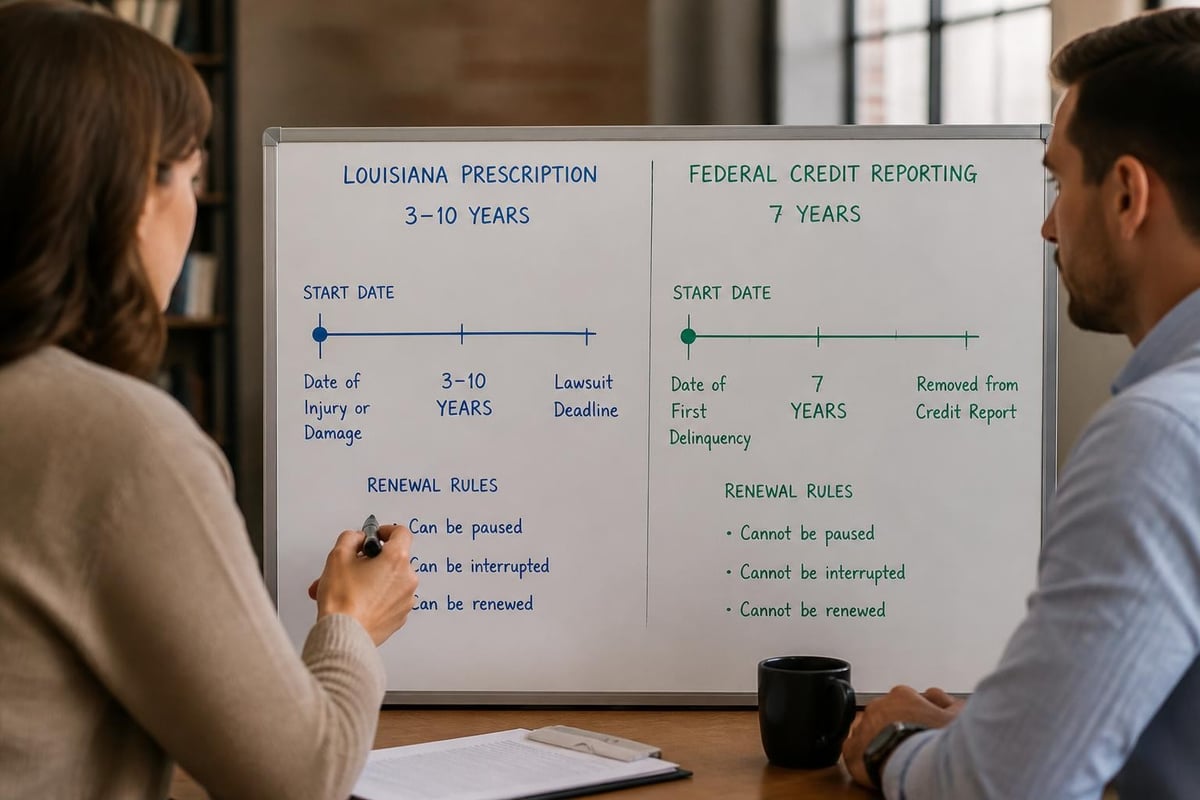
The statute of limitations on debt in Louisiana and credit reporting timeframes operate on different schedules. Understanding this distinction prevents confusion about when negative items will disappear from your credit history.
The 7-Year Credit Reporting Rule
Federal law allows most negative information to remain on your credit report for 7 years from the date of first delinquency. This federal timeline runs independently of Louisiana's prescription periods. A debt with a 3-year prescription period might still appear on your credit report for several years after becoming time-barred.
| Aspect | Prescription Period | Credit Reporting Period |
|---|---|---|
| Timeframe start | Last payment or default | First delinquency date |
| Duration (most debts) | 3-10 years | 7 years |
| Legal consequence | Cannot sue | Credit score impact |
| Renewal possibility | Can restart with activity | Generally does not restart |
Paid vs. Unpaid Time-Barred Debts
Paying a time-barred debt after the credit reporting period has expired won't add it back to your report. However, the payment can restart the prescription period for potential lawsuits. This creates a strategic consideration: whether to pay old debts that no longer affect your credit but could potentially be revived for legal action.
Dealing with Debt Collectors on Old Debts
When collectors contact you about debts approaching or past Louisiana's prescription periods, knowing your rights and options helps you navigate these conversations effectively. The statute of limitations on debt in Louisiana gives you important leverage, but only if you understand how to use it properly.
Validation Rights Under Federal Law
When a collector first contacts you, federal law requires them to send a validation notice within five days. This notice must include:
- The amount of the debt
- The name of the creditor
- Your right to dispute the debt
- Your right to request verification
Use this information to calculate whether the debt might be time-barred based on the last activity date.
Requesting Information Without Acknowledging the Debt
You can request debt validation and information about the debt's age without acknowledging that you owe it. Carefully word any written communication to avoid statements like "I owe this money but cannot pay" which could restart prescription. Instead, request documentation showing:
- The original creditor and account number
- The date of last payment
- A complete payment history
- Documentation of the original agreement
When to Consult an Attorney
Consider seeking legal advice if:
- A collector threatens to sue on debt you believe is time-barred
- You've been served with a lawsuit on old debt
- You're unsure whether your actions might restart the prescription period
- Collectors are violating federal or state consumer protection laws
Special Considerations for Louisiana Residents
The statute of limitations on debt in Louisiana includes nuances that distinguish it from neighboring states. Louisiana residents who have moved from Mississippi, Tennessee, or Georgia may find these differences particularly important when managing debts incurred in different jurisdictions.
Which State's Law Applies
Generally, the law of the state where you lived when you incurred the debt determines the prescription period. However, if you signed a contract with a choice-of-law provision specifying another state's laws, courts might apply that state's statute of limitations. Recent federal court cases in Louisiana have examined how these principles work in practice.
Moving to Louisiana with Existing Debts
If you relocated to Louisiana with debts from another state, the original state's statute of limitations typically applies to those debts. However, this area of law involves complex choice-of-law questions that may require professional legal analysis for significant debts.
Louisiana-Specific Defenses
Louisiana's civil law tradition creates unique procedural and substantive defenses not available in common law states. Working with attorneys familiar with Louisiana prescription law ensures you can raise all available defenses if faced with debt collection litigation.
Rebuilding Financial Health After Time-Barred Debt
Understanding the statute of limitations on debt in Louisiana represents just one aspect of comprehensive financial management. Once you know your legal position regarding old debts, you can focus on rebuilding your financial foundation and accessing credit options appropriate for your situation.
Addressing Current Obligations First
Prioritize debts within their prescription periods and those that actively affect your credit. Creating a payment hierarchy helps you allocate limited resources to obligations that carry the most significant legal and credit consequences.
Recommended priority order:
- Secured debts (mortgage, auto loans)
- Recent debts within prescription periods
- Debts still reporting to credit bureaus
- Tax obligations and child support
- Time-barred debts with no credit impact
Building Credit with Past Issues
Even with time-barred debts in your history, you can rebuild creditworthiness through responsible financial management. Secured credit cards, credit-builder loans, and consistent payment of current obligations gradually improve your credit profile.
Understanding Lending Options for Consumers with Credit Challenges
Many Louisiana consumers find themselves needing financing even with past credit difficulties. Reputable lenders who understand prescription laws and work with clients who have previous financial setbacks can provide pathways to necessary funds for home improvements, medical expenses, or educational opportunities. These flexible financing options acknowledge that past financial difficulties don't define future potential.
Understanding how the statute of limitations on debt in Louisiana works empowers you to make informed decisions about old obligations and protects your rights when dealing with collectors. Whether you're managing time-barred debts or rebuilding your financial health, knowing these timeframes and protections helps you navigate challenging situations with confidence. At Standard Financial, we understand that past credit challenges don't define your future-we offer flexible personal loan options across Louisiana and the Southeast for clients ready to move forward, regardless of their credit history. Contact us today to discuss how we can help you achieve your financial goals.





No comment yet, add your voice below!