

Taking control of your financial future starts with managing debt strategically. Whether you're dealing with a personal loan for home improvements, medical expenses, or educational costs, understanding how to pay off loan faster can save you thousands of dollars in interest and help you achieve financial freedom years ahead of schedule. The strategies outlined here apply to various loan types and work especially well for borrowers across Louisiana, Mississippi, Tennessee, and Georgia who want to reduce their debt burden efficiently.
Understanding Your Loan Terms and Prepayment Options
Before implementing any accelerated payment strategy, review your loan agreement thoroughly. Most consumer lenders, including Standard Financial, structure personal loans with clear terms regarding prepayment penalties and extra payment allocations. Understanding these details determines which strategies will save you the most money.
Check for Prepayment Penalties
Some loans include clauses that charge fees if you pay off your balance early. These penalties protect lenders from losing anticipated interest income, but they can undermine your efforts to reduce debt quickly. Review your loan documents or contact your lender directly to confirm whether prepayment penalties apply to your account.
If penalties exist, calculate whether the interest savings from early payoff exceed the penalty costs. In many cases, the long-term benefits still outweigh the fees, but this analysis ensures you're making the most cost-effective decision.
Ensure Extra Payments Apply to Principal
When you make payments beyond your minimum monthly obligation, specify that the additional amount should reduce your principal balance. Some lenders automatically apply extra funds to future interest unless you provide explicit instructions. Clarifying your lender’s policies on prepayment ensures every extra dollar works toward reducing your debt.
Standard Financial allows borrowers to make additional principal payments without penalties, making it easier to implement aggressive payoff strategies.

Create a Realistic Budget with Debt Reduction Goals
Financial discipline forms the foundation of any successful debt elimination plan. Creating a detailed budget reveals exactly where your money goes each month and identifies opportunities to redirect funds toward loan payoff.
Track Your Monthly Income and Expenses
Start by documenting all income sources and fixed expenses like rent, utilities, insurance, and minimum loan payments. Then track variable expenses including groceries, entertainment, dining out, and discretionary purchases for at least one month. This comprehensive view shows spending patterns you might not notice otherwise.
Many people discover they're spending $200-$400 monthly on non-essential items that could accelerate debt payoff instead. Small adjustments like preparing meals at home, reducing subscription services, or limiting impulse purchases create significant payment capacity over time.
Set Specific Payoff Targets
Determine exactly how much extra you can afford to pay each month, then calculate your new payoff timeline. For example, if you have a $10,000 loan at 12% interest with a five-year term, your minimum payment is approximately $222 monthly. Adding just $100 extra each month reduces your payoff timeline by nearly 18 months and saves over $1,000 in interest.
Setting measurable goals keeps you motivated and provides clear milestones to celebrate along your debt-free journey.
Implement the Biweekly Payment Strategy
One of the most effective methods for how to pay off loan faster involves switching from monthly to biweekly payments. This approach leverages the calendar to make one extra full payment per year without significantly impacting your monthly budget.
How Biweekly Payments Work
Instead of making one payment per month (12 payments annually), you make half-payments every two weeks (26 half-payments, equivalent to 13 full payments annually). This technique works particularly well for borrowers who receive biweekly paychecks, as payments align naturally with income.
The biweekly payment strategy reduces both your payoff timeline and total interest paid. On a $15,000 loan at 10% interest with a four-year term, switching to biweekly payments could save approximately $400 in interest and shave several months off your repayment period.
| Payment Method | Total Payments/Year | Time Saved | Interest Saved |
|---|---|---|---|
| Monthly | 12 | Baseline | Baseline |
| Biweekly | 26 (equals 13) | 4-6 months | $350-$500 |
| Weekly | 52 (equals 13) | 4-6 months | $350-$500 |
Automate Your Biweekly Payments
Contact your lender to set up automatic biweekly withdrawals. Some financial institutions charge fees for this service, so compare the cost against potential savings. Alternatively, you can manually make half-payments every two weeks by setting up automatic transfers from your checking account to ensure consistency.
Apply Windfalls and Bonuses to Principal
Tax refunds, work bonuses, inheritance, or other unexpected income provide excellent opportunities to make substantial progress on loan balances. Rather than treating windfalls as discretionary spending money, strategically applying them to debt creates lasting financial benefits.
Prioritize Debt Over Discretionary Spending
When you receive unexpected money, the temptation to spend it on wants rather than needs is strong. However, applying just 50-75% of windfalls to debt while allowing yourself to enjoy 25-50% creates a balanced approach. This strategy satisfies immediate desires while building long-term financial stability.
For example, a $2,000 tax refund applied to a personal loan could save hundreds in interest and reduce your payoff timeline by several months. Even smaller windfalls like $100 birthday gifts or $300 work bonuses add up when consistently directed toward principal reduction.
Calculate the Impact Before Spending
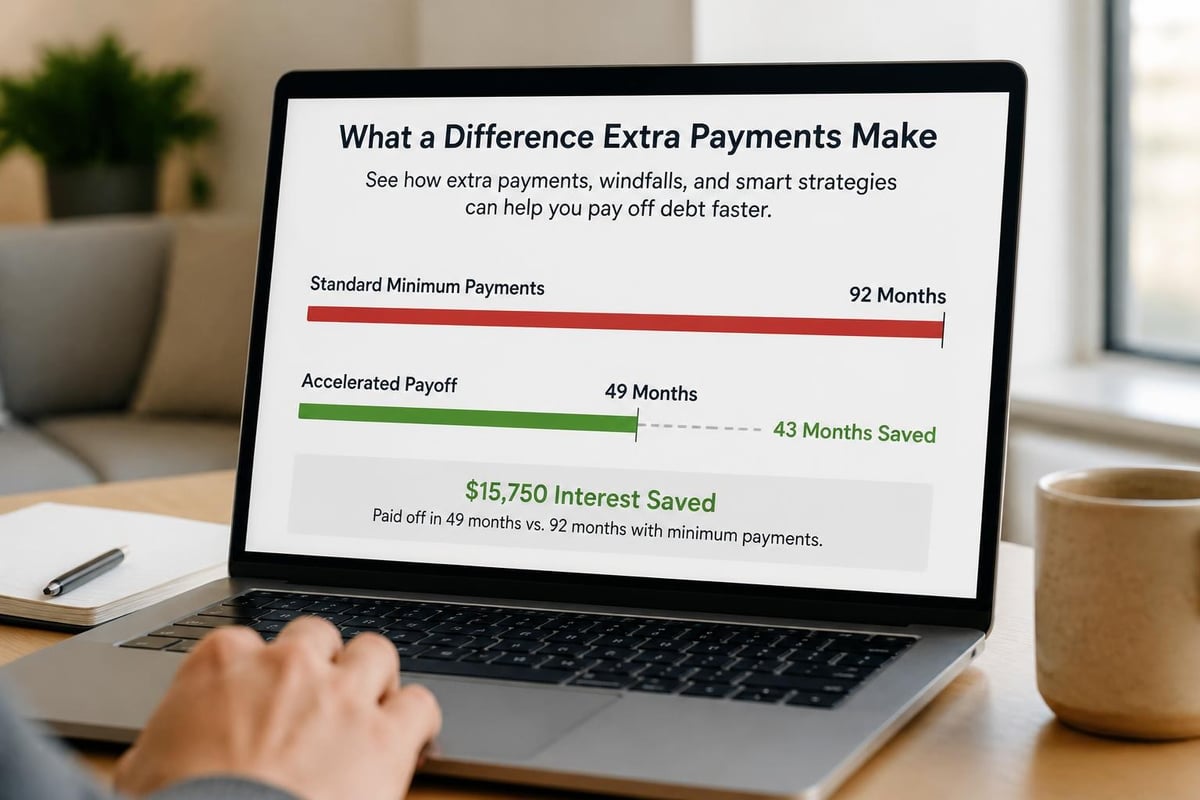
Before deciding how to use unexpected income, calculate its impact on your loan. Most lenders provide online calculators or can tell you exactly how much time and money a lump-sum payment would save. Seeing concrete numbers often motivates borrowers to prioritize debt payoff over temporary pleasures.
Round Up Your Monthly Payments
A simple yet powerful technique for how to pay off loan faster involves rounding up payments to the nearest $50 or $100. This approach requires minimal effort but creates consistent principal reduction throughout your loan term.
The Psychology of Round Numbers
Paying $250 instead of $223 feels psychologically easier than calculating exact extra amounts each month. The additional $27 might seem insignificant, but over several years it compounds into substantial savings. This strategy works particularly well for borrowers who struggle with complex budgeting or payment calculations.
Automate Rounded Payments
Set up automatic payments for your rounded amount rather than the minimum due. This automation eliminates the monthly decision-making process and ensures consistent extra payments. Over a typical four-year loan term, rounding up by just $25-$50 monthly can reduce your payoff timeline by 6-12 months.
Standard Financial's flexible payment systems allow you to set up custom payment amounts that automatically apply extra funds to your principal balance.
Consider Refinancing for Better Terms
When interest rates drop or your credit score improves significantly, refinancing your existing loan can reduce your monthly payment or allow you to maintain the same payment while shortening your loan term. This strategy works especially well for borrowers who've improved their financial situation since taking their original loan.
Evaluate Your Refinancing Options
Compare your current interest rate against available refinancing rates. Generally, refinancing makes financial sense when you can reduce your rate by at least 2 percentage points, though even smaller reductions provide benefits on larger loan balances. Consider both the interest savings and any fees associated with refinancing.
Standard Financial offers refinancing options for customers who want to improve their loan terms. Borrowers who've built positive payment history or improved their credit scores since their initial loan often qualify for significantly better rates.
Maintain Your Current Payment Amount
If refinancing reduces your required monthly payment, consider maintaining your previous payment amount instead of reducing what you pay. This approach dramatically accelerates your payoff timeline. For example, if refinancing drops your payment from $400 to $325, continuing to pay $400 means an extra $75 monthly goes directly to principal.
Increase Your Income Strategically
While reducing expenses helps, increasing income often provides faster results for accelerating debt payoff. The additional earnings can be directed entirely toward extra loan payments without impacting your existing lifestyle or budget.
Explore Side Income Opportunities
Consider freelance work, part-time employment, or monetizing hobbies during evenings and weekends. Even an extra $200-$300 monthly from side work can reduce a typical personal loan timeline by years. Popular options include rideshare driving, online tutoring, freelance writing, or selling handmade products.
The key is treating side income as dedicated debt payment money rather than discretionary spending. Opening a separate savings account for side earnings and automatically transferring them to loan payments prevents the temptation to spend this money elsewhere.
Negotiate Raises or Promotions
Document your workplace achievements and contributions, then schedule a conversation with your supervisor about compensation increases. Even a modest 3-5% raise on a $45,000 salary provides an additional $1,350-$2,250 annually that can accelerate loan payoff.
Use the Debt Snowball Method for Multiple Loans
If you're managing several loans simultaneously, the debt snowball method provides a psychological framework that maintains motivation while systematically eliminating debt. This approach focuses on paying off the smallest balance first, regardless of interest rates.
How the Snowball Method Works
List all your debts from smallest to largest balance. Make minimum payments on everything except the smallest debt, which receives all extra payment capacity. Once that smallest loan is paid off, roll its entire payment amount into the next smallest debt, creating a "snowball" effect.
| Loan Type | Balance | Interest Rate | Minimum Payment | Snowball Order |
|---|---|---|---|---|
| Credit Card | $800 | 18% | $35 | 1st |
| Personal Loan | $3,500 | 11% | $125 | 2nd |
| Medical Loan | $5,200 | 9% | $150 | 3rd |
| Auto Loan | $8,500 | 7% | $275 | 4th |
While mathematically the "avalanche method" (targeting highest interest rates first) saves more money, the snowball approach’s quick wins maintain motivation for many borrowers. Choose the strategy that matches your personality and financial situation.
Reduce Interest Charges Through Smart Timing
Understanding how lenders calculate daily interest helps you time payments for maximum impact. Most consumer loans use simple interest calculated daily based on your outstanding principal balance.
Make Payments Early in Your Billing Cycle
Since interest accrues daily, making payments as early as possible reduces the principal balance sooner, which decreases interest charges. If your payment is due on the 15th but you get paid on the 1st, submitting your payment immediately saves several days of interest accumulation.
Split Large Payments Strategically
Rather than making one large extra payment quarterly, split that amount into smaller monthly additions. This approach reduces your average daily balance more consistently throughout the year, lowering total interest charges. For example, four $100 monthly payments save more interest than one $400 quarterly payment.

Cut Unnecessary Expenses Temporarily
Temporary lifestyle adjustments create substantial extra payment capacity without permanently altering your standard of living. Viewing these changes as short-term sacrifices for long-term financial freedom makes them more palatable.
Identify High-Impact Spending Cuts
Focus on expenses that provide the biggest savings with the least lifestyle impact. Common high-impact areas include:
- Dining and entertainment: Cooking at home and choosing free activities can save $300-$500 monthly
- Subscription services: Auditing streaming, gym, and software subscriptions often reveals $50-$150 in unused services
- Transportation costs: Carpooling, combining errands, or temporarily reducing discretionary trips saves on fuel
- Shopping habits: Implementing 30-day waiting periods for non-essential purchases eliminates impulse buying
Set a Specific Timeframe
Commit to aggressive expense reduction for a defined period, such as six months or one year. Knowing the sacrifice is temporary rather than permanent makes it mentally easier to maintain. Many borrowers find they enjoy simpler lifestyles and maintain some changes even after paying off their loans.
Leverage Technology and Automation
Digital tools and automated systems remove the mental burden of remembering payments and calculating extra amounts. These technologies make how to pay off loan faster a systematic process rather than a daily decision.
Use Loan Payoff Calculators
Online calculators show exactly how extra payments impact your timeline and interest costs. Experiment with different scenarios to find the balance between aggressive payoff and comfortable monthly budgets. Many borrowers find that seeing potential savings motivates them to increase extra payments.
Automate Extra Payments
Set up automatic transfers from your checking account to your loan account for the day after payday. This "pay yourself first" approach ensures extra payments happen before you have opportunities to spend that money elsewhere. Start with modest amounts like $25-$50 and increase as your budget allows.
Standard Financial's online account management tools let you schedule automatic payments and track your progress toward early payoff goals.
Avoid New Debt During Payoff
Taking on additional debt while trying to pay off existing loans undermines your progress and extends your debt-free timeline. Developing strategies to avoid new borrowing is crucial for success.
Build an Emergency Fund Simultaneously
While it seems counterintuitive to save while paying off debt, having $500-$1,000 in emergency savings prevents you from needing new loans when unexpected expenses arise. Split extra payment capacity between debt payoff and emergency savings until you've built this cushion.
For example, if you can afford $150 extra monthly, allocate $100 to loan payoff and $50 to emergency savings. Once you've saved $1,000, redirect the entire $150 to debt elimination. This balanced approach provides financial security while maintaining aggressive payoff momentum.
Practice Delayed Gratification
When tempted by new purchases or expenses, wait 24-72 hours before deciding. This cooling-off period helps distinguish between genuine needs and impulse wants. Understanding prudent borrowing practices prevents accumulating new debt while eliminating existing obligations.
Review and Adjust Your Strategy Quarterly
Financial situations change, and your debt payoff strategy should evolve accordingly. Quarterly reviews ensure your approach remains optimal as circumstances shift.
Assess Progress Against Goals
Every three months, compare your actual progress against your original timeline and savings projections. Celebrate milestones like reaching the halfway point or paying off specific amounts. Recognition of achievements maintains motivation during the challenging middle period of debt repayment.
Adjust for Life Changes
Income increases, expense reductions, or unexpected financial setbacks may require strategy adjustments. Rather than abandoning your payoff plan during difficult periods, scale back temporarily while maintaining some extra payment amount. Even $10-$20 extra monthly keeps momentum alive during tight financial periods.
| Quarter | Target Balance | Actual Balance | Extra Paid | Adjustment Needed |
|---|---|---|---|---|
| Q1 2026 | $8,750 | $8,500 | $250 | None – ahead of schedule |
| Q2 2026 | $7,250 | $7,600 | $150 | Increase extra payment by $50 |
| Q3 2026 | $5,500 | $5,800 | $200 | Maintain current strategy |
| Q4 2026 | $3,500 | $3,200 | $300 | None – ahead of schedule |
Seek Professional Guidance
If you're struggling to make progress or facing unexpected financial challenges, consult with financial advisors who specialize in debt management. Professional guidance helps you navigate complex situations and develop customized strategies for your unique circumstances.
Implementing even a few of these strategies can significantly reduce your loan timeline and save substantial money on interest charges. Whether you choose biweekly payments, budget adjustments, or refinancing options, the key is taking consistent action toward your debt-free goals. Standard Financial understands the challenges borrowers face and offers flexible payment options, refinancing opportunities, and personalized support to help clients across Louisiana, Mississippi, Tennessee, and Georgia achieve financial freedom faster. Contact us today to discuss how we can customize a payoff strategy that works for your unique situation.






No comment yet, add your voice below!