

Orthodontic treatment transforms smiles and improves oral health, but the cost often creates a significant barrier for families across the South. With braces typically ranging from $3,000 to $7,000 or more, many people turn to a loan for braces to make treatment accessible. Understanding your financing options, comparing interest rates, and choosing the right payment structure can help you invest in orthodontic care without overwhelming your household budget. Whether you're exploring personal loans, healthcare credit cards, or in-office payment plans, informed decisions ensure both your financial health and your family's bright smiles.
Understanding the True Cost of Orthodontic Treatment
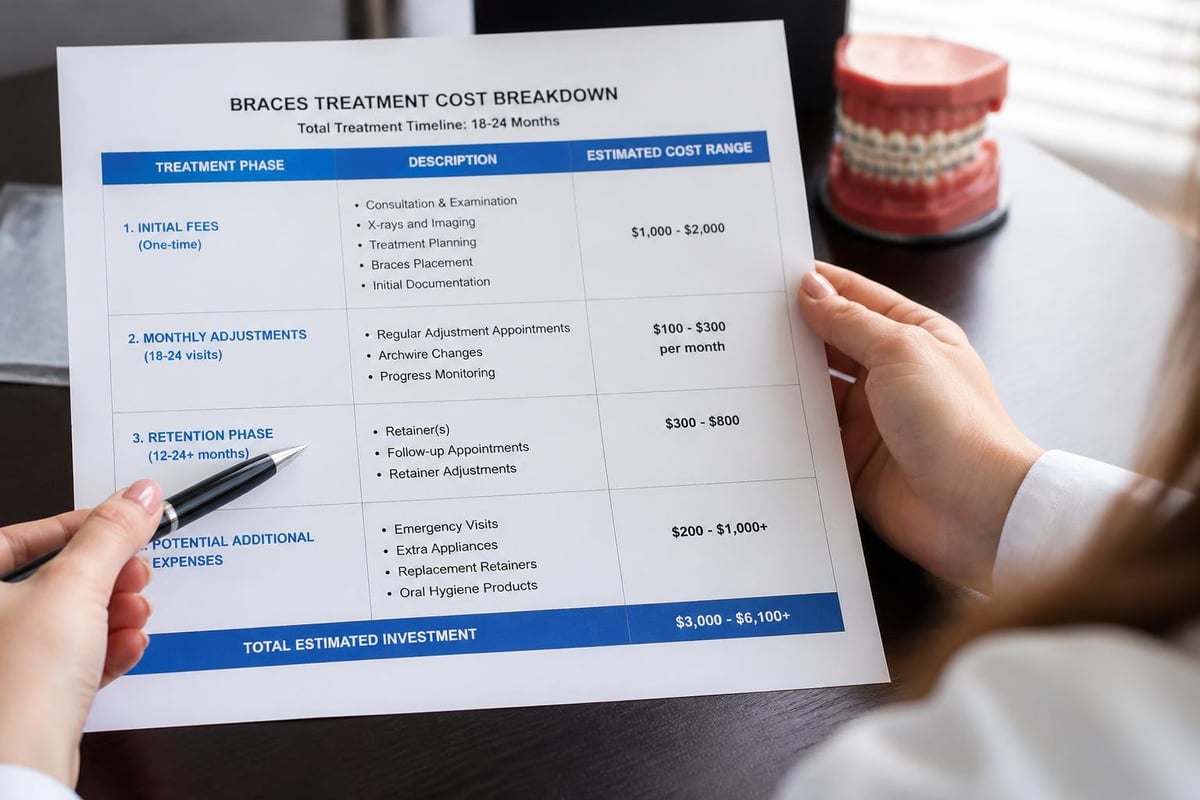
Orthodontic expenses extend beyond the initial quote you receive during consultation. Treatment costs vary based on the complexity of your case, the type of braces selected, and the duration of care.
Traditional metal braces typically cost between $3,000 and $6,000 for comprehensive treatment. Ceramic braces run slightly higher at $4,000 to $8,000, while lingual braces (attached to the back of teeth) can exceed $10,000. Clear aligner systems like Invisalign generally range from $3,500 to $8,000 depending on treatment length.
Hidden Costs to Consider
Beyond the base treatment fee, several additional expenses may arise:
- Retainers after active treatment concludes ($200-$600)
- Emergency visits for broken brackets or wires ($50-$150 per visit)
- Replacement aligners if lost or damaged ($100-$300 each)
- Extended treatment if care takes longer than initially projected
Many orthodontists include some of these costs in their treatment contracts, but clarifying what's covered upfront prevents surprise bills. The American Association of Orthodontists provides detailed information about payment structures that help patients understand comprehensive treatment costs.
Types of Financing for Braces
A loan for braces comes in several forms, each with distinct advantages and considerations. Selecting the right financing option depends on your credit profile, budget flexibility, and preferred repayment timeline.
Personal Loans from Financial Institutions
Traditional personal loans offer fixed interest rates and predictable monthly payments. These unsecured loans typically range from $1,000 to $50,000 with repayment terms between two and seven years.
Advantages:
- Fixed monthly payments that simplify budgeting
- Competitive interest rates for borrowers with good credit
- Funds deposited directly to your account for immediate use
- No restrictions on which orthodontist you choose
Considerations:
- Credit check required, which may temporarily impact your score
- Interest rates vary based on creditworthiness
- Origination fees may apply (typically 1-6% of loan amount)
For families in Louisiana, Mississippi, Tennessee, and Georgia, regional lenders often provide more flexible approval criteria than national banks, particularly for borrowers rebuilding credit.
Healthcare Credit Cards and Specialty Financing
Medical credit cards like CareCredit or LendingClub offer deferred interest promotions specifically for healthcare expenses. Many orthodontists accept these cards as payment.
| Feature | Healthcare Credit Card | Traditional Credit Card |
|---|---|---|
| Promotional APR | 0% for 6-24 months (typical) | Variable, often 18-25% |
| Deferred interest risk | Yes, retroactive if not paid in full | No |
| Credit limit | $500-$25,000 | Varies widely |
| Application location | Provider's office or online | Direct from issuer |
The Consumer Financial Protection Bureau warns about specific risks associated with deferred interest products. If you don't pay the entire balance before the promotional period ends, you may owe interest retroactively from the original purchase date at rates often exceeding 26%.
In-Office Payment Plans
Many orthodontists structure their own financing arrangements, allowing patients to spread treatment costs over the duration of care without involving third-party lenders.
Typical structure:
- Down payment of 10-25% of total cost at treatment start
- Monthly installments divided over 12-24 months
- Zero or low interest rates (often 0-5%)
- Automatic payment deductions from checking or savings accounts
These arrangements appeal to patients who prefer dealing directly with their provider rather than a separate lender. However, payment terms and availability vary significantly between practices.
Qualifying for a Loan for Braces
Lenders evaluate several factors when considering applications for orthodontic financing. Understanding these criteria helps you prepare a stronger application and potentially secure better terms.
Credit Score Requirements
Different financing products have varying credit thresholds:
- Excellent terms (rates under 8%): Credit scores above 720
- Good terms (rates 8-15%): Credit scores 660-719
- Fair terms (rates 15-25%): Credit scores 580-659
- Limited options: Credit scores below 580
Regional consumer lenders often consider factors beyond credit scores, including employment stability, income consistency, and prior relationship with the institution. Applicants with past credit challenges may still qualify through lenders who specialize in rebuilding credit.
Income and Debt-to-Income Ratio
Lenders assess whether your current income supports additional monthly obligations. Your debt-to-income ratio (DTI) compares monthly debt payments to gross monthly income.
Most lenders prefer a DTI below 43%, though some accept ratios up to 50% for well-qualified borrowers. For example, if your gross monthly income is $5,000, lenders typically want your total monthly debt payments (including the proposed loan for braces) to remain under $2,150.
Documentation typically required:
- Recent pay stubs (last 30 days)
- Previous year's tax return
- Bank statements showing regular deposits
- Proof of additional income sources if applicable

Comparing Financing Options: Making the Right Choice
Selecting appropriate financing requires analyzing multiple factors beyond the advertised interest rate. Total cost of borrowing, payment flexibility, and potential penalties significantly impact your financial outcome.
Calculation Example: $5,000 Orthodontic Treatment
| Financing Type | Interest Rate | Term | Monthly Payment | Total Repaid | Total Interest |
|---|---|---|---|---|---|
| Personal loan | 9.5% APR | 36 months | $160 | $5,760 | $760 |
| Healthcare credit (paid in promo) | 0% deferred | 18 months | $278 | $5,000 | $0 |
| Healthcare credit (not paid in promo) | 26.99% APR | 18 months | $313 | $5,634 | $634 |
| In-office plan | 3% APR | 24 months | $215 | $5,160 | $160 |
This comparison demonstrates how crucial it is to fulfill promotional payment requirements. Missing the deadline on a deferred interest plan can cost nearly as much as a higher-rate personal loan.
Questions to Ask Before Committing
When evaluating a loan for braces, ask your lender or orthodontist these specific questions:
- What is the true APR, including all fees and charges?
- Are there prepayment penalties if I pay off the loan early?
- What happens if I miss a payment or pay late?
- Does this financing require a hard credit inquiry?
- Can I adjust my payment schedule if my financial situation changes?
- Is the interest simple or compound?
- What portion of early payments goes toward principal versus interest?
Research by the Consumer Financial Protection Bureau found that many consumers don't fully understand the terms of their medical financing arrangements, leading to unexpected costs.
Maximizing Tax Benefits and Health Savings Accounts
Strategic use of tax-advantaged accounts can significantly reduce the effective cost of orthodontic treatment, making a loan for braces more manageable or potentially unnecessary.
Health Savings Accounts (HSAs) and Flexible Spending Accounts (FSAs)
Orthodontic treatment for medical necessity (not purely cosmetic) qualifies as an eligible expense for HSAs and FSAs. The American Association of Orthodontists confirms that these pre-tax accounts can cover braces when treatment corrects functional issues.
HSA advantages:
- Contributions reduce taxable income
- Funds roll over year to year (no "use it or lose it")
- Money grows tax-free through investment options
- Withdrawals for qualified medical expenses are tax-free
FSA considerations:
- Annual contribution limits ($3,200 for 2026)
- Use-it-or-lose-it rules (though some plans allow small carryovers)
- Must be offered through employer-sponsored plans
- Cannot be used simultaneously with HSA for same expenses
Medical Expense Tax Deduction
IRS Publication 502 allows taxpayers to deduct qualified medical expenses exceeding 7.5% of adjusted gross income. For a family with $60,000 AGI, medical expenses beyond $4,500 become deductible.
If orthodontic treatment costs $6,000 and you've already incurred $2,000 in other medical expenses, you could potentially deduct $3,500 ($8,000 total minus $4,500 threshold). For someone in the 22% tax bracket, this saves $770 in federal income tax.
Insurance Coverage and Alternative Funding Sources
Before pursuing a loan for braces, exhaust other payment resources that might reduce the amount you need to borrow.
Dental Insurance Limitations
Most dental insurance plans provide limited orthodontic benefits. HealthCare.gov explains that adult dental coverage in marketplace plans rarely includes orthodontics, while children's coverage may include a lifetime maximum benefit.
Typical insurance coverage patterns:
- Lifetime maximum: $1,000-$2,000 for orthodontic treatment
- Age restrictions: Coverage often ends at age 18 or 19
- Waiting periods: 12-24 months before orthodontic benefits activate
- Percentage coverage: Usually 50% of charges up to the lifetime maximum
The gap between insurance coverage and total treatment cost explains why many families require additional financing. A $5,500 treatment with $1,500 insurance coverage still leaves $4,000 to finance.
Employer Benefits and Discount Plans
Some employers offer supplemental orthodontic benefits or dental discount programs that reduce out-of-pocket costs:
- Employer-sponsored dental discount plans (10-60% savings)
- Dependent care FSAs for children's orthodontic treatment
- Employee assistance programs that may offer interest-free loans
- Wellness program incentives that offset preventive and corrective care

Managing Your Braces Loan Responsibly
Once you secure financing for orthodontic treatment, strategic management ensures you complete payments efficiently while maintaining overall financial health.
Automatic Payments and Early Payoff
Setting up automatic payments from your checking account provides several benefits:
- Prevents missed payments and late fees
- May qualify you for interest rate discounts (typically 0.25%)
- Simplifies budgeting by making payments predictable
- Protects your credit score by ensuring on-time payments
Consider making extra principal payments when possible. Even an additional $25-50 monthly reduces your total interest paid and shortens the loan term. Unlike mortgages, most personal loans and medical financing plans don't charge prepayment penalties, allowing you to pay off the balance early without cost.
Building an Emergency Fund While Repaying
Financial experts recommend maintaining at least $1,000 in emergency savings even while repaying debt. This buffer prevents you from needing additional high-interest credit if unexpected expenses arise during orthodontic treatment.
For families financing braces in the Southeast, where hurricane season creates potential property damage and evacuation costs, this emergency fund proves especially valuable. Balance debt repayment with modest savings contributions to avoid relying on credit cards when emergencies occur.
Special Considerations for Families with Multiple Children
Parents often face the challenge of financing orthodontic treatment for multiple children, sometimes with overlapping treatment timelines. Strategic planning helps manage these compounding costs.
Staggered Treatment Scheduling
When possible, spacing orthodontic treatment for siblings reduces monthly financial pressure. Starting one child's treatment and completing 12-18 months before beginning another's allows you to:
- Pay down or complete the first loan before taking on additional debt
- Rebuild savings between treatment periods
- Qualify for better loan terms with improved debt-to-income ratios
- Spread the budgetary impact across multiple years
Multi-Child Financing Strategies
Some orthodontists offer discounts for treating multiple family members:
- Sibling discounts: 5-10% reduction on second and subsequent children
- Family payment plans: Consolidated billing for multiple treatment contracts
- Bulk payment incentives: Reduced rates for upfront payment on multiple cases
When considering a loan for braces covering multiple children, ensure the monthly payment fits comfortably within your budget even if unexpected expenses arise. A general guideline suggests keeping orthodontic loan payments below 5% of monthly gross income.
Understanding Your Rights as a Borrower
Consumer protection laws govern medical and dental financing, providing specific rights and requiring lenders to disclose key information.
Truth in Lending Act Protections
The federal Truth in Lending Act requires lenders to clearly disclose:
- Annual Percentage Rate (APR) including fees
- Finance charges in dollar amounts
- Amount financed and total of payments
- Payment schedule including number, amounts, and due dates
These disclosures must appear in standardized format, allowing easy comparison between offers. Review these documents carefully before signing, and request clarification on any terms you don't understand.
Complaint and Dispute Resolution
If you encounter problems with your loan for braces, including unexpected charges, billing errors, or unfair practices, you have recourse through multiple channels:
- Contact the lender's customer service in writing
- File complaints with your state's consumer protection office
- Submit complaints to the Consumer Financial Protection Bureau
- Review your contract for mandatory arbitration clauses
- Consult with consumer protection attorneys if significant amounts are disputed
Documentation proves essential in disputes. Maintain copies of your loan agreement, payment receipts, correspondence with the lender, and treatment contracts from your orthodontist.
Regional Considerations for Southern Borrowers
Families in Louisiana, Mississippi, Tennessee, and Georgia face unique financial circumstances that influence orthodontic financing decisions.
State-Specific Lending Regulations
Interest rate caps and lending regulations vary by state:
| State | Maximum Interest Rate | Licensing Requirements | Consumer Protections |
|---|---|---|---|
| Louisiana | 36% APR (small loans) | Licensed lenders only | Strong disclosure laws |
| Mississippi | Varies by loan type | State-regulated | Moderate protections |
| Tennessee | No cap on consumer loans | Licensed required | Standard disclosures |
| Georgia | Varies (5-60% depending on amount) | Licensed lenders | Enhanced disclosure rules |
Understanding your state's framework helps you identify potentially predatory offers that exceed reasonable rate limits or lack proper licensing.
Cost of Living and Income Considerations
The Southeast generally features lower costs of living compared to coastal regions, but median incomes also trend lower. This combination means orthodontic treatment represents a significant portion of household budgets.
For families earning $50,000-70,000 annually, a $5,000 orthodontic expense equals 7-10% of gross income. Strategic use of a loan for braces, combined with insurance coverage and tax-advantaged accounts, makes this investment manageable without derailing other financial goals.
Alternative Approaches to Traditional Financing
Beyond conventional loans, creative solutions help some families afford orthodontic care without traditional debt.
Employer-Based Lending Programs
Some regional employers offer employee loan programs with favorable terms for medical and dental expenses. These arrangements typically feature:
- Lower interest rates than commercial lenders (4-8% APR)
- Automatic payroll deduction for convenience
- Minimal application requirements beyond employment verification
- Quick approval processes without extensive credit checks
Check with your human resources department about available programs, especially if you work for larger regional employers, healthcare systems, or educational institutions.
Community Health Centers and Dental Schools
University dental schools and community health centers sometimes offer orthodontic services at reduced costs:
- Dental school clinics: Treatment by supervised students at 30-50% discount
- Community health centers: Sliding fee scales based on income
- Charitable programs: Organizations like Smile Change provide pro bono orthodontics for qualifying families
While these options may extend treatment timelines, they significantly reduce the amount you need to finance through a loan for braces.
Medical Bill Advocates and Negotiation
Professional medical bill advocates negotiate with providers on your behalf, potentially reducing the total amount owed. This service typically costs 25-35% of the amount saved.
Direct negotiation with your orthodontist may also yield results:
- Request a cash-pay discount for upfront payment
- Negotiate a longer payment term at low or zero interest
- Ask about reduced fees if you refer other patients
- Inquire about seasonal promotions or special offers
Research on medical debt shows that many providers prefer receiving reduced payment immediately rather than pursuing full payment through collections, creating negotiation opportunities.
Financing orthodontic treatment requires careful evaluation of loan terms, understanding of your budget capacity, and strategic use of available resources. A loan for braces becomes a wise investment when you secure favorable terms, maintain timely payments, and leverage tax benefits to reduce effective costs. Standard Financial understands that families across Louisiana, Mississippi, Tennessee, and Georgia deserve access to quality healthcare, including orthodontic treatment that builds confidence and improves long-term oral health. With flexible financing plans designed for borrowers at all credit levels, Standard Financial can help you find a payment solution that fits your budget and puts your family's smiles first.





No comment yet, add your voice below!