

Understanding how interest works is fundamental to making informed financial decisions, whether you're borrowing money for a home improvement project or evaluating loan options. The distinction between simple vs compound interest affects everything from your monthly payments to the total amount you'll repay over the life of a loan. For consumers seeking personal loans in Louisiana, Mississippi, Tennessee, and Georgia, grasping these concepts can mean the difference between affordable financing and overwhelming debt. This guide breaks down the mechanics, calculations, and real-world implications of both interest types to help you navigate consumer lending with confidence.
What Is Simple Interest and How Does It Work
Simple interest is the most straightforward method of calculating interest on a loan or investment. With this approach, interest is calculated only on the original principal amount throughout the entire loan term, never on accumulated interest.
The formula for simple interest is remarkably uncomplicated: I = P × R × T, where I represents interest, P is the principal amount, R is the annual interest rate (expressed as a decimal), and T is the time period in years. This predictable calculation method makes budgeting significantly easier for borrowers.
Real-World Applications of Simple Interest
Many consumer lending products utilize simple interest calculations, particularly short-term loans and certain types of personal financing. When you take out a personal loan for medical expenses or education costs, the lender often applies simple interest, which means your payment schedule remains consistent and predictable.
Consider this practical example:
- Principal borrowed: $10,000
- Annual interest rate: 8%
- Loan term: 3 years
Using the simple interest formula: $10,000 × 0.08 × 3 = $2,400 in total interest. Your total repayment amount would be $12,400, typically divided into equal monthly installments of approximately $344.44.

Benefits of Simple Interest for Borrowers
Simple interest offers several advantages that make it attractive for consumer loans. The transparency of simple interest calculations allows borrowers to understand exactly what they'll pay from day one, with no surprises or escalating costs.
Key advantages include:
- Predictable payment amounts throughout the loan term
- Lower total interest costs compared to compound interest
- Easier calculation and verification of interest charges
- No interest charged on previously accrued interest
- Better suited for short-term financing needs
For borrowers with past credit issues seeking flexible financing options, simple interest loans provide a straightforward path to understanding and managing debt obligations without complex calculations or hidden escalations.
Understanding Compound Interest Mechanics
Compound interest represents a more complex calculation method where interest is charged not only on the original principal but also on previously accumulated interest. This "interest on interest" effect creates exponential growth over time, which benefits savers but increases costs for borrowers.
The compound interest formula is: A = P(1 + r/n)^(nt), where A is the final amount, P is principal, r is the annual interest rate, n is the number of times interest compounds per year, and t is time in years. The compounding frequency dramatically impacts the total amount owed or earned.
How Compounding Frequency Affects Your Loan
The frequency at which interest compounds makes a substantial difference in your total repayment amount. Interest can compound daily, monthly, quarterly, or annually, with more frequent compounding periods resulting in higher total costs for borrowers.
| Compounding Frequency | Times Per Year | Impact on $10,000 at 8% for 3 Years |
|---|---|---|
| Annually | 1 | $12,597.12 |
| Quarterly | 4 | $12,682.42 |
| Monthly | 12 | $12,702.37 |
| Daily | 365 | $12,712.49 |
This table demonstrates how the same principal amount and interest rate can result in significantly different outcomes based solely on compounding frequency. The difference between annual and daily compounding amounts to over $115 in this scenario.
Simple vs Compound Interest: The Critical Differences
When comparing simple vs compound interest, the fundamental distinction lies in what serves as the calculation base. Simple interest always uses the original principal, while compound interest recalculates on an ever-growing balance that includes previously charged interest.
Calculation Method Comparison
Understanding the mathematical difference between these two approaches helps clarify why borrowers generally prefer simple interest for loans. Let's examine identical loan parameters using both methods:
Scenario: $15,000 loan at 10% annual rate for 5 years
-
Simple Interest Calculation
- Interest = $15,000 × 0.10 × 5 = $7,500
- Total repayment = $22,500
-
Compound Interest Calculation (Annual)
- Amount = $15,000 × (1 + 0.10)^5 = $24,157.65
- Total interest = $9,157.65
- Total repayment = $24,157.65
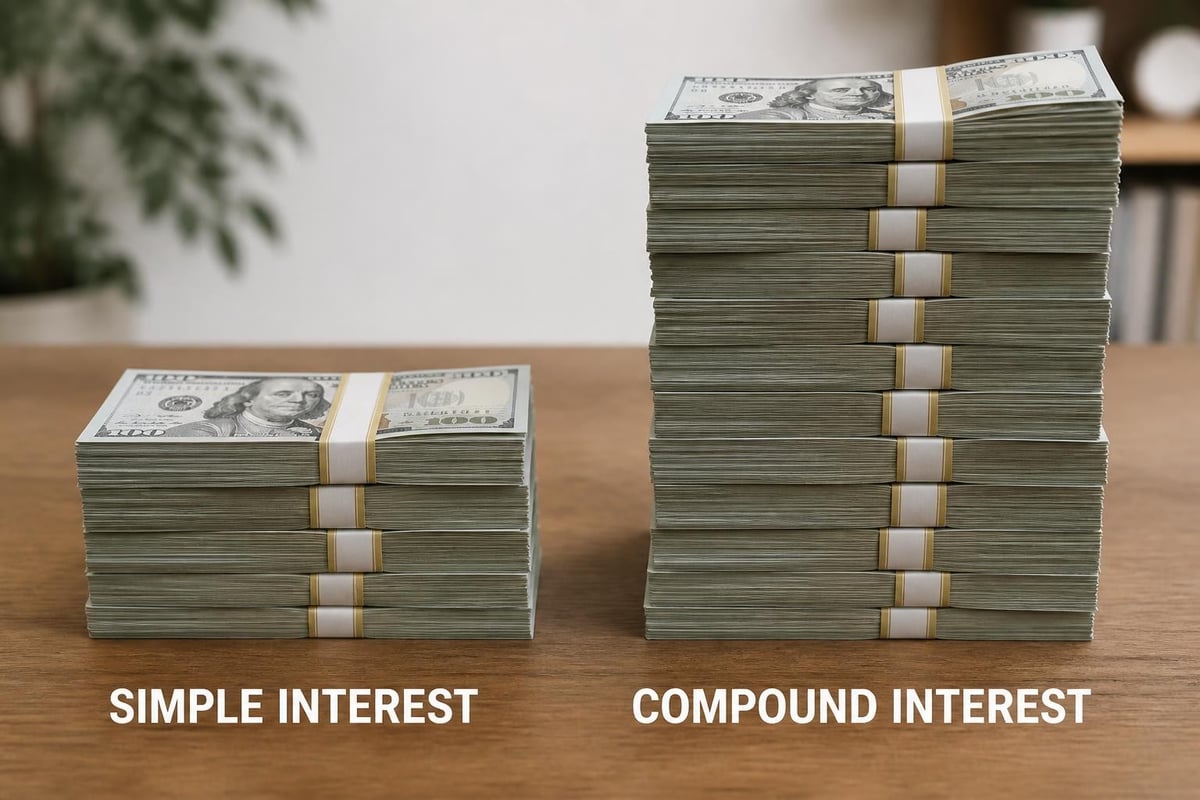
The difference of $1,657.65 represents the cost of compounding, where interest accumulates on previous interest charges. This comparison between simple and compound interest illustrates why loan terms matter significantly to borrowers.
Time Impact on Simple vs Compound Interest
The duration of your loan dramatically amplifies the difference between simple vs compound interest. Short-term loans show minimal divergence, but longer repayment periods reveal the true cost of compounding.
For a three-year loan, the gap might seem manageable. However, extending that same loan to ten years creates a substantial disparity. This time sensitivity makes understanding your loan's interest structure essential when evaluating refinancing options or choosing between different loan terms.
Short-term borrowing (1-3 years): Simple and compound interest show relatively minor differences, making either method potentially acceptable depending on other loan terms.
Medium-term borrowing (4-7 years): The gap widens noticeably, with compound interest adding significant costs. Borrowers should prioritize simple interest loans when possible.
Long-term borrowing (8+ years): Compound interest can nearly double the total interest paid compared to simple interest, making it crucial to understand your loan structure.
How Interest Type Affects Different Loan Products
Consumer lending encompasses various loan types, each potentially using different interest calculation methods. Understanding which products typically employ simple vs compound interest helps you make strategic borrowing decisions.
Personal Loans and Home Improvement Financing
Most personal loans for home improvements, medical expenses, or education use simple interest calculations, particularly when offered through traditional consumer lending institutions. This structure benefits borrowers by providing clear, predictable repayment schedules without escalating costs.
When you apply for home improvement financing, the lender calculates your monthly payment by dividing the total amount (principal plus simple interest) by the number of months in your term. This straightforward approach allows you to budget effectively and understand exactly when you'll be debt-free.
Credit Cards and Revolving Credit
Credit cards represent one of the most common applications of compound interest in consumer finance. The way compound interest functions on credit cards can create rapidly escalating balances if you only make minimum payments.
Credit card compounding characteristics:
- Interest typically compounds daily
- Applied to both purchases and accumulated interest
- Creates the highest total cost for carried balances
- Can result in paying multiple times the original purchase price
- Makes minimum payments particularly expensive over time
This daily compounding effect explains why credit card debt can feel overwhelming and why financial advisors strongly recommend paying more than the minimum whenever possible.
Strategic Considerations for Borrowers
Making informed decisions about simple vs compound interest requires understanding your specific financial situation, goals, and the loan options available to you. Smart borrowing strategies can save thousands of dollars over the life of your loans.
Evaluating Loan Offers
When comparing loan offers from different lenders, the interest type matters just as much as the interest rate. A slightly higher rate with simple interest might cost less overall than a lower rate with compound interest, especially for longer-term loans.
Questions to ask when evaluating loans:
- Does this loan use simple or compound interest?
- If compound, how frequently does it compound?
- What is the APR (Annual Percentage Rate)?
- Are there prepayment penalties?
- How do extra payments affect the interest calculation?
Understanding these distinctions empowers you to negotiate better terms and choose the most cost-effective financing option for your circumstances.
The Power of Early Repayment
Both simple and compound interest loans benefit from early repayment, but the advantage is particularly pronounced with compound interest. Paying off principal faster reduces the base amount on which future interest calculations occur.
For simple interest loans, making extra payments reduces the principal and proportionally decreases the total interest you'll pay. With compound interest, early payments have an amplified effect because they prevent future compounding cycles on that portion of the principal.
| Strategy | Simple Interest Impact | Compound Interest Impact |
|---|---|---|
| Extra $100 monthly | Reduces total interest proportionally | Eliminates multiple compounding cycles |
| Biweekly payments | Adds one extra payment yearly | Disrupts compounding frequency advantage |
| Lump sum payment | Direct principal reduction | Prevents exponential growth on that amount |

Practical Scenarios for Different Borrower Profiles
Different financial situations call for different approaches to understanding and leveraging simple vs compound interest. Your credit history, income stability, and borrowing purpose all influence which loan structure serves you best.
Borrowers Rebuilding Credit
For individuals with past credit issues seeking personal loans, simple interest products offer a clearer path to financial recovery. The predictable payment structure makes it easier to maintain consistent on-time payments, which gradually rebuilds credit scores.
Working with lenders who specialize in flexible financing plans for borrowers with credit challenges often means accessing simple interest loans with transparent terms. This approach allows you to focus on rebuilding your financial reputation without wrestling with escalating interest calculations.
Emergency Medical Expense Financing
Medical expenses often arrive unexpectedly and require immediate financing solutions. Simple interest personal loans for medical costs provide the advantage of knowing your exact repayment obligation from the start, allowing you to coordinate with insurance reimbursements and budget for recovery time.
The fixed nature of simple interest calculations means you can accurately project when you'll be debt-free, providing psychological relief during already stressful medical situations. This predictability contrasts sharply with revolving credit options that might use compound interest.
Education and Career Development Loans
Investing in education or professional certifications often requires financing, and understanding interest structures becomes crucial for long-term financial planning. While federal student loans have specific terms, private education loans may use either simple or compound interest.
For career development investments expected to increase earning potential, simple interest loans offer the advantage of fixed repayment amounts that won't increase as your career progresses. This stability allows you to allocate raises and bonuses toward other financial goals once you understand your baseline debt service requirements.
Regional Considerations for Southeastern Borrowers
Borrowers in Louisiana, Mississippi, Tennessee, and Georgia face unique economic conditions that influence how simple vs compound interest affects their financial decisions. Regional economic factors, state regulations, and local lending markets all play roles in available loan products.
State Regulations and Consumer Protection
Each state maintains specific regulations governing consumer lending practices, including interest rate caps and disclosure requirements. These protections help ensure borrowers receive clear information about whether their loans use simple or compound interest and how calculations are performed.
State-specific considerations:
- Maximum allowable interest rates vary by state
- Disclosure requirements differ across jurisdictions
- Consumer protection laws provide varying levels of oversight
- Local economic conditions influence available loan terms
Understanding your state's regulatory environment helps you recognize whether a loan offer represents fair market value or requires additional scrutiny before acceptance.
Economic Conditions and Borrowing Strategies
The Southeastern United States encompasses diverse economic conditions, from metropolitan areas with robust job markets to rural communities with different economic challenges. These variations affect both the availability of simple interest loans and the strategies borrowers should employ.
In areas with seasonal employment or industries subject to economic fluctuations, the predictability of simple interest loans provides crucial budgeting stability. Knowing your exact payment amount regardless of compounding cycles helps manage irregular income streams more effectively.
Mathematical Tools and Resources
Calculating simple vs compound interest doesn't require advanced mathematics, but having the right tools simplifies the process and helps you verify lender calculations. Several resources make these determinations straightforward for any borrower.
Online Calculators and Verification Tools
Numerous financial websites offer free calculators that demonstrate the difference between simple and compound interest on identical loan amounts. These tools allow you to input various scenarios and immediately see how different interest types and compounding frequencies affect your total repayment.
Using these calculators before accepting a loan offer provides valuable negotiating information and helps you understand whether the proposed terms represent the best available option. Resources that explain interest fundamentals often include interactive tools for comparison.
Spreadsheet Methods for Comparison
Creating a simple spreadsheet allows you to model different loan scenarios and compare simple vs compound interest side-by-side. This hands-on approach deepens your understanding and provides a reusable tool for future borrowing decisions.
Basic spreadsheet columns to include:
- Payment number or period
- Beginning balance
- Interest charged (formula varies by type)
- Principal payment
- Ending balance
- Cumulative interest paid
Building this model yourself reveals exactly how each payment affects your loan balance and demonstrates why understanding interest type matters so significantly for long-term financial planning.
Making Informed Borrowing Decisions
The knowledge of simple vs compound interest serves as just one component of comprehensive financial decision-making. Integrating this understanding with broader financial planning creates a foundation for achieving your goals while minimizing borrowing costs.
Comprehensive Loan Evaluation Framework
Before accepting any loan offer, evaluate all terms holistically rather than focusing solely on monthly payment amounts or advertised interest rates. The interest calculation method interacts with loan duration, fees, prepayment terms, and other factors to determine true borrowing costs.
Complete evaluation checklist:
- Interest type (simple vs compound)
- Nominal interest rate
- APR (includes fees and charges)
- Compounding frequency if applicable
- Loan term and total payments
- Prepayment penalties or restrictions
- Late payment fees and policies
- Total cost of borrowing over full term
This systematic approach prevents you from overlooking critical details that might make an apparently attractive loan actually cost significantly more than alternatives with less favorable initial appearances.
When to Seek Professional Guidance
Complex financial situations sometimes benefit from professional advice, particularly when comparing multiple loan offers with different structures or when your borrowing needs involve substantial amounts or extended terms. Financial advisors and lending specialists can help interpret the legal and financial implications of different interest calculation methods.
Professional guidance proves especially valuable when refinancing existing debt, as advisors can calculate whether simple interest consolidation loans genuinely improve your situation or merely extend repayment periods in ways that increase total costs despite lower monthly payments.
Understanding simple vs compound interest empowers you to make borrowing decisions that align with your financial goals and minimize unnecessary costs. Whether you need financing for home improvements, medical expenses, education, or other personal needs, recognizing how interest calculations affect your total repayment obligations protects your financial wellbeing. Standard Financial serves borrowers throughout Louisiana, Mississippi, Tennessee, and Georgia with transparent personal loan options designed to meet diverse needs, including flexible terms for those rebuilding credit. Contact Standard Financial today to discuss simple interest loan options that provide predictable, manageable repayment schedules tailored to your unique circumstances.







No comment yet, add your voice below!