

Healthcare costs continue to rise across the United States, leaving many families struggling to afford necessary medical procedures, treatments, and emergency care. When insurance coverage falls short or unexpected medical expenses arise, medical loans provide a financial solution that allows patients to receive the care they need while spreading payments over time. Understanding how these specialized financing options work and when to use them can help you make informed decisions about managing healthcare costs without compromising your financial stability.
Understanding Medical Loans and How They Work
Medical loans are personal loans specifically designed to cover healthcare expenses that patients cannot afford to pay upfront. These financing options bridge the gap between the cost of medical care and what insurance covers, allowing individuals to access treatments, procedures, and services without delay.
Unlike traditional payment plans offered directly by healthcare providers, medical loans involve borrowing money from a financial institution that you repay over a predetermined period with interest. The loan amount is deposited directly into your bank account or sent to the medical provider, giving you immediate access to funds for your healthcare needs.
Key Features of Medical Financing
Medical loans typically offer several distinct characteristics that set them apart from other types of personal loans:
- Flexible loan amounts ranging from $1,000 to $100,000 or more
- Repayment terms spanning 12 to 84 months depending on the lender
- Fixed or variable interest rates based on creditworthiness
- Quick approval processes often completed within 24 to 48 hours
- No collateral required for most unsecured medical loans
The application process generally requires basic personal information, proof of income, and details about the medical expenses you need to cover. Many lenders have simplified their online applications, making it easier than ever to compare options and secure funding quickly.

Types of Healthcare Expenses Covered by Medical Loans
Medical loans provide financing for a wide range of healthcare services and treatments. Understanding which expenses qualify can help you determine whether this financing option suits your specific situation.
Eligible Medical Procedures and Treatments
| Expense Category | Common Examples | Typical Cost Range |
|---|---|---|
| Dental Procedures | Implants, orthodontics, cosmetic dentistry | $1,500 – $50,000 |
| Vision Care | LASIK surgery, corrective procedures | $2,000 – $5,000 per eye |
| Cosmetic Surgery | Breast augmentation, rhinoplasty, liposuction | $3,000 – $15,000 |
| Fertility Treatments | IVF, egg freezing, assisted reproduction | $12,000 – $30,000 per cycle |
| Weight Loss Surgery | Gastric bypass, lap-band procedures | $15,000 – $35,000 |
| Emergency Medical Care | Unexpected surgeries, hospital stays | Varies significantly |
Medical loans can also cover veterinary expenses for pets, alternative medicine treatments, and elective procedures that insurance typically does not cover. The flexibility of these financing options makes them valuable for both planned procedures and unexpected medical emergencies.
Specialized Healthcare Financing
Some medical loans cater to specific healthcare niches. Dental financing programs, for instance, often come with promotional periods offering zero-percent interest for qualified borrowers. Vision care loans may include coverage for glasses, contacts, and corrective surgeries under a single financing plan.
Fertility treatment loans have become increasingly popular as more couples explore assisted reproduction options. These specialized medical loans often feature higher borrowing limits to accommodate the substantial costs associated with multiple treatment cycles.
Comparing Medical Loans to Alternative Payment Options
Before committing to a medical loan, it is essential to understand how this financing method compares to other options available for managing healthcare costs.
Medical Credit Cards versus Personal Loans
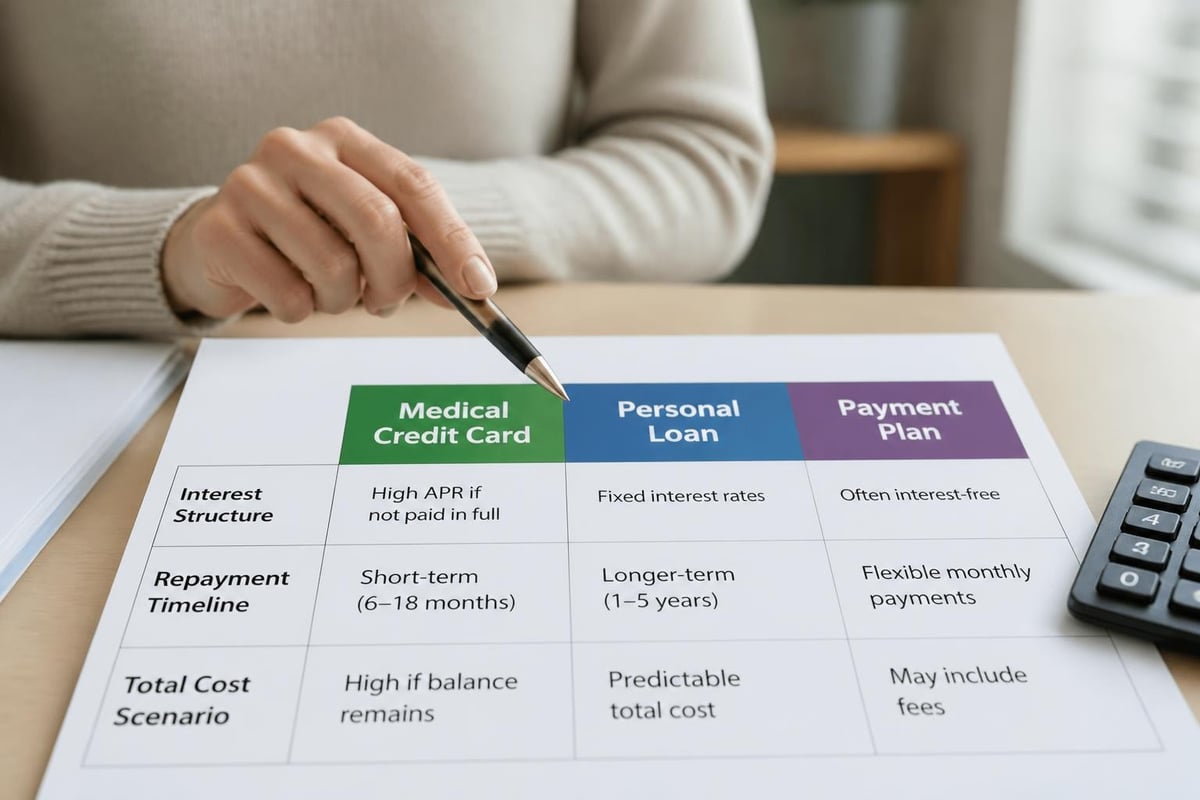
Medical credit cards and payment plans offer different advantages and disadvantages compared to traditional medical loans. Medical credit cards often feature promotional periods with deferred interest, but if you fail to pay off the balance before the promotional period ends, you may face retroactive interest charges on the entire original balance.
Medical Credit Card Pros:
- Immediate approval at point of care
- Promotional zero-percent interest periods
- Reusable credit line for future medical expenses
- Acceptance at multiple healthcare providers
Medical Credit Card Cons:
- Deferred interest can accumulate if not paid in full
- Often higher interest rates after promotional periods
- May encourage overspending on non-essential procedures
- Limited acceptance compared to traditional payment methods
Personal loans for medical expenses, by contrast, offer fixed repayment schedules with predictable monthly payments. You know exactly when the loan will be paid off and how much interest you will pay over the life of the loan.
Qualifying for Medical Loans with Various Credit Profiles
Your credit score plays a significant role in determining your eligibility for medical loans and the interest rates you will receive. However, options exist for borrowers across the credit spectrum.
Credit Score Impact on Loan Terms
| Credit Score Range | Expected APR | Loan Approval Likelihood | Special Considerations |
|---|---|---|---|
| 720 and above | 6% – 12% | Very High | Best rates, highest loan amounts |
| 660 – 719 | 12% – 18% | High | Good rates, standard terms |
| 580 – 659 | 18% – 24% | Moderate | Higher rates, may need co-signer |
| Below 580 | 24% – 36% | Lower | Limited options, secured loans preferable |
Financial institutions evaluate multiple factors beyond credit scores when reviewing medical loan applications. Income stability, debt-to-income ratio, employment history, and existing financial obligations all influence approval decisions and terms.
Options for Borrowers with Credit Challenges
Individuals with past credit issues still have pathways to secure medical financing. Co-signers with stronger credit profiles can help borrowers qualify for better rates and terms. Some lenders specialize in serving borrowers with less-than-perfect credit, offering medical loans with higher interest rates but more lenient approval criteria.
Secured medical loans, which require collateral such as a vehicle or savings account, may offer lower interest rates for borrowers with credit challenges. This option reduces the lender's risk while providing access to necessary healthcare financing.
According to Experian’s guide on medical loans, demonstrating steady income and showing a commitment to repaying the loan can help offset lower credit scores during the application process. Providing thorough documentation and explanation of past credit issues may also improve approval chances.
Strategic Approaches to Managing Medical Debt
Securing a medical loan is just the first step in effectively managing healthcare expenses. Implementing smart strategies can help you minimize costs and maintain financial health throughout the repayment period.
Negotiation and Cost Reduction Strategies
Before applying for a medical loan, explore opportunities to reduce your medical bills through negotiation with healthcare providers. Many hospitals and medical facilities offer discounts for upfront payments or can reduce bills based on financial hardship.
Request itemized bills to identify potential errors or charges for services you did not receive. Studies show that medical billing errors occur in approximately 80 percent of hospital bills, representing opportunities for significant savings.
Consider these cost-reduction tactics:
- Ask about cash discounts when paying for services upfront
- Negotiate payment plans directly with healthcare providers
- Review insurance explanation of benefits for errors or denials
- Request financial assistance through hospital charity care programs
- Compare costs between different providers for non-emergency procedures
Calculating Total Cost of Borrowing
Understanding the true cost of a medical loan requires looking beyond the advertised interest rate. The annual percentage rate (APR) includes both the interest rate and any fees charged by the lender, providing a more accurate picture of borrowing costs.
Calculate the total amount you will repay over the life of the loan, including all interest and fees. Compare this figure to alternative financing options to ensure you are making the most cost-effective choice. Online loan calculators can help you model different scenarios based on loan amounts, interest rates, and repayment terms.
Navigating the Medical Loan Application Process
The application process for medical loans has become increasingly streamlined, with many lenders offering online applications that provide decisions within minutes. Understanding what to expect can help you prepare and increase your chances of approval.
Documentation and Information Requirements
Lenders typically require the following information when you apply for a medical loan:
- Personal identification including Social Security number and government-issued ID
- Proof of income such as pay stubs, tax returns, or bank statements
- Employment verification confirming your current job and income stability
- Medical expense details including provider names and estimated costs
- Existing debt obligations including mortgage, car loans, and credit cards
Having these documents organized and readily available can expedite the application process and demonstrate your preparedness to potential lenders.
Comparing Multiple Lender Offers
NerdWallet’s comparison of medical loan options highlights the importance of shopping around before committing to a lender. Interest rates, fees, repayment terms, and eligibility requirements vary significantly between financial institutions.
Submit applications to multiple lenders within a short timeframe, typically 14 to 45 days, to minimize the impact on your credit score. Credit scoring models recognize when consumers are rate shopping and count multiple inquiries for the same type of loan as a single inquiry during this window.

Responsible Borrowing and Long-Term Financial Planning
Taking on debt to cover medical expenses requires careful consideration of your long-term financial situation. Responsible borrowing practices can help you access needed healthcare while maintaining overall financial stability.
Determining Appropriate Loan Amounts
Borrow only what you need to cover your medical expenses, avoiding the temptation to take out additional funds for non-essential purposes. Larger loan amounts mean higher monthly payments and more interest paid over time.
Create a detailed budget that accounts for the new monthly loan payment alongside your existing financial obligations. Ensure you can comfortably afford the payment without sacrificing other essential expenses or emergency savings.
Building an Emergency Medical Fund
While medical loans provide crucial access to healthcare financing, building an emergency fund specifically for medical expenses can reduce future reliance on borrowing. Financial experts recommend maintaining a dedicated medical savings account separate from your general emergency fund.
High-deductible health insurance plans often pair with Health Savings Accounts (HSAs), which offer triple tax advantages: tax-deductible contributions, tax-free growth, and tax-free withdrawals for qualified medical expenses. Flexible Spending Accounts (FSAs) provide similar benefits for those without HSA-eligible insurance plans.
Regional Considerations for Medical Financing
Healthcare costs and financing options vary by geographic region, influenced by factors such as local cost of living, state regulations, and the competitive landscape of healthcare providers and lenders.
Southeast Healthcare Financing Landscape
States like Louisiana, Mississippi, Tennessee, and Georgia experience unique healthcare financing challenges and opportunities. These regions have seen growing competition among consumer lenders, creating more options for residents seeking medical loans.
Local and regional financial institutions often provide more personalized service and may offer competitive rates compared to national online lenders. Branch locations in these states allow for face-to-face consultations, which some borrowers prefer when discussing significant financial decisions.
Understanding state-specific consumer protection laws and lending regulations can help you identify potential red flags in loan agreements and ensure you are working with reputable lenders who comply with all applicable regulations.
Impact of Medical Loans on Credit Health
Medical loans affect your credit profile in multiple ways, both positive and negative. Understanding these impacts helps you make informed borrowing decisions and manage your credit effectively.
How Medical Financing Influences Credit Scores
When you apply for a medical loan, the lender performs a hard inquiry on your credit report, which may temporarily lower your credit score by a few points. This effect is typically minor and short-lived, especially if you avoid multiple applications over an extended period.
Once approved, the loan appears as a new account on your credit report. The loan increases your total debt, which can temporarily lower your score, but also adds to your credit mix, which can have a positive long-term effect.
Credit Score Factors Affected by Medical Loans:
- Payment history (35% of score)
- Amounts owed (30% of score)
- Length of credit history (15% of score)
- Credit mix (10% of score)
- New credit (10% of score)
Making consistent, on-time payments demonstrates creditworthiness and builds positive payment history, the most important factor in credit scoring models. This can help improve your credit score over time, especially if you previously had limited credit history.
Recovering from Medical Debt Challenges
If financial hardship makes it difficult to keep up with medical loan payments, contact your lender immediately to discuss options. Many lenders offer hardship programs that temporarily reduce payments, defer payments, or modify loan terms to help borrowers avoid default.
Defaulting on a medical loan severely damages your credit score and may result in collection activities, legal action, and wage garnishment. Proactive communication with your lender and exploring alternative solutions like debt consolidation or credit counseling can help you navigate financial difficulties while minimizing credit damage.
Evaluating Medical Loan Features and Terms
Not all medical loans are created equal. Carefully reviewing loan features and terms ensures you select financing that aligns with your financial goals and capabilities.
Essential Loan Features to Compare
| Feature | Why It Matters | What to Look For |
|---|---|---|
| Origination Fees | Upfront cost reduces net proceeds | 0% to 8% of loan amount |
| Prepayment Penalties | May prevent early payoff savings | No penalties preferred |
| Payment Flexibility | Helps during financial hardship | Skip-a-payment or deferment options |
| Autopay Discounts | Reduces interest rate | 0.25% to 0.50% rate reduction |
| Customer Service | Support when you need help | 24/7 availability, multiple channels |
Flexible repayment options become particularly valuable when unexpected financial challenges arise. Look for lenders that offer payment date flexibility, grace periods, and the ability to modify payment schedules without excessive fees.
Understanding Fine Print and Loan Agreements
Read loan agreements thoroughly before signing, paying special attention to sections describing fees, penalties, and circumstances that could trigger default. Variable-rate loans may offer lower initial rates but can increase over time, potentially making future payments unaffordable.
Some medical loans include insurance products that promise to make payments if you become disabled or unemployed. Evaluate these products carefully, as they often come with significant premiums that may not provide proportional value compared to traditional insurance coverage.
Medical loans provide essential access to healthcare financing when you need it most, bridging the gap between medical expenses and available resources. By comparing lenders carefully, understanding terms thoroughly, and borrowing responsibly, you can access the medical care you need while maintaining long-term financial health. Standard Financial offers flexible medical loan options with personalized service through branch locations across Louisiana, Mississippi, Tennessee, and Georgia, working with clients across all credit profiles to find financing solutions that fit their unique healthcare needs and budget requirements.







No comment yet, add your voice below!