

Tax season brings both opportunity and stress for millions of Americans. While many taxpayers anticipate refunds that can help cover essential expenses or pay down debt, waiting weeks or months for that money to arrive can create financial pressure. Tax loans, also known as tax refund advances or tax refund anticipation loans, offer a solution by providing immediate access to funds based on your expected refund. Understanding how these financial products work, their costs, and whether they're right for your situation can help you make informed decisions during tax season.
Understanding Tax Loans and How They Work
Tax loans provide borrowers with quick access to a portion of their anticipated tax refund before the IRS processes their return. Unlike traditional personal loans, these products are specifically tied to your expected refund amount and are typically offered through tax preparation companies, financial institutions, and specialized lenders.
The application process is straightforward. After filing your taxes, you can apply for a tax refund advance based on the amount you expect to receive. Lenders review your tax return information, verify your refund eligibility, and determine how much they're willing to advance. Most tax loans range from a few hundred dollars to several thousand, depending on your refund size.
The Timeline and Disbursement Process
Once approved, tax loans typically disburse funds within 24 to 48 hours, giving you immediate access to money that might otherwise take weeks to arrive. The IRS then deposits your actual refund directly to the lender, who takes their fee and the loan amount before sending any remaining balance to you.
Key characteristics of tax loans include:
- Loan amounts based on expected refund size
- Quick approval and funding timelines
- Repayment through direct IRS refund deposit
- Short-term nature, lasting only until refund arrival
- Availability primarily during tax season

Types of Tax Loans Available in 2026
The tax loan market has evolved significantly, offering consumers multiple options to access their refunds early. Understanding the differences between these products helps you choose the most suitable option for your needs.
Tax Refund Advances
Tax refund advances represent the most common type of tax loan. Many major tax preparation companies offer these no-fee or low-fee advances to clients who file with their services. Several providers compare favorably in terms of costs and accessibility, making them attractive options for taxpayers seeking immediate funds.
These advances typically range from $250 to $4,000 and may be available even before you file your return, based on preliminary tax information. The competitiveness of this market has driven many providers to reduce or eliminate fees, making refund advances more accessible than ever.
Traditional Tax Refund Anticipation Loans
Traditional tax refund anticipation loans carry more structure and often higher costs than modern refund advances. These products involve formal loan agreements with specific interest rates and fees. While less common today due to regulatory changes and market competition, some lenders still offer them, particularly to borrowers with urgent financial needs.
Personal Loans for Tax Purposes
Some consumers turn to standard personal loans during tax season rather than waiting for refunds. These loans aren't tied to tax refunds and function as traditional installment loans with monthly payments. While they provide flexibility and aren't limited by refund amounts, they typically require credit checks and may have higher interest rates.
| Loan Type | Typical Amount | Fees/Interest | Credit Check | Repayment Method |
|---|---|---|---|---|
| Refund Advance | $250-$4,000 | Often none | Usually no | Automatic from refund |
| Anticipation Loan | $500-$5,000 | Varies widely | Sometimes | Automatic from refund |
| Personal Loan | $1,000-$35,000 | Interest rates 6%-36% | Yes | Monthly installments |
The True Cost of Tax Loans
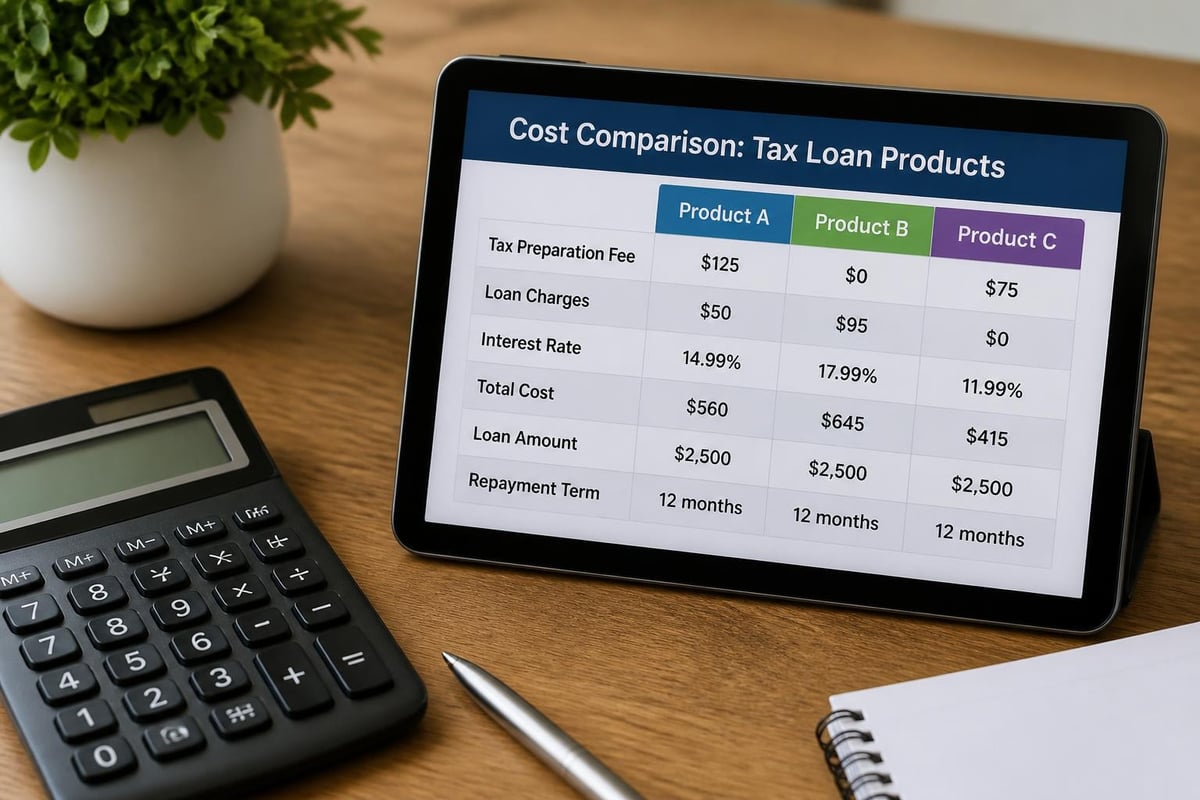
Understanding the financial implications of tax loans requires looking beyond marketing claims to examine the actual costs you'll bear. While many providers advertise "free" tax refund advances, the total cost picture often includes multiple components.
Direct Fees and Interest Charges
Traditional tax loans may carry origination fees, processing charges, or interest rates that can reach triple digits when annualized. Even a $50 fee on a $1,000 advance that you repay in three weeks translates to an annual percentage rate exceeding 85%. This makes it crucial to calculate the true cost before accepting any tax loan offer.
Modern refund advances have largely eliminated direct loan fees, but borrowers still typically pay for tax preparation services. These preparation fees can range from $50 to $300 or more, depending on the complexity of your return and the provider you choose.
Opportunity Costs and Hidden Expenses
Beyond direct costs, tax loans carry opportunity costs. By committing your refund to repay a loan, you lose flexibility in how you use those funds when they arrive. Additionally, if the IRS adjusts your refund downward due to errors or offsets for outstanding debts, you might owe the lender the difference.
Common cost components include:
- Tax preparation fees required to access the advance
- Loan origination or processing fees
- Interest charges on the outstanding balance
- Potential charges for expedited funding
- Bank fees for refund transfer services
Benefits That Make Tax Loans Attractive
Despite potential costs, tax loans serve important purposes for many consumers. Understanding these benefits helps explain why millions of Americans utilize these products each year.
Immediate Access to Funds
The primary advantage of tax loans is speed. When you face urgent expenses like medical bills, car repairs, or utility payments, waiting three to six weeks for your refund may not be practical. Tax loans provide immediate liquidity, allowing you to address financial emergencies without delay.
This immediacy proves particularly valuable for households living paycheck to paycheck, where even short delays in receiving expected funds can cascade into late fees, service disconnections, or other costly consequences.
No Traditional Credit Requirements
Many tax refund advances don't require credit checks, making them accessible to borrowers with poor credit or limited credit history. This inclusivity provides options for individuals who might struggle to qualify for traditional personal loans or credit cards.
The approval process focuses primarily on your expected refund amount rather than your credit score, opening doors for consumers who need financial assistance but have been turned away by conventional lenders.
Simplicity and Convenience
Tax loans typically involve minimal paperwork and straightforward approval processes. Since you're already filing taxes, adding a refund advance to the process requires little extra effort. The automatic repayment mechanism eliminates the need to remember payment dates or manage loan servicing.
When Tax Loans Make Financial Sense
Not every taxpayer benefits from tax loans, and determining whether these products suit your situation requires honest assessment of your financial circumstances and alternatives.
Appropriate Use Cases
Tax loans make the most sense when you face genuine financial emergencies that can't wait for your regular refund. Essential car repairs needed to get to work, urgent medical expenses not covered by insurance, or preventing utility disconnections represent scenarios where the convenience of immediate funds may justify any associated costs.
Similarly, taxpayers who can access truly free refund advances with zero fees might reasonably choose early access over waiting, particularly if they've already budgeted for tax preparation services.
Situations to Avoid Tax Loans
Conversely, tax loans rarely make sense for discretionary purchases or expenses that can wait. Using a tax loan to fund a vacation, purchase electronics, or buy gifts typically represents poor financial judgment, as the costs outweigh any benefits.
- Evaluate the urgency of your need
- Calculate total costs including all fees
- Compare alternatives like payment plans or small personal loans
- Assess whether waiting three weeks is truly unfeasible
- Consider whether the expense can be reduced or eliminated
If your primary motivation is simply wanting your money faster rather than addressing a genuine emergency, waiting for your regular refund usually makes better financial sense.
Alternatives to Consider Before Choosing Tax Loans
Before committing to a tax loan, exploring alternative options may reveal better solutions for your financial needs. Several strategies can provide relief without the costs associated with tax loans.
Filing Early and Choosing Direct Deposit
The most straightforward alternative to tax loans is optimizing your filing strategy. Filing your taxes as early as possible and selecting direct deposit accelerates refund delivery significantly. Electronic filing combined with direct deposit typically delivers refunds within 21 days, substantially faster than paper filing or check issuance.
Emergency Funds and Short-Term Credit
Building even a modest emergency fund creates a buffer that eliminates the need for tax loans in future years. Even $500 to $1,000 in savings can cover most unexpected expenses that arise during the refund waiting period.
For immediate needs, some consumers find that credit cards, despite their interest rates, provide more flexibility than tax loans. Other specialized loan products may also offer competitive terms worth comparing.
Payment Plans and Negotiation
When facing bills or obligations, many creditors and service providers offer payment plans or extensions. Utility companies, medical providers, and other businesses often accommodate customers facing temporary financial constraints, potentially eliminating the need for any loan.
| Alternative | Timeframe | Cost | Best For |
|---|---|---|---|
| Early filing + direct deposit | 2-3 weeks | Free | Most taxpayers |
| Emergency savings | Immediate | None | Planned ahead |
| Credit card | Immediate | 15%-25% APR | Good credit holders |
| Payment plan | Negotiable | Often free | Flexible creditors |
| Personal loan | 1-7 days | 6%-36% APR | Larger amounts |
How to Choose the Right Tax Loan Provider
If you determine that a tax loan serves your best interests, selecting the right provider requires careful comparison and due diligence. The tax loan market includes both reputable companies and predatory lenders, making research essential.
Evaluation Criteria
Start by comparing fees across multiple providers. Request clear disclosure of all costs, including tax preparation fees, loan charges, and any additional expenses. Reputable lenders provide transparent information about their terms before you commit.
Essential factors to evaluate include:
- Total cost including preparation and loan fees
- Loan amount limits and flexibility
- Funding timeline and delivery method
- Provider reputation and customer reviews
- Accessibility through online or in-person services
Understanding Provider Requirements
Different providers impose varying eligibility criteria. Some require minimum refund amounts, while others limit advances to specific percentages of your expected refund. Understanding these requirements upfront prevents wasted application time.
Most tax loan providers require that you file your taxes with them to access their advance products. This bundling means comparing tax preparation quality and costs alongside loan terms.

Special Considerations for Different Tax Situations
Your individual tax circumstances significantly influence whether tax loans suit your needs and which products might serve you best. Certain situations warrant extra caution or create unique opportunities.
Earned Income Tax Credit and Child Tax Credit
Taxpayers claiming the Earned Income Tax Credit (EITC) or Additional Child Tax Credit face special timing considerations. Federal law requires the IRS to hold refunds claiming these credits until mid-February, even if you file earlier. This delay affects when you can receive both regular refunds and tax loan proceeds.
Understanding this timing helps set realistic expectations. If your refund depends primarily on these credits, traditional tax loans may not accelerate access significantly compared to waiting for direct deposit.
Self-Employed and Complex Returns
Self-employed individuals and taxpayers with complex returns face additional scrutiny from both the IRS and tax loan providers. These returns take longer to process and may face higher adjustment rates, increasing the risk for lenders.
As a result, some tax loan providers either decline applications from self-employed borrowers or offer reduced advance amounts. If you fall into this category, expect more limited options and potentially higher costs.
Tax Debt and Offset Situations
If you owe back taxes, child support, student loans, or other government debts, the IRS may offset your refund to cover these obligations. Tax loan providers can't predict these offsets perfectly, creating potential complications. Some lenders screen for likely offsets and adjust loan amounts accordingly, while others may hold you responsible for repaying advances even if your refund gets offset.
Always disclose known debts during the application process and understand your potential liability if your refund doesn't cover the advance amount.
Managing Tax Loans Responsibly
If you proceed with a tax loan, responsible management ensures the best possible outcome and minimizes potential complications. Following best practices protects your financial interests throughout the process.
Verification and Documentation
Before accepting a tax loan, verify that all information on your tax return is accurate. Errors can delay refunds or trigger adjustments that reduce your refund amount. Double-checking calculations, ensuring accurate dependent information, and confirming banking details prevents costly mistakes.
Keep all documentation related to your tax loan, including the loan agreement, fee disclosures, and your filed tax return. These records prove valuable if disputes arise or questions emerge about repayment.
Understanding Repayment Mechanisms
Most tax loans repay automatically when your refund arrives, with the IRS depositing funds directly to the lender. Understanding this process helps you anticipate the timeline and know when to expect any remaining refund balance.
If complications arise, such as refund delays or adjustments, contact your lender immediately. Proactive communication often leads to better outcomes than ignoring potential problems.
Planning for Future Tax Seasons
Use the current tax season as a learning opportunity for future planning. If you needed a tax loan this year, consider strategies to avoid that necessity next year. Adjusting withholding to increase your take-home pay throughout the year reduces your refund but provides earlier access to your money.
Alternatively, building emergency savings specifically to cover the gap between filing and refund receipt eliminates the need for future tax loans. Even small monthly contributions accumulate into meaningful buffers over time.
The Regulatory Landscape for Tax Loans
The tax loan industry operates under various federal and state regulations designed to protect consumers. Understanding this regulatory environment helps you recognize legitimate providers and identify potential red flags.
Consumer protection laws require lenders to disclose all fees, interest rates, and terms clearly before you accept a loan. The Truth in Lending Act mandates that lenders provide APR calculations and total cost information, enabling meaningful comparison shopping.
State regulations vary significantly, with some states imposing interest rate caps or additional disclosure requirements on tax loan providers. Others have few specific rules governing these products. Knowing your state's regulatory framework helps you understand your rights and protections.
Industry changes over recent years have generally favored consumers, with major tax preparation companies moving toward no-fee refund advances and improved transparency. This competitive pressure benefits borrowers by reducing costs and expanding access.
Tax loans offer a valuable option for accessing your refund quickly when genuine emergencies arise, but they require careful evaluation of costs and alternatives. Understanding the different types of tax loans, their true costs, and when they make financial sense empowers you to make informed decisions during tax season. If you find yourself needing financial assistance beyond what tax loans can provide, or if you're looking for more flexible lending options throughout the year, Standard Financial offers personal loans designed for your unique circumstances, with flexible terms and consideration for various credit situations across Louisiana, Mississippi, Tennessee, and Georgia.







No comment yet, add your voice below!