
Understanding how often your credit score updates is crucial for anyone managing their financial health, especially when planning to apply for loans or refinancing options. Your credit score doesn't change on a fixed schedule like your birthday or payday. Instead, it fluctuates based on a complex interplay of reporting cycles, bureau processing times, and the specific scoring model being used. For consumers across Louisiana, Mississippi, Tennessee, and Georgia seeking personal loans or flexible financing, knowing these update patterns can help you time your applications strategically and monitor your progress as you rebuild or strengthen your credit profile.
Understanding the Credit Score Update Cycle
Your credit score updates whenever the credit bureaus receive new information from your lenders and creditors. This happens continuously throughout the month, but not all lenders report on the same schedule. Most creditors report account information to Experian, Equifax, and TransUnion once per month, typically within a few days after your statement closing date.
The question of how often does your credit score update depends on three distinct processes working together. First, your creditors must report your account activity to the bureaus. Second, the bureaus must process and incorporate that data into your credit file. Third, the scoring model must recalculate your score based on the updated information. Each step operates on its own timeline.
The Role of Lender Reporting Schedules
Most credit card issuers and loan servicers follow a monthly reporting cycle. They typically transmit data to the credit bureaus within 30 days of your statement date, though some report more frequently. Bankrate’s research shows that the majority of card issuers report within three to five days after your billing cycle closes, though exact timing varies by institution.
This reporting schedule has significant implications for your score. If you pay down a large balance mid-cycle, your credit report won't reflect that change until after your next statement closes and the creditor reports the new balance. Similarly, opening a new account won't appear on your credit report until the lender completes its initial reporting, which can take 30 to 60 days from account opening.

Frequency Varies by Scoring Model and Monitoring Service
When people ask how often does your credit score update, the answer also depends on which score they're checking. FICO scores and VantageScore calculations refresh whenever the underlying credit report data changes, but you'll only see a new score when you check it or when a monitoring service generates one.
Many free credit monitoring services update your score monthly. Others provide weekly or even daily updates. However, these frequent score checks don't mean your actual credit file is changing that often. The service is simply recalculating your score based on your current credit report data using whatever model they've licensed.
FICO Score Update Patterns
FICO scores can technically update every time your credit report changes. Since most people have multiple accounts reporting throughout the month, your FICO score could theoretically change several times monthly. However, you'll only see these changes when you request your score or when a lender pulls your credit.
Different FICO versions also update based on different criteria. FICO Score 8, the most widely used version for general lending decisions, and newer versions like FICO Score 9 and 10 may update at different intervals depending on the bureau and the specific data elements that changed. Mortgage lenders often use older FICO models (typically FICO 2, 4, and 5) that may show different update patterns than the scores you see through consumer monitoring services.
VantageScore Update Frequency
VantageScore operates similarly to FICO in that it recalculates whenever your credit file changes. VantageScore’s consumer FAQs explain that scores can update as often as daily when new information posts to your credit report, though most consumers see meaningful changes on a monthly basis aligned with creditor reporting cycles.
The newer VantageScore 4.0 model, which is being adopted for mortgage underwriting in accordance with FHFA implementation guidelines, incorporates trending data and machine learning components that may reflect changes differently than previous versions. Understanding which version of VantageScore you're monitoring helps set realistic expectations for update frequency.
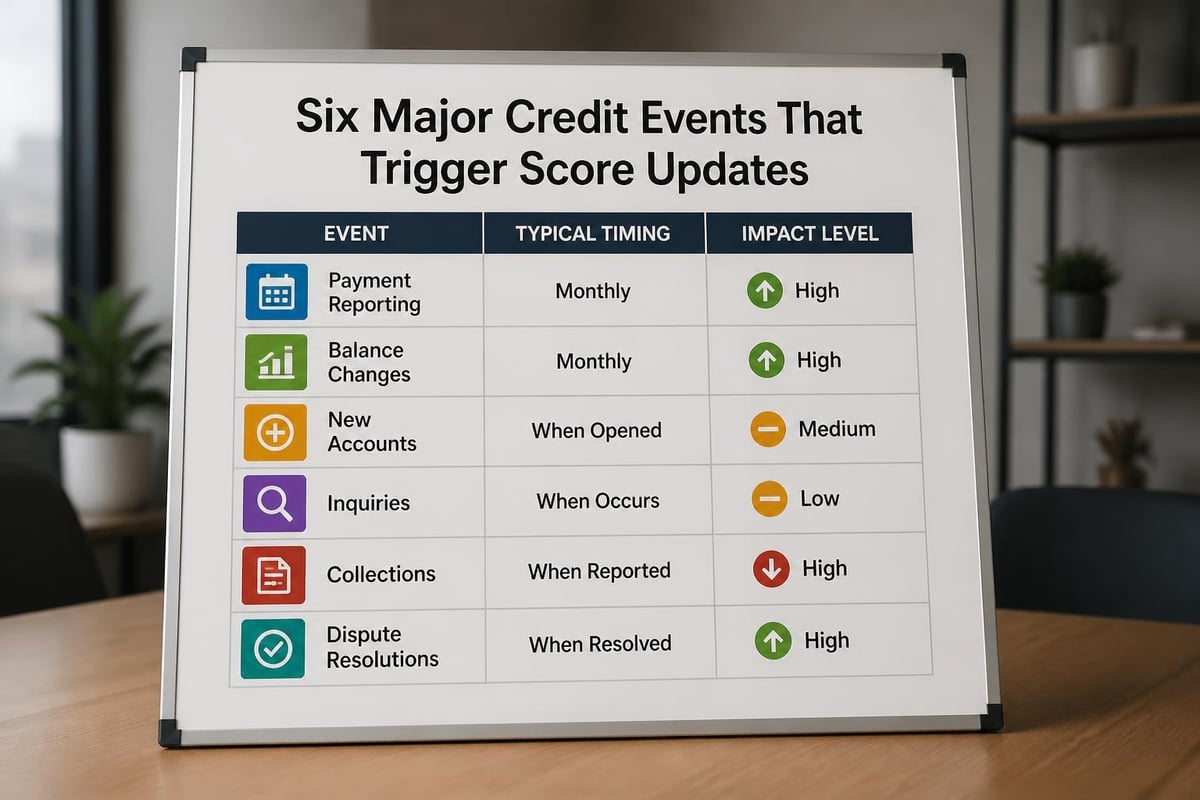
What Triggers a Credit Score Update
Several specific events trigger changes to your credit report and score. Understanding these triggers helps answer how often does your credit score update in practical terms for your specific situation.
Payment Activity: Your payment history accounts for the largest portion of your credit score. When creditors report your on-time payments or missed payments, your score will typically update within 30 to 45 days of the payment date.
Credit Utilization Changes: Paying down credit card balances or increasing your utilization can significantly impact your score. These changes appear when your creditor reports your new balance, usually after your statement closes.
New Accounts or Inquiries: Opening a new loan or credit card generates a hard inquiry and adds a new account to your file. The inquiry posts within days, while the new account may take 30 to 60 days to appear fully.
Account Closures: Closing an account updates your credit file, potentially affecting your score by changing your available credit or average account age.
Public Records and Collections: Bankruptcies, tax liens, judgments, and collection accounts update your credit file when the reporting entity submits the information. The CFPB explains that most negative items remain on your report for seven years, while bankruptcies can stay for up to ten years.
| Event Type | Typical Update Timeline | Score Impact |
|---|---|---|
| Monthly payment reported | 3-5 days after statement date | Low to moderate |
| Balance paydown reported | Next statement cycle | Moderate to high |
| New account opened | 30-60 days | Moderate (short-term decrease) |
| Hard inquiry | 1-2 days | Low |
| Collections account added | Varies (immediately to 60 days) | High |
| Dispute resolution | 30-45 days after dispute filed | Varies |
Checking Your Score: How Often Should You Monitor?
Knowing how often does your credit score update should inform your monitoring strategy, especially when you're actively working to improve your credit for a loan application. Experian’s guidance on checking frequency suggests monthly checks provide adequate oversight for most consumers.
For individuals planning to apply for home improvement loans, medical financing, or education loans through lenders like Standard Financial, more frequent monitoring may be beneficial during the months leading up to your application. Weekly checks can help you track the impact of credit-building strategies and ensure your score is optimized before you apply.
Strategic Monitoring for Loan Applications
- Three to six months before applying: Check monthly to establish a baseline and identify any errors or issues
- 60 to 90 days before applying: Increase to bi-weekly checks as you implement score-improvement strategies
- 30 days before applying: Consider weekly monitoring to catch any unexpected changes
- Immediately before applying: Final check to ensure no surprises from recent account activity
This graduated approach helps you understand your score trajectory without obsessing over minor fluctuations. Remember that checking your own credit score is a soft inquiry that doesn't affect your credit.
Bureau-Specific Update Differences
One complexity in answering how often does your credit score update is that the three major bureaus don't always receive information simultaneously. A creditor might report to all three bureaus on the same day, only to two bureaus, or to each bureau on different days.
This asynchronous reporting means your Experian-based score might update before your TransUnion or Equifax scores. You could have three different scores at any given time, not because the calculation differs, but because the underlying data differs across bureaus.
Why Your Scores Differ Across Bureaus
Not all creditors report to all three bureaus. Some lenders report only to one or two bureaus, meaning certain accounts appear on some credit reports but not others. This selective reporting particularly affects consumers with limited credit history or those working with smaller, regional lenders.
Consumer Reports’ investigation found that reporting errors and inconsistencies across bureaus are surprisingly common. Regular monitoring across all three bureaus helps identify discrepancies that could be holding your score back.
Common Misconceptions About Update Timing
Many consumers hold incorrect assumptions about how often does your credit score update, leading to frustration or missed opportunities.
Misconception #1: Scores update on a fixed schedule. Unlike a monthly subscription that renews on the same date, credit scores update based on when creditors report, which varies by account. Your mortgage servicer might report on the 15th while your credit card issuer reports on the 3rd.
Misconception #2: Paying off debt immediately updates your score. Even after you submit payment, your score won't change until your creditor processes the payment, reports the new balance to the bureaus, the bureaus update your file, and you request or generate a new score.
Misconception #3: All monitoring services show real-time scores. Most free monitoring services calculate scores monthly or weekly using a snapshot of your credit file. Real-time updates would require constant rescoring, which is computationally expensive and unnecessary for most consumers.
Misconception #4: Disputed items immediately disappear from your report. Credit disputes can take 30 to 45 days to investigate and resolve. The CFPB recommends reviewing your report regularly but understanding that corrections take time to process.

Maximizing Score Updates for Loan Applications
For consumers across the Southeast preparing to apply for personal loans, understanding update timing creates strategic advantages. If you're planning to apply for financing through Standard Financial for medical expenses, home improvements, or educational costs, timing your credit optimization efforts around update cycles can improve your approval odds and interest rates.
Steps to Optimize Before Your Application
- Identify your statement closing dates across all credit cards and revolving accounts
- Pay down balances strategically before statement dates to maximize utilization improvements
- Wait 45 to 60 days after making changes for updates to fully post across all bureaus
- Pull your own credit reports from all three bureaus to verify updates have posted
- Time your application for 30 to 45 days after your optimized balances report
This deliberate approach ensures your credit score reflects your most positive financial position when lenders evaluate your application.
Special Considerations for Credit Rebuilding
Consumers working to rebuild credit after past issues need to understand how often does your credit score update to maintain realistic expectations. Credit rebuilding is a marathon, not a sprint, and scores typically improve gradually over months rather than weeks.
Timeline for Rebuilding Scores
| Strategy | Initial Impact | Time to See Results | Long-term Benefit |
|---|---|---|---|
| Paying down revolving debt | Moderate | 30-60 days | High |
| Making on-time payments | Low initially | 3-6 months | Very high |
| Becoming authorized user | Moderate | 30-90 days | Moderate |
| Secured credit card | Low initially | 6-12 months | High |
| Credit builder loan | Low initially | 6-12 months | Moderate to high |
| Disputing errors | Varies | 30-45 days | Varies |
Lenders like Standard Financial that work with clients with past credit challenges understand this rebuilding timeline. However, demonstrating consistent progress through strategic actions timed with reporting cycles can accelerate your access to better loan terms.
Monitoring Progress During Rebuilding
When rebuilding credit, monthly score checks provide sufficient feedback without creating anxiety over small fluctuations. Focus on quarter-over-quarter trends rather than month-to-month changes. A score that increases 10 to 20 points per quarter indicates solid progress.
Track not just your score but the underlying factors: credit utilization percentage, number of on-time payments, and age of newest account. These metrics often improve before your score reflects the changes, giving you confidence that you're on the right track.
The Impact of Multiple Accounts Updating
Most consumers carry multiple credit accounts, each reporting on its own schedule. This staggered reporting means your credit file receives updates throughout the month, potentially triggering multiple score recalculations.
Understanding this pattern explains why the answer to how often does your credit score update can be "multiple times per month" even though you only see monthly snapshots through most monitoring services. Your actual credit file is more dynamic than your monitoring dashboard might suggest.
Coordinating Updates Across Accounts
- Auto loans and personal loans: Usually report monthly, close to the same date each month
- Credit cards: Report based on statement closing dates, which vary by account
- Mortgages: Typically report monthly to all three bureaus
- Student loans: Report monthly, often mid-month for federal loans
- Collections and judgments: Report when added, then update monthly or when resolved
If you have five credit cards with statement dates on the 5th, 12th, 18th, 23rd, and 28th, your credit file could receive five separate updates monthly. Each update has the potential to change your score, though small balance fluctuations on one card rarely move the score significantly.
When Updates Don't Happen as Expected
Sometimes consumers notice that their credit score doesn't update despite making significant changes like paying off debt. Several factors can explain these apparent delays.
Processing backlogs at credit bureaus can delay updates, particularly during high-volume periods. Creditor reporting errors may prevent account updates from posting correctly. Closed accounts sometimes stop reporting entirely, meaning positive payment history from that account no longer refreshes. Disputed items freeze during investigation, preventing updates until resolution.
If you've made substantial improvements but your score hasn't reflected them after 60 days, request your credit reports from all three bureaus to identify the issue. Look for accounts that should have reported new information but haven't, or for errors that might be suppressing your score improvement.
Seasonal and Cyclical Patterns
Credit reporting shows some predictable patterns throughout the year, though how often does your credit score update remains tied primarily to your individual account reporting cycles rather than calendar effects.
Many consumers see credit utilization spike during holiday seasons (November through January) as spending increases. Tax refund season (February through April) often brings balance paydowns and score improvements. Back-to-school periods (July through September) can show increased borrowing for education expenses.
Understanding these patterns helps you contextualize your score changes and plan major financing applications around periods when your credit profile is strongest. For parents financing education expenses or homeowners planning summer renovation projects, checking your score several months ahead helps you time applications strategically.
Your credit score updates continuously as creditors report new information, typically translating to meaningful changes every 30 to 45 days for most consumers. By understanding these cycles and monitoring strategically, you can optimize your credit profile before applying for financing. Whether you're rebuilding credit after past challenges or maintaining strong credit for a major purchase, Standard Financial offers flexible financing solutions across Louisiana, Mississippi, Tennessee, and Georgia, with loan officers who understand that your credit score tells only part of your financial story. Contact us today to discuss personal loan options tailored to your unique situation, even if your credit isn't perfect.





No comment yet, add your voice below!