

When consumers across Louisiana, Mississippi, Tennessee, and Georgia need access to funds, they often face a critical choice between two popular financing options. Understanding the personal loan vs line of credit decision requires careful examination of how each product works, what it costs, and which situations favor one over the other. Both financing tools serve important purposes in consumer lending, yet they operate under fundamentally different structures that can significantly impact your monthly budget, total interest paid, and financial flexibility. For borrowers evaluating their options, the right choice depends on specific needs, spending patterns, and repayment preferences.
How Personal Loans and Lines of Credit Work
Personal loans deliver a lump sum of money upfront that you repay over a fixed period through equal monthly installments. When you secure a personal loan, you receive the entire amount at closing, whether that's $5,000 for medical expenses or $25,000 for home improvements. The FDIC explains that installment loans follow a predictable schedule where each payment includes both principal and interest, gradually reducing your balance to zero by the end of the loan term.
Lines of credit operate on a revolving basis, similar to credit cards but typically with lower interest rates. Rather than receiving a lump sum, you gain access to a credit limit that you can draw from as needed. The Consumer Financial Protection Bureau defines personal lines of credit as flexible borrowing arrangements where you only pay interest on the amount you actually use, and as you repay the principal, that credit becomes available again.

Borrowing Mechanics and Access to Funds
The personal loan vs line of credit distinction becomes clearest when examining how you access money. Personal loans provide immediate, one-time funding. You apply, get approved for a specific amount, receive the full disbursement, and begin making payments according to your fixed schedule. This structure works exceptionally well for defined expenses like medical procedures, education costs, or specific home improvement projects where you know exactly how much you need.
Lines of credit require a two-step process: approval for a credit limit, then multiple draws over time. You might secure a $15,000 line of credit but initially withdraw only $3,000. Months later, you could draw another $5,000 if needed. This flexibility appeals to borrowers managing ongoing expenses, phased projects, or those who want a financial safety net for emergencies.
Key mechanical differences include:
- Disbursement timing: Personal loans fund immediately; lines of credit fund on demand
- Number of transactions: Personal loans involve one disbursement; lines of credit allow multiple draws
- Access duration: Personal loans close after disbursement; lines of credit remain open during the draw period
- Repayment flexibility: Personal loans require fixed payments; lines of credit often have minimum payment requirements
Interest Rates and Cost Comparison
Interest rate structures represent a critical factor in the personal loan vs line of credit evaluation. Personal loans typically carry fixed interest rates that remain constant throughout the entire repayment period. When Standard Financial approves a personal loan at 9.5% APR, that rate stays locked for the full term, whether three years or seven years. This predictability helps borrowers budget accurately and protects against rising interest rate environments.
Lines of credit almost always feature variable interest rates tied to benchmark rates like the prime rate. If the prime rate increases by one percentage point, your line of credit rate typically rises by the same amount. While variable rates can benefit borrowers when rates fall, they create uncertainty in monthly payment amounts and total interest costs over time.
| Feature | Personal Loan | Line of Credit |
|---|---|---|
| Rate type | Fixed | Variable |
| Payment predictability | Fully predictable | Changes with rate |
| Protection from rate increases | Yes | No |
| Benefit from rate decreases | No | Yes |
| Typical APR range (2026) | 7% to 25% | 10% to 28% |
Total Interest Paid Over Time
The personal loan vs line of credit cost comparison extends beyond just the interest rate. Because personal loans amortize over a set schedule, you know exactly how much interest you will pay from day one. A $10,000 personal loan at 10% APR over five years will cost approximately $2,748 in total interest, with each payment reducing both principal and interest.
Lines of credit make cost prediction much more challenging. Your total interest depends on how much you borrow, when you borrow it, how quickly you repay, and how interest rates fluctuate during your draw period. Bankrate’s analysis of personal loans versus lines of credit shows that disciplined borrowers who repay quickly may spend less with a line of credit, while those who maintain balances long-term often pay significantly more.
According to recent Federal Reserve data on household credit access, consumers increasingly weigh interest costs against flexibility when choosing between structured installment products and revolving credit options.
When to Choose a Personal Loan
Personal loans excel in specific financial scenarios where structure and predictability matter most. Borrowers consolidating high-interest credit card debt benefit tremendously from personal loans because they exchange variable-rate revolving debt for fixed-rate installment debt with a clear payoff date. A consumer carrying $12,000 across three credit cards at rates between 18% and 24% might refinance into a personal loan at 11%, saving thousands in interest while eliminating the temptation to re-borrow.

Situations favoring personal loans:
- Defined one-time expenses: Medical procedures, wedding costs, or funeral expenses with known amounts
- Home improvement projects: Kitchen renovations, roof replacements, or HVAC installations with contractor quotes
- Debt consolidation: Combining multiple debts into one predictable payment
- Major purchases: Vehicles, appliances, or furniture when you need the full amount upfront
- Budget certainty requirements: Fixed income households that cannot absorb payment fluctuations
Personal Loan Advantages for Specific Borrower Profiles
Past credit challenges create additional considerations in the personal loan vs line of credit decision. Lenders often view personal loans as lower risk because the fixed structure and closed-end nature limit additional borrowing. For borrowers rebuilding credit in Louisiana, Mississippi, Tennessee, or Georgia, personal loans from institutions like Standard Financial may be more accessible than lines of credit, which typically require stronger credit profiles.
The psychological benefit of fixed payments cannot be overstated. Behavioral finance research demonstrates that consumers manage debt more successfully when they see steady progress toward a zero balance. Personal loans create this visible path to debt freedom, with each payment bringing you closer to ownership rather than simply maintaining access to revolving credit.
When to Choose a Line of Credit
Lines of credit serve different financial needs, particularly those involving uncertainty, flexibility, or ongoing expenses. Homeowners undertaking phased renovation projects benefit from drawing funds as each phase completes, paying interest only on the amounts actually used rather than the entire projected cost upfront. A bathroom remodel in month one, kitchen updates in month four, and exterior painting in month eight can all draw from the same line of credit without paying interest on future phases.
Emergency preparedness represents another compelling use case. Consumers who want financial protection against unexpected expenses but do not currently need funds can establish a line of credit and leave it untapped. Unlike a personal loan that begins accruing interest immediately on the full amount, a line of credit costs nothing until you actually draw funds.
Ideal Line of Credit Scenarios
The personal loan vs line of credit choice often hinges on the nature of your upcoming expenses. NerdWallet’s comparison guide identifies flexibility as the primary line of credit advantage, making this option suitable for:
- Ongoing education costs: Tuition, books, and fees spread across multiple semesters
- Business expenses: Startup costs, inventory purchases, or cash flow management for self-employed individuals
- Variable medical treatment: Ongoing therapy, dental work, or procedures scheduled over time
- Emergency backup: Financial safety net for unexpected home repairs, auto problems, or income disruptions
- Seasonal expenses: Annual insurance premiums, property taxes, or holiday spending smoothed throughout the year
Lines of credit also appeal to financially sophisticated borrowers who can manage revolving credit responsibly. These individuals may arbitrage the difference between their line of credit rate and other investment returns, or use the credit strategically for short-term needs while maintaining savings in higher-yield accounts.
Credit Score Impact and Reporting Differences
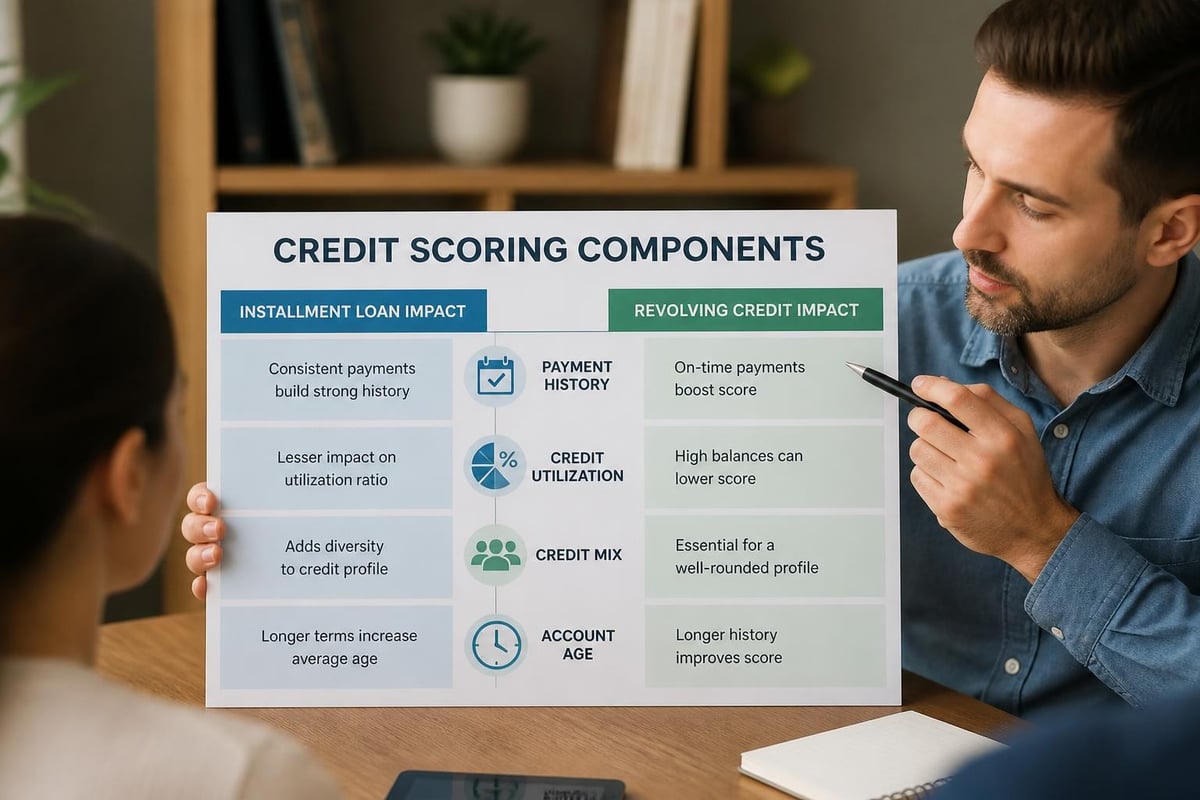
Both products affect your credit profile, but the personal loan vs line of credit distinction matters for credit scoring. Personal loans appear as installment accounts on your credit report. Experian notes that installment loans contribute to credit mix diversity and show responsible payment history when paid on time, but they do not impact your credit utilization ratio in the same way revolving accounts do.
Lines of credit function as revolving accounts, similar to credit cards. Credit scoring models heavily weight your credit utilization, the percentage of available credit you are using. Maintaining a high balance on a line of credit can significantly damage your credit score even if you make every payment on time. A $8,000 balance on a $10,000 line of credit creates 80% utilization, which most scoring models consider risky.
| Credit Impact Factor | Personal Loan | Line of Credit |
|---|---|---|
| Account type | Installment | Revolving |
| Affects utilization ratio | No | Yes |
| Ideal utilization | N/A | Below 30% |
| Payment history weight | High | High |
| Credit mix contribution | Yes | Yes |
| Impact of closing | Moderate | Can significantly hurt utilization |
Strategic Credit Building Considerations
For consumers rebuilding credit after past financial difficulties, the personal loan vs line of credit decision carries additional weight. Personal loans offer a clearer path to credit improvement through consistent, on-time payments without the utilization concerns that plague revolving credit. A 36-month personal loan creates 36 opportunities to demonstrate payment reliability, with your balance declining each month and no risk of re-borrowing.
Lines of credit require more discipline to benefit your credit profile. You must maintain low utilization, make every payment on time, and avoid maxing out your available credit. The New York Fed’s household debt report shows that consumers with lower credit scores often struggle more with revolving credit management, making installment loans the safer choice for credit building.
Application Process and Approval Requirements
Lenders evaluate personal loan and line of credit applications using similar criteria but with different emphasis. Both products require credit checks, income verification, and debt-to-income ratio calculations. However, the personal loan vs line of credit approval process diverges in several important ways.
Personal loan applications typically require:
- Specific loan amount and purpose
- Proof of income through pay stubs or tax returns
- Credit score review (requirements vary by lender)
- Employment verification
- Identification and residency documentation
- Bank statements showing financial stability
Line of credit applications additionally consider:
- Demonstrated ability to manage revolving credit
- Lower debt-to-income ratios (stricter requirements)
- Longer credit history with diverse account types
- Higher credit score thresholds in most cases
- Ongoing income stability and employment tenure
- Financial reserves or asset verification
Standard Financial and other consumer lenders in the Southeast often show more flexibility with personal loan approvals for borrowers with past credit issues. The structured nature of personal loans allows lenders to assess repayment capacity more easily than with open-ended lines of credit where future borrowing remains uncertain.
Tax Implications and Deductibility
Tax considerations rarely dominate the personal loan vs line of credit decision for most consumers, but they warrant attention in specific situations. The IRS explains interest expense deductibility with clear rules: personal loan and line of credit interest generally are not tax deductible when used for consumer purposes like debt consolidation, medical expenses, or personal purchases.
Exceptions exist when borrowed funds finance business activities or certain educational expenses. Self-employed borrowers who use a personal loan or line of credit for legitimate business purposes may deduct the proportional interest on Schedule C. Students using borrowed funds for qualified education expenses at eligible institutions might claim education credits or deductions, though federal student loans typically offer better terms for educational borrowing.
Home equity lines of credit create an entirely separate category with specific tax rules, but traditional personal lines of credit without collateral do not qualify for mortgage interest deduction treatment regardless of how you use the funds.
Repayment Flexibility and Early Payoff
The personal loan vs line of credit comparison must address repayment flexibility, an area where each product offers distinct advantages. Personal loans typically include fixed monthly payments calculated to retire the debt over the specified term. Many lenders, including Standard Financial, allow early payoff without penalties, letting borrowers save on interest by paying more than the minimum or retiring the loan ahead of schedule.
Lines of credit offer different flexibility through minimum payment structures. You might owe only interest each month, or a small percentage of the outstanding balance. This structure helps during tight financial months but can trap undisciplined borrowers in perpetual debt if they never pay more than the minimum. The ability to re-borrow repaid amounts creates convenience for ongoing needs but removes the forced savings discipline of installment debt.
Prepayment Penalties and Fees
Before choosing between options, examine all fee structures carefully. Personal loans may carry origination fees ranging from 1% to 6% of the loan amount, effectively increasing your borrowing cost. Some lenders charge prepayment penalties if you pay off the loan early, though this practice has become less common in consumer lending.
Lines of credit often include annual fees, maintenance charges, or transaction fees for each draw. While you avoid paying interest on unused credit, these fees can erode the cost advantage, especially if you maintain the line for emergency purposes but rarely draw funds. Always calculate the total cost of credit, including all fees, when making the personal loan vs line of credit determination.
Choosing Between Products for Your Situation
The personal loan vs line of credit decision ultimately depends on matching product features to your specific financial circumstances and behavioral patterns. Borrowers who value certainty, need a defined amount for a specific purpose, or struggle with revolving credit management typically fare better with personal loans. Those who need ongoing access to funds, manage multiple phased expenses, or demonstrate strong financial discipline often benefit from line of credit flexibility.
Decision framework questions:
- Do you know exactly how much you need, or will expenses vary?
- Can you handle payment fluctuations, or do you need budget certainty?
- Will you use funds immediately, or might you need access over time?
- How disciplined are you with revolving credit management?
- What is your current credit profile and score range?
- Do you prefer the psychological benefit of watching debt decrease to zero?
Mississippi, Louisiana, Tennessee, and Georgia residents should also consider local economic conditions and personal circumstances. Manufacturing, healthcare, education, and service sector workers across these states have different income stability patterns that may favor one product over another. Seasonal workers or commission-based earners might value line of credit flexibility during income gaps, while salaried employees with steady paychecks may prefer personal loan predictability.
Understanding the personal loan vs line of credit decision empowers you to choose the financing option that best aligns with your needs, budget, and financial goals. Whether you need structured installment payments for a specific expense or flexible access to funds over time, the right product depends on your unique situation. Standard Financial specializes in helping consumers across Louisiana, Mississippi, Tennessee, and Georgia find the right financing solution, including personal loans for home improvements, medical expenses, and education, even if you have faced credit challenges in the past. Visit a branch office near you to discuss which option works best for your financial future.







No comment yet, add your voice below!