

When you need cash quickly for medical bills, home repairs, or consolidating debt, you face a critical decision: should you tap into your retirement savings or seek external financing? The personal loan vs 401k loan debate represents one of the most important financial choices you can make, with consequences that ripple through both your present budget and future retirement security. Understanding the fundamental differences between these two borrowing options helps you protect your financial well-being while addressing immediate needs. Each option carries distinct advantages, risks, and long-term implications that deserve careful consideration before you commit.
How 401(k) Loans Actually Work
A 401(k) loan allows you to borrow money directly from your retirement account, essentially lending to yourself. The IRS sets clear rules on how 401(k) loans operate, including maximum borrowing limits and repayment requirements.
Borrowing Limits and Terms
Most plans permit you to borrow up to 50% of your vested account balance or $50,000, whichever is less. If your vested balance falls below $20,000, you may borrow up to $10,000 regardless of the 50% rule.
Standard 401(k) loan parameters:
- Minimum loan amounts typically start around $1,000
- Maximum five-year repayment period for general purposes
- Extended repayment up to 15 years for primary residence purchases
- Interest rates usually prime rate plus 1-2%
- Payments deducted automatically from your paycheck
The interest you pay goes back into your own retirement account, which sounds appealing at first glance. However, you're paying yourself back with after-tax dollars, and those dollars will be taxed again when you eventually withdraw them in retirement.
The Hidden Costs of Borrowing from Retirement
The true cost of a 401(k) loan extends far beyond the stated interest rate. When you withdraw funds from your retirement account, those dollars stop growing through compound interest and market gains.
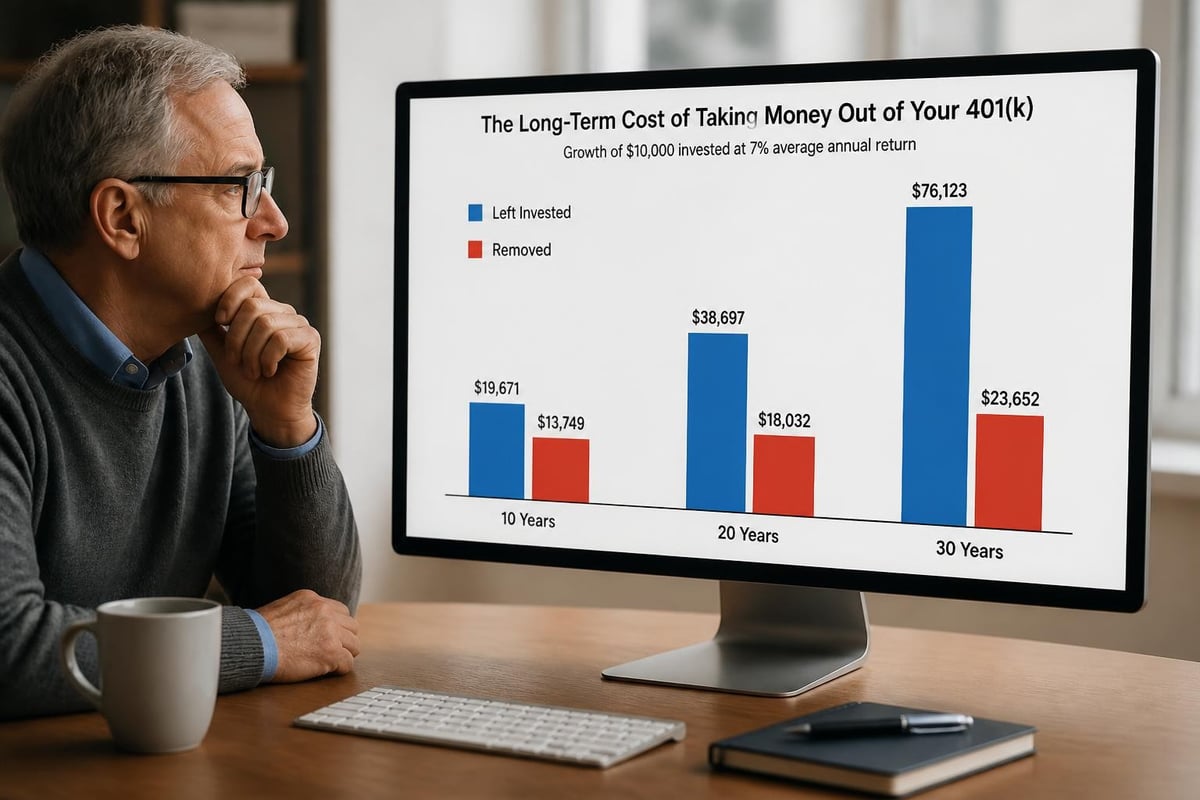
Consider this scenario: If you borrow $20,000 from your 401(k) and the market returns 8% annually over the next five years, you've potentially missed out on approximately $9,400 in investment growth. This opportunity cost represents money that won't be available during your retirement years.
| Factor | Impact on Retirement |
|---|---|
| Lost compound growth | Potentially thousands in forgone earnings |
| Reduced contributions | Many borrowers stop contributing while repaying |
| Market timing risk | Missing market upswings during loan period |
| Double taxation | Pay with after-tax dollars, taxed again at withdrawal |
Personal Loans: External Financing Basics
Personal loans represent borrowed money from banks, credit unions, or consumer lending companies like Standard Financial. These unsecured installment loans don't require collateral and come with fixed repayment schedules.
Qualification Requirements
Lenders evaluate your creditworthiness based on multiple factors before approving a personal loan application. Your credit score, income stability, employment history, and debt-to-income ratio all influence approval decisions and the interest rate you'll receive.
Common personal loan qualifications:
- Credit score minimums (though some lenders work with challenged credit)
- Proof of steady income
- Valid identification and Social Security number
- Reasonable debt-to-income ratio
- U.S. citizenship or permanent residency
Standard Financial specializes in working with borrowers across the credit spectrum, including those who have faced past credit challenges. This flexibility makes personal loans accessible even when traditional banks might decline your application.
Interest Rates and Repayment Structures
Personal loan interest rates in 2026 typically range from 6% to 36%, depending on your credit profile and the lender's risk assessment. Borrowers with excellent credit scores often qualify for the lowest rates, while those rebuilding credit pay higher rates reflecting increased lender risk.
The fixed-rate structure means your monthly payment remains constant throughout the loan term, simplifying budget planning. Most personal loans offer terms between two and seven years, giving you flexibility to balance monthly affordability with total interest costs.
Personal Loan vs 401k Loan: Direct Comparison
When weighing the personal loan vs 401k loan decision, several critical factors deserve examination. Your specific circumstances, financial goals, and risk tolerance should guide your choice.
Credit Impact Considerations
Personal loans:
- Appear on credit reports and affect credit utilization
- On-time payments build positive credit history
- Hard inquiry may temporarily lower score by a few points
- Successful repayment demonstrates creditworthiness
401(k) loans:
- No credit check required for approval
- Don't appear on credit reports
- No impact on credit score (positive or negative)
- Default consequences include taxes and penalties, not credit damage
For borrowers working to rebuild or establish credit, a personal loan offers the advantage of demonstrating responsible debt management to future lenders. Standard Financial reports to major credit bureaus, helping clients build stronger credit profiles through consistent repayment.
Risk Assessment by Employment Status
Your job security plays a dramatically different role when comparing these borrowing options. The personal loan vs 401k loan analysis must account for employment stability and career plans.

If you leave your employer (whether voluntarily or through layoff), most 401(k) plans require full loan repayment within 60 to 90 days. Failure to repay triggers a taxable distribution, meaning you'll owe income taxes on the outstanding balance plus a 10% early withdrawal penalty if you're under age 59½.
Personal loans remain unaffected by employment changes. You continue making the same monthly payments regardless of where you work, providing stability during career transitions.
| Scenario | Personal Loan Impact | 401(k) Loan Impact |
|---|---|---|
| Job change | None – same terms continue | Full repayment often required |
| Layoff/termination | None – same terms continue | Repayment accelerated or taxable event |
| Career gap | Payments continue as scheduled | Default triggers taxes and penalties |
| Promotion/raise | Opportunity to pay extra | Payroll deductions adjust automatically |
Tax Implications and Financial Planning
The tax treatment of these loans differs substantially. Personal loan proceeds aren't taxable income, and personal loan interest isn't tax-deductible for general purposes (though home equity loan interest may be deductible in specific situations).
When considering official IRS retirement loan guidance, the tax picture for 401(k) loans becomes complex. While the loan itself isn't taxable, defaults or unpaid balances at job termination become taxable distributions. Additionally, the after-tax repayment dollars get taxed again during retirement, creating a double-taxation scenario.
Flexibility and Access to Additional Funds
Personal loans provide one-time funding that doesn't affect your future borrowing capacity from retirement accounts. If an emergency arises later, your 401(k) remains available as a backup option.
With a 401(k) loan, you've already tapped your retirement safety net. Taking a second loan (if your plan allows) further depletes your retirement savings and compounds the opportunity cost of lost investment growth.
When a Personal Loan Makes More Sense
Certain financial situations strongly favor personal loans over retirement account borrowing. Understanding these scenarios helps you make decisions aligned with long-term financial health.
Career Transitions and Job Uncertainty
If you're contemplating a career change, starting a business, or working in an industry with high turnover, personal loans offer crucial protection. The accelerated repayment requirement when leaving an employer can create a devastating financial crisis during already-stressful transitions.
Residents of Louisiana, Mississippi, Tennessee, and Georgia facing industry disruptions in sectors like hospitality, retail, or energy extraction particularly benefit from the employment-change protection that personal loans provide.
Credit Building Opportunities
Young professionals establishing credit history or individuals recovering from past financial setbacks gain valuable credit-building benefits from personal loans that 401(k) loans simply cannot provide.
Personal loan credit advantages:
- Positive payment history reported monthly
- Demonstrates installment debt management
- Improves credit mix when combined with revolving credit
- Successful payoff strengthens future loan applications
- Opens doors to better rates on mortgages and auto loans
Preserving Retirement Growth Potential
When markets are performing well or you're in your peak earning years (typically ages 45-60), preserving retirement account growth becomes paramount. Every dollar left invested continues compounding, potentially doubling multiple times before retirement.
Consider consulting resources on responding to financial emergencies that emphasize protecting long-term retirement security even during short-term cash needs.

When a 401(k) Loan Might Be Appropriate
Despite the significant drawbacks, specific circumstances can make 401(k) loans a reasonable choice for some borrowers. The personal loan vs 401k loan equation occasionally tilts toward retirement borrowing.
Severe Credit Challenges
Borrowers with recent bankruptcies, multiple collections, or credit scores below 580 may find personal loan approval impossible or available only at extremely high interest rates exceeding 30%. In these limited cases, a 401(k) loan provides access to funds at reasonable rates.
However, even borrowers with challenged credit should explore options with lenders like Standard Financial that specialize in working with diverse credit profiles before raiding retirement accounts.
Short-Term Needs with Guaranteed Repayment
If you need funds for 6-12 months and have absolute certainty of repayment (such as awaiting a property sale or structured settlement payment), a 401(k) loan minimizes interest costs while preserving most of your retirement growth timeline.
Requirements for this strategy:
- Iron-clad repayment source within one year
- Stable employment with no change anticipated
- Sufficient emergency fund remaining after loan
- Understanding of opportunity cost calculations
Very High Personal Loan Rates
When the interest rate gap between available personal loans and 401(k) loan rates exceeds 15-20 percentage points, borrowers might rationally choose the lower-cost 401(k) option for small loans under $5,000 with brief repayment periods.
This narrow scenario requires careful calculation of true costs, including opportunity cost, and should involve consultation with a financial advisor.
Making Your Decision: Factors to Evaluate
The personal loan vs 401k loan choice demands honest assessment of your complete financial picture, not just immediate borrowing costs.
Questions to Ask Before Deciding
Regarding employment:
- How secure is my current position?
- Am I planning any career changes in the next five years?
- Does my industry face disruption or volatility?
About retirement:
- How many years until I retire?
- What's my current retirement savings trajectory?
- Can I afford to reduce my retirement nest egg?
Concerning credit:
- Would building credit history benefit my future financial goals?
- What personal loan rates do I actually qualify for?
- Am I planning major purchases (home, car) requiring good credit?
Financial stability factors:
- Do I have an adequate emergency fund separate from this need?
- Can I maintain 401(k) contributions while repaying a personal loan?
- What happens if I face another emergency during repayment?
Running the Numbers Honestly
Create a complete cost comparison spreadsheet that includes all variables. For 401(k) loans, calculate lost investment growth using conservative market return estimates. For personal loans, obtain actual rate quotes from multiple lenders rather than relying on advertised ranges.
| Cost Element | Personal Loan Example | 401(k) Loan Example |
|---|---|---|
| Loan amount | $15,000 | $15,000 |
| Interest rate | 12% APR | 6% |
| Term | 5 years | 5 years |
| Monthly payment | $334 | $290 |
| Total interest paid | $5,040 | $2,400 |
| Lost investment growth (8% return) | $0 | $7,065 |
| True total cost | $5,040 | $9,465 |
This example demonstrates how the lower interest rate on a 401(k) loan masks the real financial impact when accounting for opportunity cost.
Alternative Strategies to Consider
Before committing to either option in the personal loan vs 401k loan decision, explore alternatives that might better serve your financial goals.
Building and Using Emergency Funds
The best defense against borrowing needs is a fully-funded emergency account covering three to six months of expenses. If you haven't built this safety net, prioritize doing so after addressing your current financial need.
Home Equity Options
Homeowners with equity may access home equity loans or lines of credit at lower rates than personal loans, with potential tax advantages. However, these secured loans put your home at risk if you cannot repay.
Family Loans with Formal Agreements
Borrowing from family members can provide low-cost financing, but requires formal written agreements specifying repayment terms to protect relationships and create legal clarity.
Credit Union Membership Benefits
Credit unions often offer lower personal loan rates and more flexible underwriting than traditional banks. Many Louisiana, Mississippi, Tennessee, and Georgia residents qualify for membership through employer groups, community organizations, or family connections.
Hardship Withdrawals vs. Loans
Some situations qualify for 401(k) hardship withdrawals rather than loans. Understanding the differences between hardship withdrawals and loans helps you evaluate all available options, though withdrawals typically carry heavier tax consequences than loans.
Regional Considerations for Southern Borrowers
Residents of Louisiana, Mississippi, Tennessee, and Georgia face unique economic conditions that influence the personal loan vs 401k loan analysis.
Economic Volatility and Employment
The Gulf Coast economy experiences periodic disruption from hurricanes, offshore energy price fluctuations, and seasonal tourism variations. This regional volatility makes job security less predictable than in more economically diversified regions.
Personal loans provide crucial protection during these disruptions, as 401(k) loan acceleration during involuntary job loss can compound financial stress during already-difficult circumstances.
Local Lending Options
Standard Financial maintains branch offices throughout these four states, offering personalized service and understanding of regional economic conditions. Local lenders often provide more flexible underwriting and customized solutions than national online lenders unfamiliar with Southern economic patterns.
Cost of Living Advantages
The relatively lower cost of living in many parts of Louisiana, Mississippi, Tennessee, and Georgia means borrowed amounts often stretch further than in high-cost coastal markets. This regional advantage can make personal loan payments more manageable on typical Southern incomes.
The personal loan vs 401k loan decision ultimately depends on your unique financial situation, employment stability, and long-term goals. While 401(k) loans offer lower rates and no credit requirements, they carry substantial hidden costs through lost retirement growth and acceleration risks when changing jobs. Personal loans protect your retirement future, build credit history, and remain unaffected by employment changes, making them the smarter choice for most borrowers despite higher interest rates. If you're facing an unexpected expense and need flexible financing that won't jeopardize your retirement security, Standard Financial offers personal loans designed for real people facing real financial challenges, with branch offices across Louisiana, Mississippi, Tennessee, and Georgia ready to help you find the right solution for your needs.





No comment yet, add your voice below!