

Making an informed decision about borrowing requires understanding exactly what you'll pay each month and over the life of the loan. A personal loan calculator provides this crucial insight by transforming loan terms into concrete numbers you can evaluate before committing to any financing agreement. Whether you're considering financing for home improvements, medical expenses, or education, these digital tools empower you to compare options, budget effectively, and choose the loan that best fits your financial situation. In 2026's competitive lending environment, knowing how to use and interpret calculator results is an essential skill for any prospective borrower.
Understanding Personal Loan Calculator Fundamentals
A personal loan calculator is a digital tool designed to estimate your monthly payment based on three primary inputs: the loan amount you wish to borrow, the annual percentage rate (APR), and the repayment term. The mathematical formulas underlying amortization calculations may seem complex, but the calculator handles these computations instantly, giving you actionable information in seconds.
The core calculation involves determining how principal and interest distribute across equal monthly payments over your chosen term. Each payment consists of both principal reduction and interest charges, with the proportion shifting gradually over time. Early payments apply more toward interest, while later payments chip away more significantly at the principal balance.
Key Inputs That Drive Your Results
When you open a personal loan calculator, you'll encounter several input fields that directly affect your estimated monthly payment:
- Loan amount: The total dollar amount you plan to borrow, typically ranging from $1,000 to $50,000 or more
- Interest rate (APR): The annual percentage rate, which includes interest plus any fees, expressed as a yearly percentage
- Loan term: The repayment period, commonly offered in 12, 24, 36, 48, or 60-month increments
- Additional fees: Some calculators allow you to include origination fees or other upfront costs
Understanding how personal loans function helps you use calculators more effectively. Experian’s overview of personal loan mechanics explains that these unsecured loans typically carry higher rates than secured products but offer flexibility for various purposes.

What Calculator Results Reveal About Your Loan
Beyond the basic monthly payment figure, comprehensive calculators provide several valuable outputs that help you evaluate the true cost of borrowing. These results paint a complete picture of your financial commitment.
Monthly Payment Breakdown
Your estimated monthly payment represents the fixed amount you'll owe each month throughout the loan term. This figure remains constant for the duration of most personal loans, which use fixed-rate structures. For example, if you borrow $10,000 at 8.5% APR for 36 months, your calculator might show a monthly payment of approximately $316.
The consistency of fixed payments simplifies budgeting. You know precisely what amount to set aside each month, making it easier to manage your household finances alongside other obligations.
Total Interest Paid Over Loan Life
One of the most eye-opening calculator outputs is total interest paid. This number shows exactly how much the privilege of borrowing costs you above the principal amount. Using the example above, that $10,000 loan would generate roughly $1,376 in total interest charges over three years.
Comparing this figure across different loan scenarios helps you quantify the savings available through shorter terms or lower rates. A calculator instantly shows that the same $10,000 loan at 8.5% APR paid over 24 months would cost only about $900 in total interest, saving you $476 despite requiring higher monthly payments.
| Loan Term | Monthly Payment | Total Interest | Total Repayment |
|---|---|---|---|
| 24 months | $452 | $900 | $10,900 |
| 36 months | $316 | $1,376 | $11,376 |
| 48 months | $246 | $1,808 | $11,808 |
| 60 months | $204 | $2,240 | $12,240 |
Amortization Schedule Insights
Advanced personal loan calculators generate full amortization schedules showing how each payment divides between principal and interest. Khan Academy’s interactive lesson on amortization helps borrowers understand this concept through visual demonstrations.
These schedules reveal important patterns. Your first payment on a $10,000 loan at 8.5% APR might allocate $71 to interest and $245 to principal. By the final payment, nearly the entire amount reduces principal. This information proves valuable if you're considering early payoff strategies or want to understand your outstanding balance at any point.
Comparing Loan Offers With Calculator Tools
Shopping for the best personal loan requires comparing multiple offers, and calculators make this process straightforward and objective. Rather than relying on lender marketing materials, you can input various scenarios and see exact payment obligations side by side.
Rate Shopping Made Simple
Interest rates vary significantly across lenders based on your creditworthiness, loan amount, and term. A personal loan calculator lets you model different APRs to understand their impact on affordability. The difference between a 7% and 12% rate on a $15,000 loan over 48 months amounts to roughly $67 per month and more than $3,200 in total interest.
When evaluating offers, input each lender's quoted APR, not just the interest rate. The APR incorporates fees and provides a true cost comparison. The Consumer Financial Protection Bureau’s guidance on loan estimates emphasizes this distinction for mortgage shoppers, but the principle applies equally to personal loans.
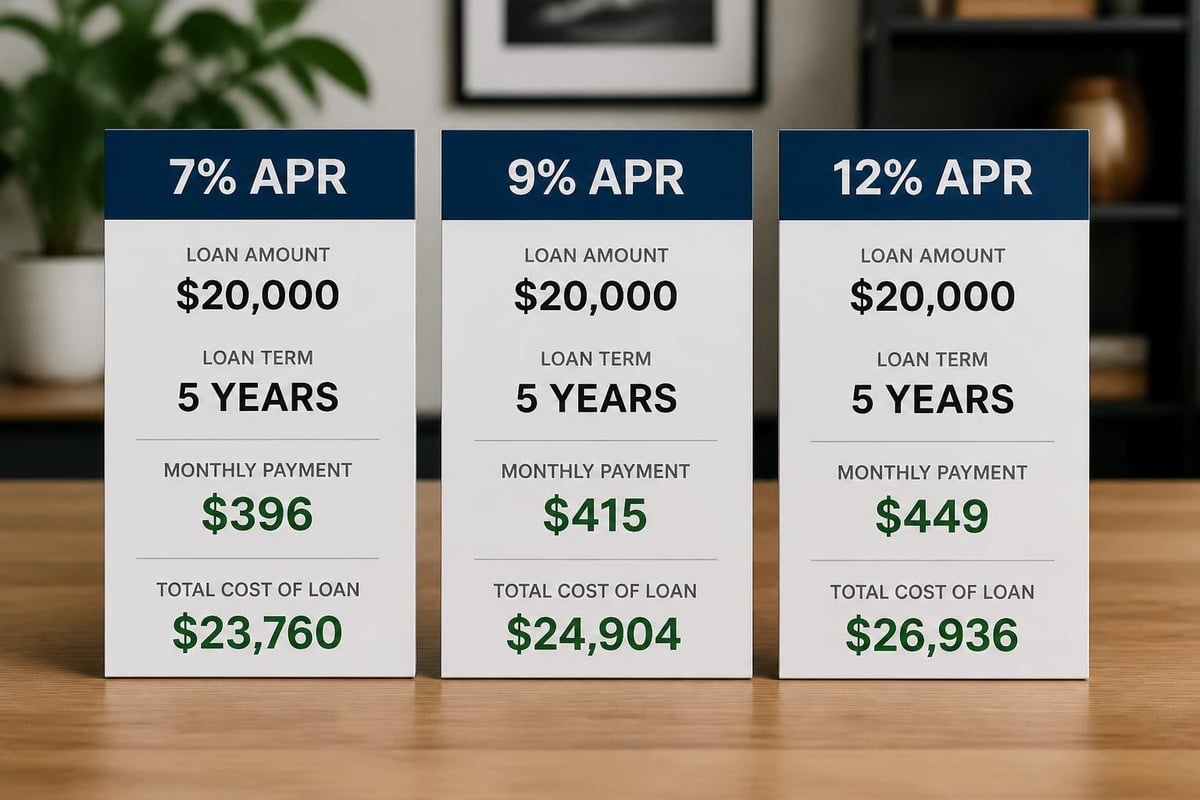
Term Length Trade-Offs
Your chosen repayment term creates a fundamental trade-off between monthly affordability and total cost. Calculators illuminate this balance by showing how extending or shortening the term affects both metrics simultaneously.
Consider these scenarios for a $20,000 loan at 10% APR:
- 36-month term: $645 monthly, $3,220 total interest
- 48-month term: $507 monthly, $4,336 total interest
- 60-month term: $425 monthly, $5,500 total interest
The 60-month option offers the most manageable monthly payment but costs $2,280 more than the 36-month plan. Your calculator helps you decide which balance suits your budget and long-term financial goals.
Fee Impact Assessment
Origination fees, typically ranging from 1% to 6% of the loan amount, can significantly affect your financing cost. Some calculators allow you to include these fees in your analysis, showing whether a loan with a slightly higher rate but no origination fee beats a lower-rate loan with substantial upfront costs.
A $10,000 loan at 8% APR with a 5% origination fee effectively costs you $10,500 from day one. Running both scenarios through your calculator reveals the true payment and cost comparison.
Using Calculators to Budget and Plan
Beyond comparing lender offers, a personal loan calculator serves as a powerful budgeting tool that helps you determine how much you can realistically afford to borrow. Starting with your available monthly budget rather than a desired loan amount creates a more sustainable borrowing plan.
Reverse Engineering Affordable Borrowing
Most calculators let you adjust inputs dynamically to see how changes affect results. If you know you can allocate $300 monthly toward a loan payment, you can experiment with different amounts and terms to find the maximum borrowing capacity within your budget.
At 9% APR over 36 months, a $300 payment supports roughly $9,400 in borrowing. Extending to 48 months increases capacity to about $12,200, while accepting a 24-month term reduces it to approximately $6,900. This reverse approach ensures you don't overextend yourself financially.
Emergency Cushion Planning
Responsible borrowing includes maintaining an emergency fund alongside your loan obligation. Financial experts typically recommend three to six months of essential expenses in readily accessible savings. Your personal loan calculator helps you verify that loan payments leave sufficient income for both regular expenses and continued emergency fund contributions.
If your monthly payment consumes too large a portion of your income, reducing the loan amount or extending the term might be necessary to maintain financial resilience. The FDIC’s consumer resources on credit and loans emphasize the importance of borrowing within your means to avoid default and credit damage.
Early Payoff Scenario Modeling
Many borrowers wonder about the benefits of paying extra toward principal or paying off loans early. While calculators typically show standard amortization, you can model accelerated payoff by calculating the interest savings from a shorter term.
The difference between your desired term and a shorter term represents the potential savings available through extra payments. On a $15,000 loan at 11% APR, choosing 36 months over 48 months saves roughly $1,550 in interest. Making occasional extra principal payments moves you toward the 36-month timeline even if you initially chose 48 months for payment flexibility.
Calculator Limitations and Considerations
While personal loan calculators provide valuable estimates, understanding their limitations ensures you interpret results appropriately and avoid surprises during the actual borrowing process.
Estimates Versus Actual Terms
Calculator results represent estimates based on the inputs you provide. Your actual loan offer may differ based on:
- Credit score verification and underwriting results
- Final APR determination after credit review
- Specific lender fee structures and policies
- Updated rate environments between calculation and application
Always verify final terms in your loan agreement before signing. Consumer Reports’ personal finance guidance recommends carefully reviewing all loan documents to ensure they match your expectations and calculations.
Variable Rate Complexity
Most personal loan calculators assume fixed interest rates that remain constant throughout the loan term. If you're considering a variable-rate loan, standard calculators cannot predict future payment changes resulting from rate adjustments. These products require specialized calculators or manual scenario planning to understand potential payment fluctuations.
Fixed-rate personal loans dominate the market for this reason-they provide payment certainty that calculators can accurately model.
State and Local Variations
Interest rate regulations, fee caps, and lending laws vary by state. A calculator shows mathematical results but cannot account for state-specific consumer protections that might limit fees or rates in Louisiana, Mississippi, Tennessee, or Georgia. Working with local lenders familiar with regional regulations ensures compliance and appropriate pricing.

Advanced Calculator Features Worth Seeking
Basic calculators handle standard payment estimation, but advanced tools offer additional functionality that enhances your decision-making process and loan management capabilities.
Extra Payment Calculators
Specialized calculators show how additional principal payments accelerate payoff and reduce total interest. You can input extra amounts applied monthly, annually, or as one-time payments to see the revised payoff date and interest savings. This feature helps you develop an aggressive debt-reduction strategy when financial circumstances allow.
Refinancing Analysis Tools
If you already have a personal loan, refinancing calculators compare your current obligation against potential new terms. These tools factor in any refinancing fees, remaining balance, and time left on your existing loan to determine whether refinancing generates net savings. The calculation becomes more complex than new loan estimation but provides crucial guidance for refinancing decisions.
Payment Date and First Payment Options
Some calculators let you specify your desired payment date and anticipated loan funding date. This precision shows exactly when payments begin and how many payments you'll make in the first calendar year-valuable information for tax planning and cash flow management.
Mobile and App-Based Calculators
While web-based calculators work well, mobile apps often provide saved scenarios, notification features, and integration with your broader financial planning tools. Bankrate’s loan calculator suite exemplifies comprehensive online tools that work across devices, letting you save comparisons and return to your analysis later.
Maximizing Calculator Value in Your Borrowing Journey
Strategic calculator use transforms borrowing from a reactive process into a proactive, well-planned financial decision. Integrating calculator insights throughout your lending journey creates better outcomes and greater confidence.
Pre-Shopping Credit Improvement
Before applying for loans, use calculators to understand how different APRs affect affordability. This knowledge motivates credit improvement efforts. If the difference between a 12% and 8% rate saves you $50 monthly, you might delay borrowing to raise your credit score and qualify for better terms.
Simple credit improvements-paying down credit cards, disputing errors, making all payments on time-can shift you into better rate tiers within a few months. Running calculator scenarios with target rates shows the concrete financial benefit of this preparation.
Application Timing Strategy
Calculator analysis helps you determine the optimal loan amount and term before contacting lenders. Rather than accepting whatever offer comes first, you approach lenders with specific targets in mind, making it easier to negotiate or walk away from unsuitable offers.
Having calculator printouts or saved scenarios during lender conversations demonstrates financial literacy and seriousness, potentially improving your negotiating position.
Ongoing Loan Management
After securing your loan, periodically revisiting a personal loan calculator helps you evaluate prepayment opportunities and refinancing potential. As you pay down the balance or as market rates change, running new scenarios identifies opportunities to accelerate payoff or reduce costs through refinancing.
Creating a quarterly review habit-checking remaining balance, calculating payoff with extra payments, monitoring market rates-keeps you engaged with debt reduction and prevents complacency about outstanding obligations.
Regional Considerations for Southern Borrowers
Borrowers in Louisiana, Mississippi, Tennessee, and Georgia benefit from understanding how local economic conditions and lending markets affect personal loan accessibility and pricing. Calculator results provide national-standard estimates, but regional factors influence actual offers.
State Rate Regulations
Each state maintains specific usury laws and lending regulations that cap interest rates or fees. These consumer protections mean calculator scenarios showing extremely high rates may not reflect legally available loans in your state. Familiarizing yourself with state-specific limits ensures realistic modeling.
Local Lender Advantages
Regional lenders with physical branches often provide more flexible underwriting for borrowers with past credit challenges compared to national online-only lenders. While calculators show mathematical equivalence between any lenders offering identical terms, the accessibility of those terms varies. Local institutions may approve borrowers whom calculators suggest should qualify but whom algorithmic national lenders decline.
Economic and Employment Factors
Regional employment stability, income levels, and cost of living affect both loan need and repayment capacity. Using a personal loan calculator alongside local economic data creates more accurate affordability assessments. A $400 monthly payment represents different budget impacts in Memphis versus rural Mississippi based on typical household incomes and expenses.
When Calculator Results Should Pause Your Borrowing
Sometimes calculator analysis reveals that borrowing may not serve your best interests under current circumstances. Recognizing these warning signs protects your long-term financial health.
Payment-to-Income Ratios
Financial advisors typically recommend keeping total debt payments below 36% of gross monthly income. If adding your calculated loan payment pushes you above this threshold, you risk overextension. Consider these alternatives:
- Reduce the loan amount to bring payments within acceptable ranges
- Extend the term to lower monthly obligations, accepting higher total cost
- Delay borrowing to increase income or reduce other debts first
- Explore alternative funding through savings, payment plans, or family assistance
Unaffordable Interest Burden
If calculator results show total interest exceeding 40-50% of the principal amount, you're likely looking at unfavorable terms that suggest either a very long term or a very high rate. Such loans indicate predatory pricing or unsuitable term selection. Reassessing your options, improving credit, or seeking alternative lenders becomes essential.
Insufficient Emergency Reserves
Before committing to any loan, ensure you maintain adequate emergency savings. If calculator results show that loan payments would prevent emergency fund contributions or require depleting existing reserves for loan purposes other than true emergencies, postponing borrowing allows you to build financial resilience first.
A personal loan calculator transforms abstract borrowing concepts into concrete numbers that guide smarter financial decisions. By understanding monthly payments, total interest costs, and amortization schedules before you borrow, you gain the clarity needed to choose loan terms that support rather than strain your budget. Whether you're planning home improvements, covering medical expenses, or funding educational goals, Standard Financial provides flexible personal loan solutions across Louisiana, Mississippi, Tennessee, and Georgia-even for clients working to rebuild credit. Visit Standard Financial to discuss your financing needs with experienced lending professionals who understand regional markets and individual circumstances.






No comment yet, add your voice below!