

Understanding how much you can borrow is the critical first step in any financing journey. Whether you need funds for home improvements, medical expenses, education, or consolidating debt, knowing your borrowing capacity helps you plan realistically and avoid applying for amounts you cannot qualify for. Lenders use a consistent set of financial metrics to determine your maximum loan amount, and in 2026, these calculations remain rooted in your income, existing obligations, credit history, and the specific type of loan you seek. This guide explains the key factors that answer the question "how much can I borrow" and provides actionable insights for consumers across the Southeast looking to secure financing.
Income: The Foundation of Borrowing Power
Your gross monthly income forms the starting point for every lender's assessment. Lenders typically count wages, salary, bonuses, self-employment income, retirement distributions, and certain benefits as qualifying income. The more you earn, the more you can generally borrow, but income alone does not determine your limit.
Most consumer lenders apply a simple rule: your total monthly debt payments, including the new loan, should not exceed a certain percentage of your gross monthly income. This ratio ensures you have sufficient funds remaining for living expenses and emergencies after meeting all credit obligations.
Documenting Your Income
Lenders require documentation to verify every dollar of income you claim. Standard documentation includes:
- Pay stubs covering the most recent 30 days
- W-2 forms or 1099 forms for the past two years
- Tax returns with all schedules if you are self-employed
- Bank statements showing regular deposits
If you receive irregular income such as commissions, bonuses, or seasonal work, lenders typically average the past two years to determine a stable monthly figure. Self-employed borrowers face additional scrutiny, as lenders analyze net income after business expenses rather than gross revenue.
Debt-to-Income Ratio: The Gatekeeper Metric
The debt-to-income ratio (DTI) is the single most important number in determining how much you can borrow. DTI measures the percentage of your gross monthly income that goes toward debt payments. Lenders calculate it by dividing your total monthly debt obligations by your gross monthly income, then multiplying by 100.
For example, if you earn $5,000 per month and have $1,500 in monthly debt payments (car loan, credit cards, student loans, and the proposed new loan), your DTI is 30 percent. Most consumer lenders cap DTI at 36 to 43 percent, though some specialized programs allow higher ratios.

What Counts as Debt?
Lenders include these monthly obligations in your DTI calculation:
- Minimum credit card payments
- Auto loans and leases
- Student loan payments
- Personal loans and installment debt
- Mortgage or rent (for some loan types)
- Alimony and child support
- Co-signed loans
Utilities, insurance (except mortgage insurance), groceries, and other living expenses do not count toward DTI. This distinction is crucial because it means you need to budget separately for these costs even if your DTI is acceptable.
Maximum Loan Calculation Based on DTI
If you want to know how much you can borrow, start by calculating your maximum allowable monthly debt payment. Multiply your gross monthly income by the lender's maximum DTI (often 40 percent), then subtract your current monthly debt obligations. The result is the maximum monthly payment you can afford for a new loan.
For instance, if you earn $4,500 per month and the lender allows 40 percent DTI, your maximum total debt payment is $1,800. If you currently pay $900 monthly toward existing debts, you can afford up to $900 for a new loan. Using a loan calculator with the lender's interest rate and term, you can convert that $900 monthly payment into a maximum loan amount.
Credit Score Impact on Borrowing Limits
Your credit score does not directly set how much you can borrow, but it profoundly affects the interest rate and terms you receive. A higher rate means a larger portion of each payment goes to interest, reducing the principal amount you can afford within your DTI limit.
Credit Score Tiers and Their Effects
| Credit Score Range | Typical Rate Impact | Borrowing Effect |
|---|---|---|
| 740+ | Lowest available rates | Maximum borrowing power |
| 670-739 | Moderate rates | Good borrowing capacity |
| 580-669 | Higher rates | Reduced loan amounts for same payment |
| Below 580 | Highest rates or denial | Significantly limited capacity |
Borrowers with credit scores below 670 often find that the higher interest rates compress how much they can borrow. For example, a $500 monthly payment might support a $25,000 loan at 7 percent APR over five years, but only $22,000 at 12 percent APR for the same term and payment.
Past Credit Issues and Borrowing Capacity
Many consumers with past credit challenges ask "how much can I borrow after bankruptcy or foreclosure?" The answer depends on how much time has passed and how your credit has recovered. Most lenders require at least two years since a bankruptcy discharge or foreclosure before considering new applications, and initial loan amounts may be conservative even with qualifying income and DTI.
Specialized lenders, including those focused on near-prime borrowers, evaluate compensating factors such as stable employment, significant down payments, or co-borrowers to offset credit weaknesses. This approach can restore borrowing capacity sooner than waiting for credit scores to fully rebound.
Loan Type and Purpose Affect Limits
The type of loan you seek introduces additional constraints on how much you can borrow. Secured loans (backed by collateral) generally allow larger amounts than unsecured personal loans, while government-backed programs impose statutory limits.
Personal Loan Limits
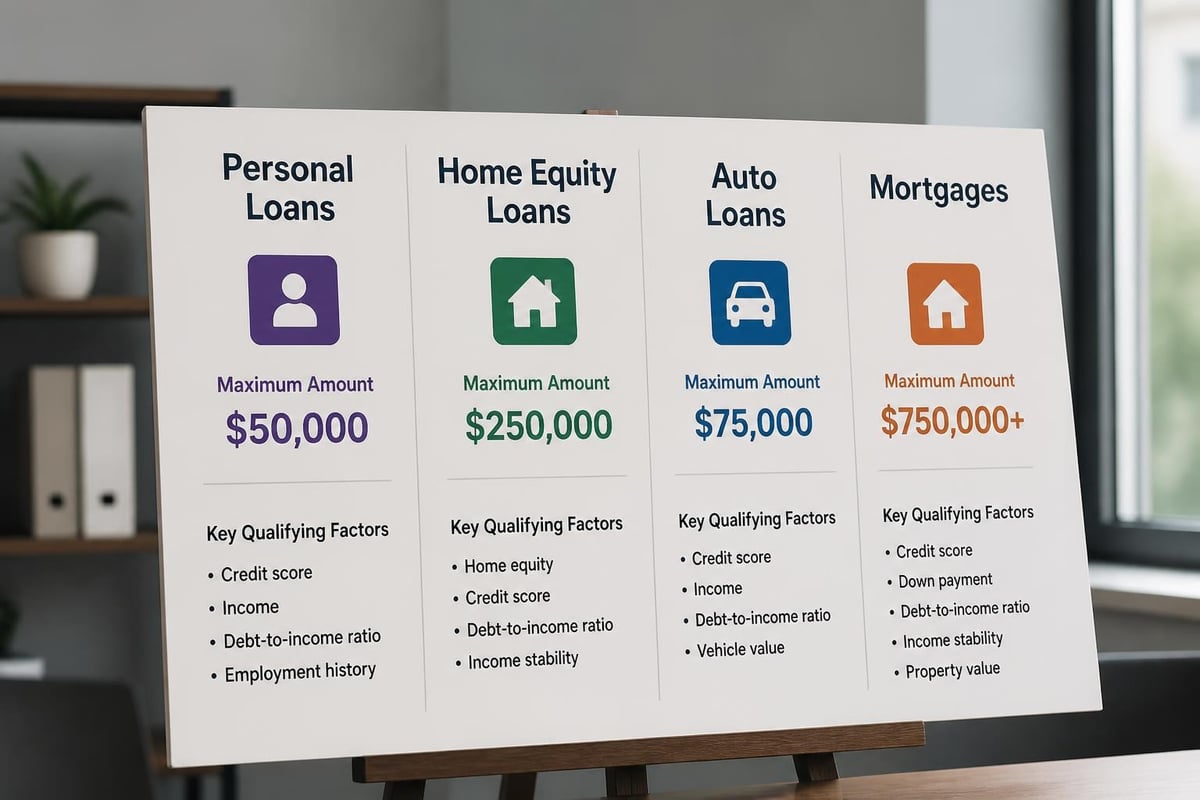
Unsecured personal loans typically range from $1,000 to $50,000, though most consumer lenders cap individual loans at $25,000 to $35,000. Your actual limit depends on your income, DTI, and credit profile. Lenders may offer higher amounts if you provide collateral such as a vehicle or savings account.
Common personal loan uses and typical amounts include:
- Home improvements: $5,000 to $35,000
- Medical expenses: $2,000 to $20,000
- Debt consolidation: $5,000 to $40,000
- Educational expenses: $3,000 to $25,000
Mortgage and Home Loan Limits
If you are wondering how much you can afford when buying a home, the answer involves both your DTI and government-imposed loan limits. Conventional mortgages backed by Fannie Mae and Freddie Mac have conforming loan limits that vary by county. For 2026, the baseline conforming limit is $806,500 in most areas, with higher limits in expensive markets.
FHA loans, popular among first-time buyers and those with lower credit scores, also have county-specific limits. Veterans using VA-backed financing should consult the VA home loan program to understand how their entitlement affects borrowing capacity.
Collateral and Loan-to-Value Ratios
For secured loans, lenders limit how much you can borrow based on the collateral's value. The loan-to-value (LTV) ratio expresses the loan amount as a percentage of the asset's appraised value or purchase price.
Common LTV Limits by Loan Type
| Loan Type | Typical Maximum LTV | Example |
|---|---|---|
| Auto loan (new) | 100-110% | $30,000 car = $30,000-$33,000 loan |
| Auto loan (used) | 80-100% | $15,000 car = $12,000-$15,000 loan |
| Home equity loan | 80-85% | $300,000 home, $200,000 owed = $40,000-$55,000 available |
| Cash-out refinance | 80% | $300,000 home = $240,000 total loan |
Lower LTV ratios reduce lender risk and often qualify you for better interest rates. If you want to borrow more against an asset, increasing your down payment or equity position expands your capacity.
Employment Stability and Borrowing Confidence
Lenders assess your employment history to gauge income stability. Most require at least two years in the same field, though not necessarily with the same employer. Frequent job changes, employment gaps, or recent career shifts can reduce how much you can borrow or require additional documentation.
Self-employed borrowers and those with non-traditional income face stricter scrutiny. Lenders average income over two years and may discount irregular earnings. If you recently became self-employed, you may need to wait until you have two years of tax returns showing stable or growing income before qualifying for your maximum borrowing amount.
Strengthening Your Employment Profile
To maximize how much you can borrow:
- Avoid changing jobs during the application process
- Document all income sources thoroughly
- Provide letters from employers confirming bonuses or commissions
- Maintain at least six months of cash reserves if self-employed
Regional and Local Market Factors
Borrowing limits can vary by geography due to differences in cost of living, housing prices, and state regulations. Lenders operating in Louisiana, Mississippi, Tennessee, and Georgia adjust their underwriting to reflect local economic conditions and competition.
For instance, home loan limits in metropolitan areas like Memphis or Atlanta may be higher than in rural counties, reflecting property values. Similarly, some states impose interest rate caps or consumer protection laws that influence maximum loan amounts and terms.
Market Trends Affecting 2026 Borrowing
Consumer credit data shows that lenders have maintained steady underwriting standards through 2026, with DTI and credit score requirements holding relatively constant. However, interest rate fluctuations continue to impact how much consumers can borrow for a given monthly payment.
When rates rise, borrowing capacity decreases even if income and DTI remain unchanged. Monitoring rate trends and locking rates when favorable can preserve your maximum borrowing power.

Specialized Loan Programs and Alternative Limits
Beyond traditional personal and mortgage loans, specialized programs offer different borrowing limits tailored to specific needs.
Student Loans
Federal student loans have annual and aggregate limits based on dependency status and grade level. Dependent undergraduates can borrow $5,500 to $7,500 per year, while graduate students and independent undergraduates have higher limits. Private student loans typically require a creditworthy co-borrower and base limits on the cost of attendance minus other aid.
Small Business Loans
Entrepreneurs asking "how much can I borrow for my business" should explore SBA-backed programs. The 7(a) and 504 loan programs have increased limits in recent years, with cumulative borrowing caps reaching $10 million for eligible businesses. Personal income and credit still factor into approval, but business cash flow and collateral play larger roles.
Home Equity Lines of Credit
HELOCs provide revolving credit secured by home equity, with limits typically set at 85 percent LTV. If your home is worth $250,000 and you owe $150,000, you could access up to $62,500 ($250,000 × 0.85 = $212,500 minus $150,000 owed). Your DTI and credit score determine whether you qualify for the full amount.
Improving Your Borrowing Capacity
If your current financial situation limits how much you can borrow, several strategies can increase your capacity over time.
Reduce Existing Debt
Paying down credit cards, auto loans, or other obligations lowers your DTI and frees up capacity for new borrowing. Even small reductions in monthly payments can meaningfully increase your maximum loan amount.
Increase Your Income
Taking on additional work, negotiating raises, or adding a co-borrower with qualifying income all expand how much you can borrow. Lenders typically allow you to combine incomes if co-borrowers share responsibility for the loan.
Improve Your Credit Score
Raising your score from 650 to 720 can reduce your interest rate by several percentage points, allowing you to borrow thousands more for the same monthly payment. Focus on paying bills on time, reducing credit utilization, and correcting errors on your credit report.
Choose the Right Loan Term
Extending the repayment period lowers your monthly payment, which can help you qualify for a larger loan amount within your DTI limit. However, longer terms increase total interest paid, so balance monthly affordability with overall cost.
Calculating Your Personal Borrowing Limit
To determine exactly how much you can borrow, follow this process:
- Calculate your gross monthly income from all sources
- List all monthly debt obligations (minimums on credit cards, loan payments, etc.)
- Determine the lender's maximum DTI (often 36-43 percent for personal loans)
- Multiply your income by the maximum DTI percentage to find your maximum total debt payment
- Subtract current monthly debts to find your available payment capacity
- Use a loan calculator with the lender's rate and desired term to convert the monthly payment into a loan amount
For example, with $6,000 monthly income, $1,200 in existing debt, and a 40 percent DTI limit:
- Maximum total debt: $6,000 × 0.40 = $2,400
- Available for new loan: $2,400 – $1,200 = $1,200/month
- At 9 percent APR for 5 years, $1,200/month supports approximately $59,000
This calculation provides a realistic estimate, though final approval depends on credit review and lender-specific policies.
Understanding how much you can borrow empowers you to make informed financing decisions and pursue your goals with confidence. Your income, debt-to-income ratio, credit history, and the specific loan type all interact to set your maximum borrowing capacity. If you are in Louisiana, Mississippi, Tennessee, or Georgia and need flexible financing for home improvements, medical expenses, education, or other personal needs, Standard Financial can help you explore your options and find a solution that works for your situation, even if you have faced credit challenges in the past.




No comment yet, add your voice below!