

Understanding your credit card approval chances can make the difference between a successful application and a frustrating rejection. Whether you're rebuilding your financial profile or simply seeking better terms, knowing what lenders evaluate helps you prepare effectively. Credit card issuers use sophisticated algorithms and established criteria to assess risk, and these same principles apply across consumer lending products. By understanding these factors, you can position yourself for success in 2026's competitive lending environment.
Key Factors That Determine Credit Card Approval Chances
Credit card issuers evaluate multiple data points when reviewing applications, and each factor carries significant weight in the final decision. Your credit card approval chances depend on how well you meet these combined criteria rather than excelling in just one area.
Credit Score Requirements
Your credit score serves as the foundation of any credit decision. Understanding credit score ranges helps you target appropriate products and set realistic expectations for approval.
Credit score categories include:
- Excellent (750+): Qualifies for premium rewards cards and lowest rates
- Good (700-749): Access to most standard cards with competitive terms
- Fair (650-699): Limited options, often secured or starter cards
- Poor (below 650): Primarily secured cards or credit-builder products
Lenders don't just look at your current score. They examine the trajectory of your credit profile over time, seeking patterns of improvement or decline. A score that has climbed 50 points over six months demonstrates positive financial behavior, while a declining score raises red flags regardless of the current number.
Income Verification and Stability
Credit card approval criteria include verifiable income that demonstrates your ability to repay borrowed funds. Issuers want to see consistent income sources that exceed your existing financial obligations.
Employment history matters significantly. Someone who has worked at the same company for three years presents less risk than an applicant who changes jobs every six months, even if their current income is higher. Self-employed individuals and those with variable income may need to provide additional documentation, such as tax returns or bank statements showing regular deposits.

| Income Factor | What Lenders Assess | Impact on Approval |
|---|---|---|
| Amount | Monthly gross income | High – determines credit limit |
| Stability | Employment duration | Medium – indicates reliability |
| Source | W-2 vs. self-employed | Medium – affects documentation |
| Trends | Income growth over time | Low – shows financial trajectory |
Credit History Depth and Payment Patterns
Your credit history tells a story about your financial responsibility over time. Credit card approval chances improve substantially when you can demonstrate years of successful credit management rather than just months.
Length of Credit History
Newer credit users face an inherent challenge because they lack the track record that reassures lenders. Even with excellent payment habits, someone with only one year of credit history will find their credit card approval chances limited compared to someone with five or ten years of demonstrated responsibility.
The average age of your accounts matters as much as your oldest account. Opening multiple new accounts in a short period lowers your average account age, which can temporarily reduce your credit card approval chances even if you're managing everything perfectly.
Payment History Performance
Nothing influences your credit card approval chances more than your payment history. Factors that credit card issuers consider include not just whether you've paid on time, but how recently any late payments occurred.
Payment history considerations:
- Recency of late payments (last 6 months vs. 2 years ago)
- Severity of delinquencies (30 days vs. 90+ days)
- Frequency of missed payments (isolated incident vs. pattern)
- Type of accounts affected (credit cards, installment loans, mortgages)
A single 30-day late payment from three years ago carries minimal weight if you've maintained perfect payment history since. However, multiple recent late payments create serious obstacles to approval, regardless of your current credit score.
Debt-to-Income Ratio and Credit Utilization
How you manage existing debt significantly impacts your credit card approval chances. Lenders want to see that you're not overextended, which they measure through two related but distinct metrics.
Calculating Your Debt-to-Income Ratio
Your debt-to-income ratio (DTI) compares your monthly debt payments to your gross monthly income. Most credit card issuers prefer to see a DTI below 43%, though some may approve applicants with higher ratios if other factors are strong.
To calculate your DTI, add all monthly debt payments including credit cards, auto loans, student loans, mortgages, and personal loans. Divide this total by your gross monthly income, then multiply by 100 to get a percentage. A monthly income of $5,000 with $1,500 in debt payments yields a 30% DTI, which generally supports favorable credit card approval chances.
Credit Utilization Management
Credit utilization measures how much of your available credit you're actually using. Six key factors affecting credit card approval include maintaining utilization below 30% across all revolving accounts.
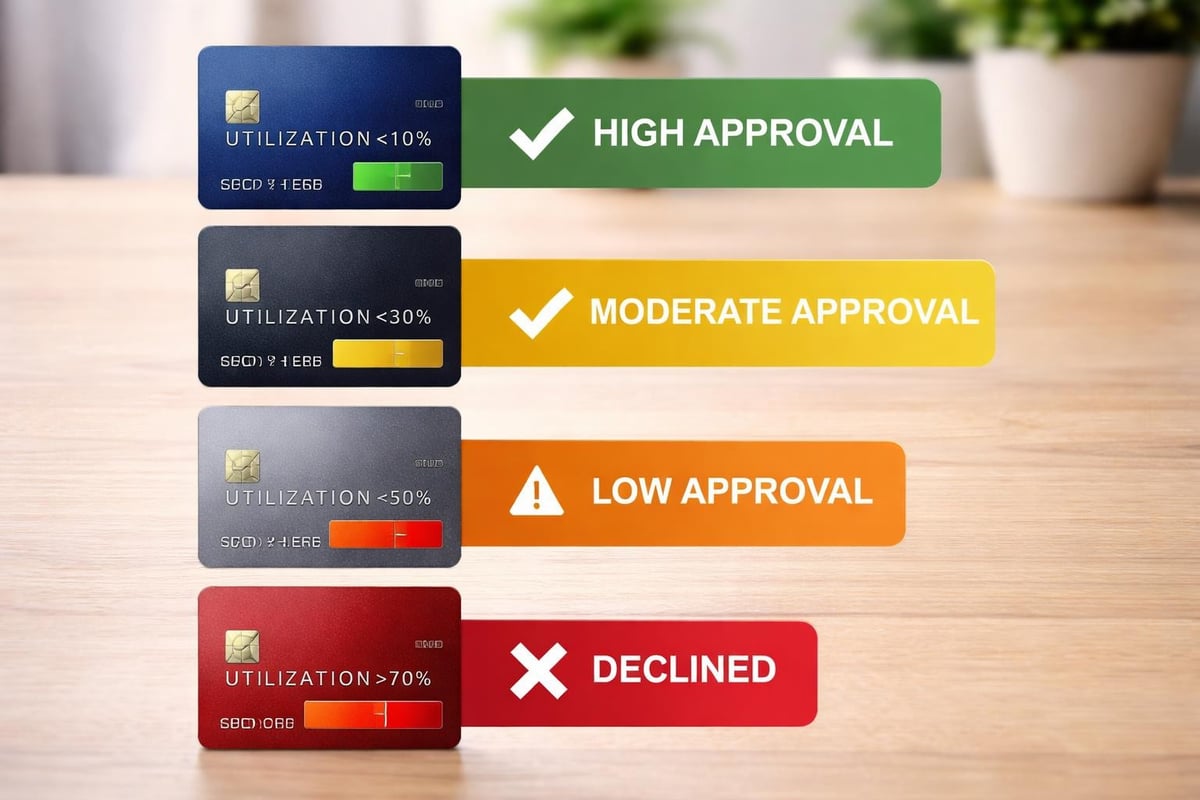
| Utilization Rate | Credit Impact | Approval Implications |
|---|---|---|
| Under 10% | Excellent | Maximizes approval chances |
| 10-30% | Good | Neutral to positive effect |
| 30-50% | Fair | May reduce credit limits offered |
| 50-70% | Poor | Significantly hurts approval odds |
| Over 70% | Very Poor | Major obstacle to approval |
Recent Credit Activity and Hard Inquiries
Your recent credit-seeking behavior provides lenders with insights into your financial stress level and risk profile. Multiple applications in a short timeframe can damage your credit card approval chances substantially.
Understanding Hard Inquiries
Each credit card application generates a hard inquiry on your credit report. While a single inquiry typically reduces your score by fewer than five points, multiple inquiries suggest financial desperation to lenders. Six hard inquiries in three months raises serious concerns, even if your credit score remains in the good range.
Hard inquiries remain on your credit report for two years but only affect your score for the first 12 months. Their impact diminishes over time, with inquiries from the past six months carrying the most weight in approval decisions.
Strategic Application Timing
Space your credit applications at least three to six months apart to minimize the negative impact on your credit card approval chances. This patient approach demonstrates financial stability and allows your credit score to recover between applications.
Application timing best practices:
- Wait 3 months minimum between credit card applications
- Limit applications to 2-3 per year maximum
- Avoid applying during major loan processes (mortgage, auto)
- Consider pre-qualification tools that use soft inquiries
Special Circumstances That Affect Approval
Beyond standard metrics, certain situations create unique challenges or opportunities for improving your credit card approval chances. Understanding these circumstances helps you navigate the application process more effectively.
Banking Relationships and Approval Odds
Existing relationships with financial institutions can improve your credit card approval chances significantly. Banks view current customers as lower risk because they have access to additional information about your financial behavior, including checking account balances, deposit history, and overdraft patterns.
Customers with checking and savings accounts, direct deposit arrangements, or existing loans at a financial institution often receive preferential treatment in the approval process. Some issuers even offer pre-approved credit card offers to established customers, virtually guaranteeing approval if you accept.
Reasons for Rejection Despite Good Credit
Why good credit doesn’t guarantee approval involves factors beyond your credit score. High income volatility, recent job changes, or geographic considerations can lead to denials even with excellent credit.
Some issuers maintain internal policies limiting the number of accounts they'll extend to a single individual. If you already have three credit cards from the same bank, they may deny your fourth application regardless of your creditworthiness. Similarly, issuers sometimes reject applications from individuals who live outside their preferred geographic footprint.

Improving Your Credit Card Approval Chances
Taking proactive steps to strengthen your credit profile can transform your credit card approval chances from uncertain to highly favorable. These strategies require time and consistency but deliver measurable results.
Building Credit Strategically
Steps to improve approval chances begin with becoming an authorized user on someone else's account or opening a secured credit card. These entry-level options help establish credit history when traditional cards remain out of reach.
Credit-building sequence:
- Obtain a secured credit card with monthly reporting
- Maintain utilization under 10% with on-time payments
- Become an authorized user on a well-managed account
- After 6-12 months, apply for a starter unsecured card
- Continue perfect payment history while gradually adding accounts
Addressing Credit Report Errors
Review your credit reports from all three bureaus (Equifax, Experian, TransUnion) at least annually. Errors occur frequently and can unfairly damage your credit card approval chances. Dispute any inaccuracies immediately through the bureau's online portal, providing supporting documentation.
Common errors include accounts that don't belong to you, incorrect payment statuses, outdated account information, and duplicate entries. Correcting these mistakes can increase your credit score by 20-50 points, substantially improving your approval odds.
Reducing Existing Debt
Paying down balances improves both your credit utilization and debt-to-income ratio simultaneously. Prioritize high-utilization accounts first, as these have the greatest impact on your credit score. Even reducing utilization from 45% to 29% can trigger score increases that improve your credit card approval chances.
Consider the avalanche or snowball method for systematic debt reduction. The avalanche method targets highest-interest debt first, saving money over time. The snowball method focuses on smallest balances first, providing psychological wins that maintain motivation.
How Credit Limits Are Determined
Understanding how credit card limits are set reveals important connections to the approval process itself. The same factors that determine approval also influence your initial credit limit.
Issuers consider your income, existing debt obligations, credit history, and payment patterns when setting limits. Someone approved with excellent credit and high income might receive a $15,000 limit, while another applicant with fair credit and moderate income might receive $2,000, even though both were approved for the same card.
Your initial credit limit isn't permanent. Demonstrating responsible usage over six to twelve months often leads to automatic increases. You can also request increases after establishing a positive track record, further improving your overall credit profile and future credit card approval chances.
Timing Your Application for Maximum Success
Strategic timing can significantly influence your credit card approval chances. Apply when your financial profile appears strongest, not when you're most desperate for credit.
Optimal application timing includes:
- After receiving a salary increase or promotion
- Following six months of perfect payment history
- When credit utilization drops below 20%
- After resolving errors on your credit report
- During promotional periods offering enhanced approval odds
Avoid applying during financially stressful periods, immediately after job changes, or while carrying high balances. Wait until your situation stabilizes and your credit reports reflect your improved circumstances. This patience pays dividends in both approval likelihood and the terms you receive.
Application Best Practices
How you complete the application itself affects your credit card approval chances. Accurate, complete information processed through secure channels demonstrates attention to detail and reduces processing delays.
Provide exact information matching your credit reports, including your legal name, current address, and employment details. Inconsistencies between your application and credit file trigger additional verification steps that slow processing and may lead to denial.
Report your income accurately but comprehensively. Include salary, bonuses, investment income, retirement distributions, alimony, and other regular income sources. Underreporting income unnecessarily limits your approval chances and potential credit limit.
Regional Considerations for Consumer Lending
For residents of Louisiana, Mississippi, Tennessee, and Georgia, local economic conditions and regional lending patterns influence credit card approval chances differently than national averages. Regional lenders often understand local employment markets, seasonal income variations, and economic cycles better than national issuers.
Applicants in these states benefit from relationships with community-focused financial institutions that consider factors beyond standardized credit scores. Local lenders may show greater flexibility for applicants with non-traditional income sources or those recovering from past credit challenges common in regional economic downturns.
Building credit through smaller, regional accounts before applying for major national credit cards creates a foundation that improves overall approval chances. This stepped approach acknowledges that credit building is a journey, not a single event.
Understanding what affects your credit card approval chances empowers you to make informed decisions and take strategic action to improve your financial position. While credit cards serve specific purposes, many consumers find that personal loans offer greater flexibility for major expenses, debt consolidation, or credit building. Standard Financial specializes in helping clients throughout Louisiana, Mississippi, Tennessee, and Georgia access financing options suited to their unique situations, including those working to rebuild their credit. Whether you need funds for home improvements, medical expenses, or education, our team provides personalized guidance and flexible solutions designed around your financial goals.







No comment yet, add your voice below!