

When unexpected expenses arise, choosing the right borrowing option can significantly impact your financial health for months or even years to come. Understanding the personal loan vs payday loan decision is crucial for consumers across Louisiana, Mississippi, Tennessee, and Georgia who need access to quick cash. While both products provide funding when you need it, they differ dramatically in cost, repayment structure, and long-term financial consequences. This comprehensive guide breaks down everything you need to know to make an informed choice that aligns with your circumstances and goals.
Understanding Personal Loans: Structure and Benefits
Personal loans represent installment credit products offered by banks, credit unions, and consumer finance companies. These loans provide a lump sum of money that borrowers repay over a fixed term, typically ranging from 12 to 84 months.
How Personal Loans Work
When you apply for a personal loan, lenders evaluate your credit history, income, and debt-to-income ratio to determine eligibility and rates. Approval decisions generally take anywhere from a few hours to several business days, depending on the lender and documentation requirements.
Once approved, you receive the full loan amount in one disbursement. You then make fixed monthly payments that include both principal and interest until the loan is fully repaid. This predictable structure allows for better budgeting and financial planning.
Key characteristics of personal loans include:
- Loan amounts typically ranging from $1,000 to $50,000
- Annual Percentage Rates (APRs) between 6% and 36%, depending on creditworthiness
- Fixed monthly payments for the life of the loan
- Longer repayment terms spanning multiple months or years
- Credit reporting to major bureaus, which can help build positive credit history

Advantages of Choosing Personal Loans
Personal loans offer several distinct benefits that make them suitable for larger expenses or debt consolidation. The extended repayment period spreads costs over time, making monthly obligations more manageable for household budgets.
Lower overall costs represent perhaps the most significant advantage. Because personal loans carry substantially lower APRs than payday alternatives, borrowers pay less in total interest charges. A $5,000 personal loan at 12% APR repaid over 36 months costs approximately $830 in interest, compared to potentially thousands in fees for repeatedly rolling over payday loans.
According to FDIC consumer lending guidance, responsible personal loan products include clear disclosures, reasonable rates, and ability-to-repay underwriting. These protections help ensure borrowers can afford their payments without falling into debt traps.
Additional advantages include:
- Building credit history through on-time payments
- Flexibility to use funds for various purposes
- No collateral required for unsecured personal loans
- Potential to refinance for better terms later
- Protection under federal lending regulations
Payday Loans Explained: Costs and Risks
Payday loans are short-term, small-dollar loans designed to provide quick cash until your next paycheck arrives. These products typically involve borrowing small amounts-usually $500 or less-for two weeks to one month.
The Payday Loan Process
The payday loan application process is notably simpler than traditional lending. Borrowers typically need only proof of income, a bank account, and identification. The Consumer Financial Protection Bureau defines payday loans as short-term, high-cost loans that require repayment in full, plus fees, on the borrower's next payday.
Here's how the typical payday loan transaction unfolds:
- Application: Complete a brief form in-store or online
- Approval: Receive near-instant approval with minimal credit checks
- Funding: Get cash or direct deposit within hours or one business day
- Repayment: Authorize lender to withdraw full amount plus fees on your next payday
- Rollover option: If you cannot repay, roll the loan over for additional fees
The True Cost of Payday Loans
The personal loan vs payday loan cost comparison reveals a stark difference. Payday lenders charge fees rather than traditional interest rates, but these fees translate to extremely high APRs when annualized.
| Loan Feature | Typical Payday Loan | Personal Loan |
|---|---|---|
| Loan Amount | $300-$500 | $1,000-$50,000 |
| Term Length | 2 weeks | 12-84 months |
| Typical Fee/Rate | $15 per $100 borrowed | 6%-36% APR |
| Effective APR | 400%+ | 6%-36% |
| Payment Structure | Lump sum due | Fixed monthly installments |
A typical two-week payday loan charging $15 per $100 borrowed carries an APR of approximately 391%. If you borrow $500, you'll owe $575 in just two weeks-a $75 charge for borrowing money for 14 days.
The Debt Cycle Problem
Research from the Federal Reserve’s 2026 report on household economic well-being shows that many payday loan borrowers struggle to repay loans without reborrowing. Data indicates that the majority of payday loans go to borrowers who renew loans multiple times throughout the year.
This cycle occurs because borrowers cannot afford the lump-sum repayment after covering regular expenses. When the loan comes due, they face a choice: default and incur additional fees and potential legal action, or roll over the loan by paying another fee to extend the due date.
Common rollover scenarios include:
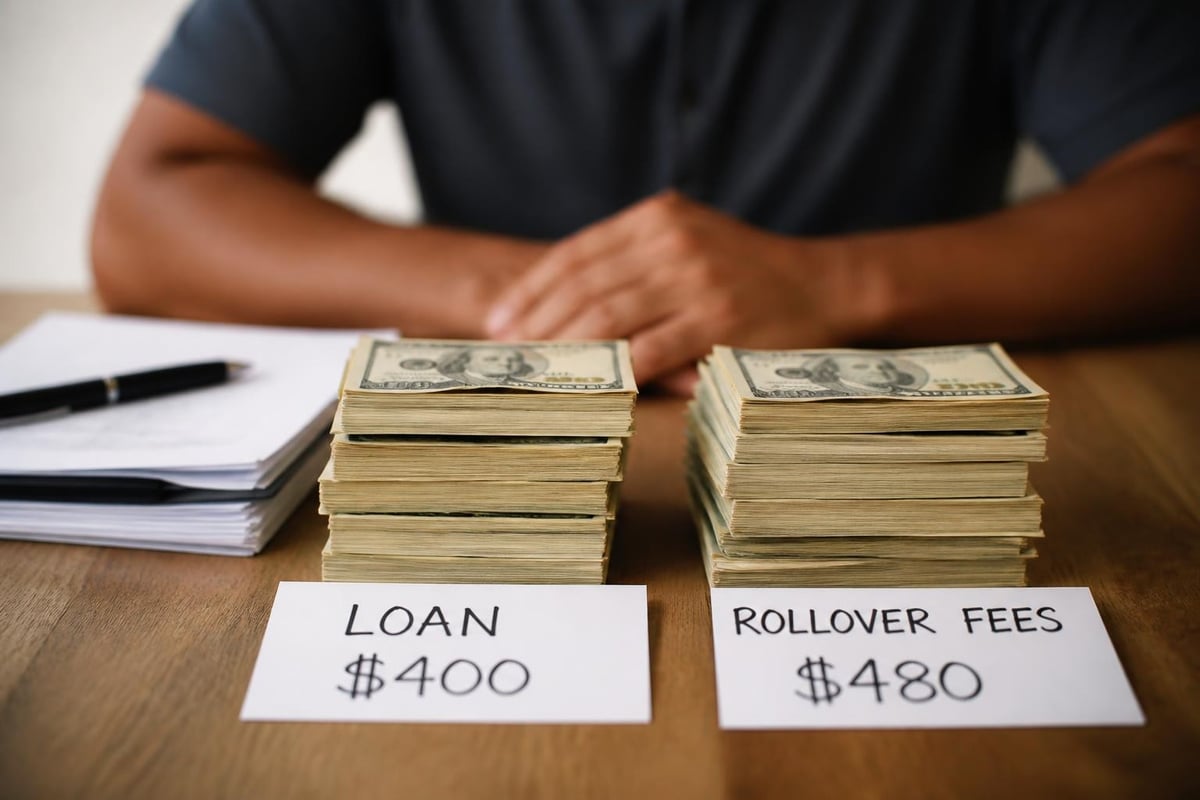
- Borrowing $400 with an $60 fee due in two weeks
- Unable to repay $460, paying $60 to roll over for another two weeks
- Repeating this cycle multiple times, paying $60 every two weeks
- After eight renewals (16 weeks), paying $480 in fees alone on a $400 loan
Regulatory Landscape and Consumer Protections
The personal loan vs payday loan regulatory environment differs significantly, with payday products facing increased scrutiny and reform efforts at both federal and state levels.
Federal Payday Loan Regulations
The Consumer Financial Protection Bureau has implemented rules to address predatory payday lending practices. New federal protections for payday and installment loans that took effect in 2025 require lenders to verify borrowers' ability to repay loans while meeting basic living expenses.
These regulations aim to prevent the debt trap cycle by:
- Requiring ability-to-repay assessments before origination
- Limiting consecutive loan renewals
- Restricting payment withdrawal attempts from borrower bank accounts
- Mandating clear disclosure of costs and terms
The Federal Trade Commission also provides oversight on payday lending practices, focusing on deceptive marketing, unauthorized account charges, and unfair collection practices.
State-Level Protections
State laws governing payday lending vary dramatically across the country. Some states have effectively banned payday loans through interest rate caps, while others allow the industry to operate with minimal restrictions.
According to the National Consumer Law Center’s 2024 report on predatory installment lending, states with stronger consumer protections see better outcomes for borrowers, including lower default rates and fewer debt-related complaints.
States with strong protections typically:
- Cap interest rates at 36% APR or lower
- Limit loan sizes and terms
- Prohibit rollovers or limit renewal frequency
- Require extended payment plans for struggling borrowers
- License and monitor lenders closely
Louisiana, Mississippi, Tennessee, and Georgia each have different regulatory frameworks. Consumers should research their state's specific rules and protections before borrowing.
When Each Loan Type Makes Sense
The personal loan vs payday loan decision depends heavily on your specific circumstances, financial needs, and ability to repay.
Situations Favoring Personal Loans
Personal loans work best for planned expenses or debt consolidation where you need a larger sum and can afford consistent monthly payments. These situations include:
- Home improvements: Financing kitchen renovations, roof repairs, or HVAC replacements
- Medical expenses: Covering surgery costs, dental work, or ongoing treatment not covered by insurance
- Education expenses: Paying for vocational training, certifications, or tuition costs
- Debt consolidation: Combining multiple high-interest debts into one lower-rate payment
- Major purchases: Funding a wedding, moving expenses, or essential vehicle repairs
Personal loans excel when you have time to apply, compare offers, and want to minimize total borrowing costs. Even borrowers with past credit challenges can often qualify for personal loans, though rates may be higher.
Scenarios Where Payday Loans Might Be Considered
Payday loans are designed for emergency situations where you need very small amounts immediately and can repay in full within two weeks. However, safer alternatives almost always exist.
If considering a payday loan:
- Ensure you can repay the full amount plus fees on the due date
- Confirm you have no other options available
- Understand the total cost and consequences of non-payment
- Avoid rolling over or renewing the loan
The reality is that situations genuinely requiring payday loans are rare. Most financial emergencies are better addressed through emergency funds, credit cards, personal loans, or assistance programs.
Alternatives to Both Traditional Options
Beyond the personal loan vs payday loan comparison, several alternatives deserve consideration when you need quick funding.
Employer-Based Programs
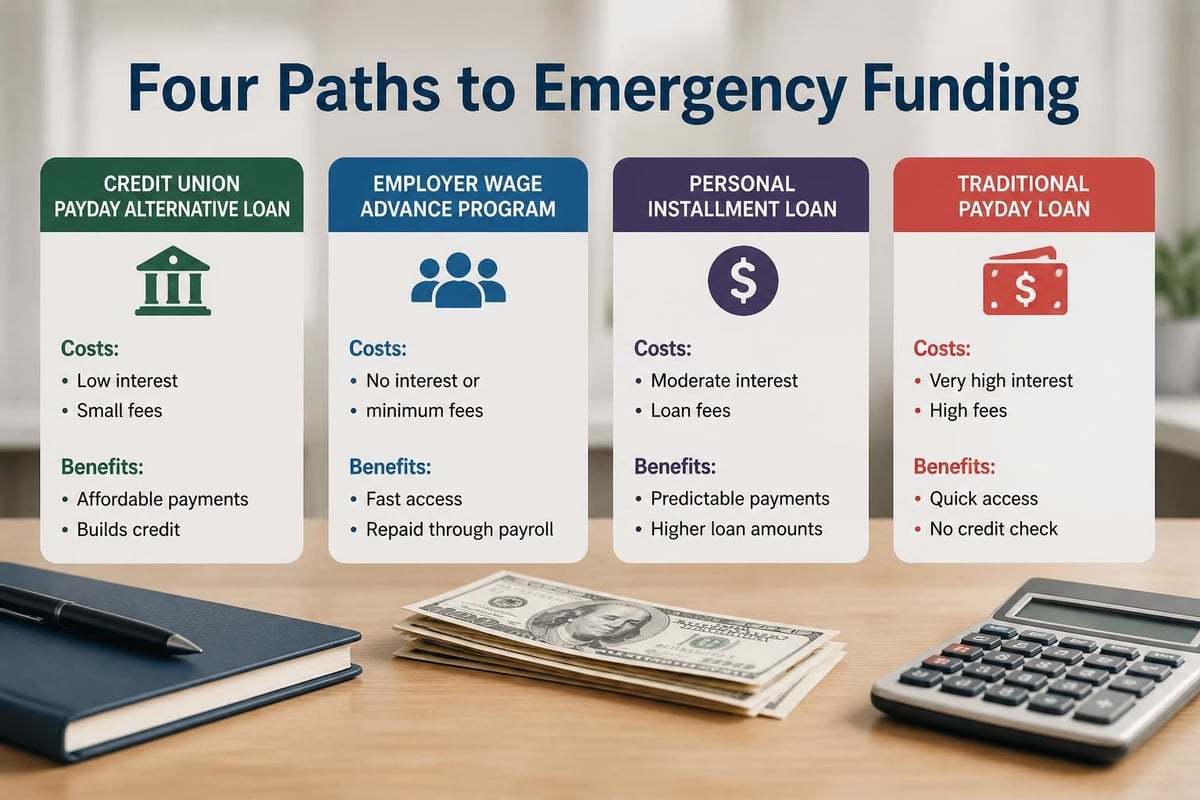
Some employers now offer paycheck advances or earned wage access programs that let you access already-earned wages before payday. The Urban Institute’s research on employer-based small-dollar credit programs shows these alternatives help employees avoid payday loans while maintaining financial stability.
Benefits include:
- Little to no fees (typically $0-$5 per transaction)
- No credit check required
- Automatic repayment through payroll deduction
- No debt cycle risk
Credit Union Payday Alternative Loans
Federally chartered credit unions offer Payday Alternative Loans (PALs) with substantially better terms than payday loans. PAL II loans allow amounts up to $2,000 with 1-12 month terms and APRs capped at 28%.
| Feature | Payday Loan | Credit Union PAL | Personal Loan |
|---|---|---|---|
| Max APR | 400%+ | 28% | Varies, typically 6%-36% |
| Application Fee | None or minimal | Up to $20 | Varies by lender |
| Credit Check | Minimal | Moderate | Comprehensive |
| Membership Required | No | Yes | No |
| Term Options | 2-4 weeks | 1-12 months | 12-84 months |
Community Assistance Programs
Many communities offer emergency assistance for specific needs like utilities, rent, or food. These programs provide grants or interest-free loans that don't require repayment or carry minimal costs.
Check with:
- Local churches and faith-based organizations
- Community action agencies
- United Way and 211 services
- Government assistance programs (LIHEAP, SNAP, TANF)
- Nonprofit credit counseling agencies
Making an Informed Borrowing Decision
When weighing the personal loan vs payday loan choice, focus on total cost, repayment structure, and long-term financial impact rather than just speed of funding.
Questions to Ask Before Borrowing
Evaluating your situation honestly helps prevent costly mistakes:
- How much do I actually need? Borrow only the minimum necessary amount
- Can I afford the payments? Calculate whether monthly installments fit your budget
- What are my alternatives? Exhaust free or low-cost options first
- What is the total cost? Compare all fees, interest, and charges across products
- How will this affect my credit? Consider whether the loan helps or hurts your credit profile
Reading the Fine Print
Regardless of which product you choose, carefully review all loan documents before signing. Pay special attention to:
- APR and fees: The true cost of borrowing
- Payment schedule: When and how payments are collected
- Prepayment penalties: Whether you can pay off early without charges
- Default consequences: What happens if you miss payments
- Arbitration clauses: Whether you waive rights to sue
Legitimate lenders provide clear, written disclosures. If a lender pressures you to sign quickly or refuses to explain terms, consider it a red flag.
Building Better Financial Resilience
The best solution to the personal loan vs payday loan dilemma is avoiding the need for emergency borrowing altogether. While unexpected expenses happen to everyone, building financial resilience reduces their impact.
Practical steps to improve financial stability include:
- Starting an emergency fund, even with small regular contributions
- Creating and following a realistic monthly budget
- Addressing underlying cash flow problems through increased income or reduced expenses
- Seeking financial counseling for debt management strategies
- Building credit gradually through responsible use of credit cards or small installment loans
Many nonprofit organizations offer free financial education and counseling services to help consumers develop stronger money management skills and avoid predatory lending.
Impact on Credit and Financial Future
The personal loan vs payday loan decision affects not only immediate costs but also your long-term financial health and credit profile.
How Personal Loans Build Credit
Personal loans from reputable lenders report to the three major credit bureaus-Experian, Equifax, and TransUnion. This reporting creates opportunities to demonstrate responsible credit behavior.
Making on-time payments helps your credit score by:
- Establishing positive payment history (35% of FICO score)
- Adding installment loan diversity to your credit mix (10% of score)
- Maintaining low overall credit utilization
- Creating a track record of successfully managing debt
Even consumers with past credit problems can use personal loans to rebuild their credit profiles when they make consistent, timely payments.
Payday Loans and Credit Damage
Most payday lenders don't report regular payment activity to credit bureaus, meaning on-time payday loan repayment doesn't help build credit. However, defaults and collections absolutely damage your credit.
When payday loan debt goes unpaid:
- Lenders may send accounts to collections agencies
- Collection accounts appear on credit reports for up to seven years
- Credit scores drop significantly, often by 100+ points
- Future borrowing becomes more difficult and expensive
- Employment and housing applications may be affected
The negative credit impact compounds the already high cost of payday borrowing, creating obstacles that persist long after the original debt is resolved.
Long-Term Financial Trajectory
Choosing appropriate credit products influences your financial path for years. Consumers who rely on payday loans often find themselves trapped in cycles of debt that prevent wealth building, savings accumulation, and financial goal achievement.
Conversely, using personal loans responsibly-borrowing only when necessary, at affordable rates, with realistic repayment plans-supports financial stability and progress. The discipline required to manage installment debt translates to other areas of personal finance.
Comparing Real-World Scenarios
Understanding the personal loan vs payday loan difference becomes clearer through concrete examples showing how each product works in practice.
Scenario 1: $1,500 Car Repair
Your vehicle needs an urgent $1,500 repair to remain operational for work. You have two options:
Option A: Payday Loans
- Borrow $500 from three different payday lenders (typical maximum)
- Pay $75 fee per $500 loan ($225 total fees)
- Must repay $1,725 in two weeks
- If unable to repay, roll over at $225 per renewal period
- After three rollovers (8 weeks), total cost: $1,500 + $900 in fees = $2,400
Option B: Personal Loan
- Borrow $1,500 at 18% APR for 12 months
- Monthly payment: $137.50
- Total repayment: $1,650
- Total interest paid: $150
The personal loan saves $750 in this scenario compared to just three payday loan rollovers, while providing manageable monthly payments.
Scenario 2: Medical Emergency
You face an unexpected $2,000 medical bill not covered by insurance. Examining the personal loan vs payday loan options reveals:
Payday Loan Approach:
- Cannot borrow $2,000 from a single payday lender (typical limits are $500-$1,000)
- Would need multiple loans from different lenders
- Two-week repayment period unrealistic for $2,000+ with fees
- High probability of debt cycle and default
Personal Loan Approach:
- Single $2,000 loan at 15% APR for 24 months
- Monthly payment: $96.90
- Total repayment: $2,325.60
- Total interest: $325.60
- Manageable payments, single creditor, credit-building opportunity
The personal loan provides a realistic path to repayment, while payday loans create an unsustainable debt burden for this expense level.
Understanding the personal loan vs payday loan differences empowers you to make choices that support rather than undermine your financial wellbeing. Personal loans offer lower costs, manageable repayment terms, and credit-building opportunities, while payday loans create expensive debt cycles that trap borrowers in financial instability. If you're facing unexpected expenses or need flexible financing options, Standard Financial offers personal loans tailored to your needs across Louisiana, Mississippi, Tennessee, and Georgia, with options available even if you've experienced past credit challenges. Contact Standard Financial today to explore affordable borrowing solutions that work for your unique situation.






No comment yet, add your voice below!