
A compound interest loan is a loan where interest is calculated on both the original amount borrowed and any interest that has already been added to the balance. Because each period's interest becomes part of the amount that earns interest next, the total cost grows faster than it would under simple interest, unless regular payments keep the balance shrinking.
For most personal loans, the practical question is not whether interest compounds but how often it is charged and how your payments are applied. Understanding that difference helps you compare offers, predict your real cost, and decide when paying early makes sense.
What Is Compound Interest on a Loan?
Compound interest on a loan is interest charged on the outstanding principal plus interest that has previously accrued and been added to the balance. Simple interest, by contrast, is calculated only on the original principal.
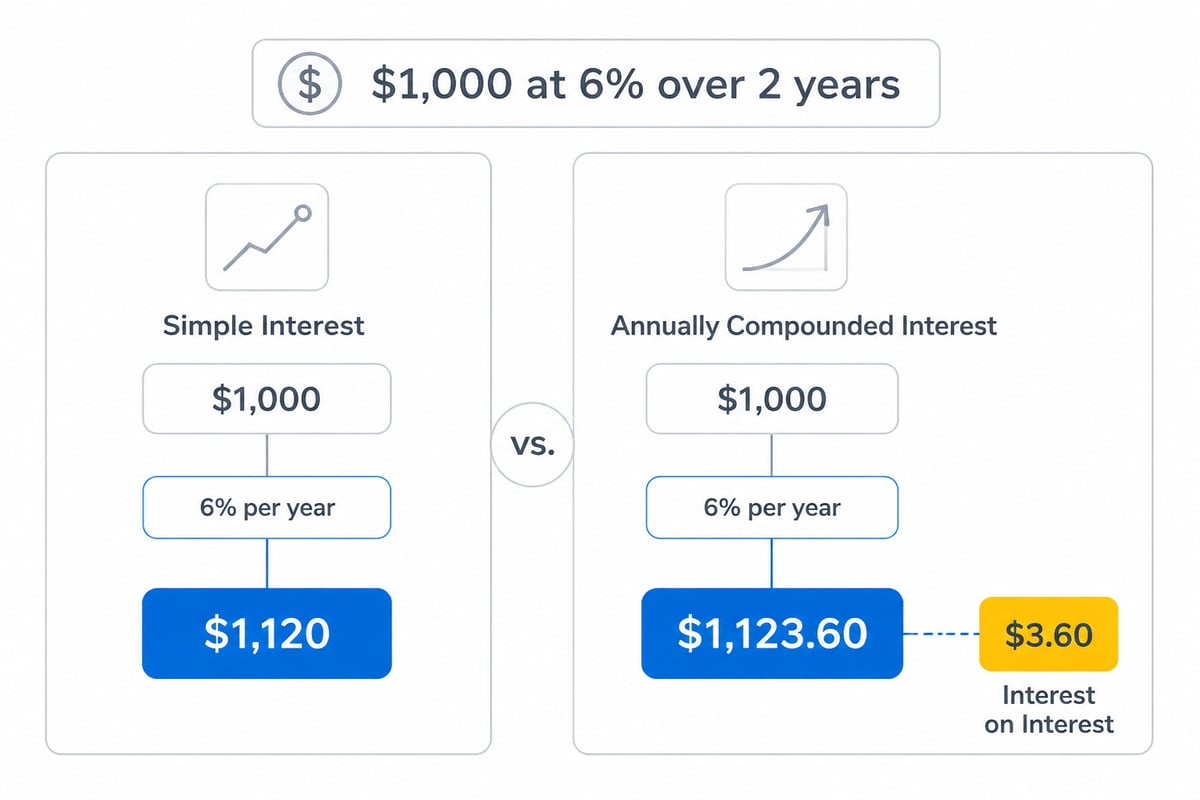
Here is the difference in plain terms. Suppose you borrow $1,000 at 6% per year and make no payments for two years:
- Simple interest: $60 each year, so you owe $1,120 after two years.
- Compound interest, compounded annually: $60 in year one, then 6% of $1,060 ($63.60) in year two, so you owe $1,123.60.
The gap looks small on a short, small loan. It widens with larger balances, higher rates, longer terms, and more frequent compounding.
The rate you see quoted is usually the annual percentage rate, or APR. The Consumer Financial Protection Bureau describes APR as an annualized interest rate, which is the figure lenders use to express yearly borrowing cost.
How Compound Interest Works on a Loan
Compounding works in repeating cycles: interest is calculated on the current balance, added to that balance, and then the next cycle's interest is calculated on the larger total. The length of each cycle is the compounding frequency, and it can be annual, monthly, or even daily.
The compound interest formula
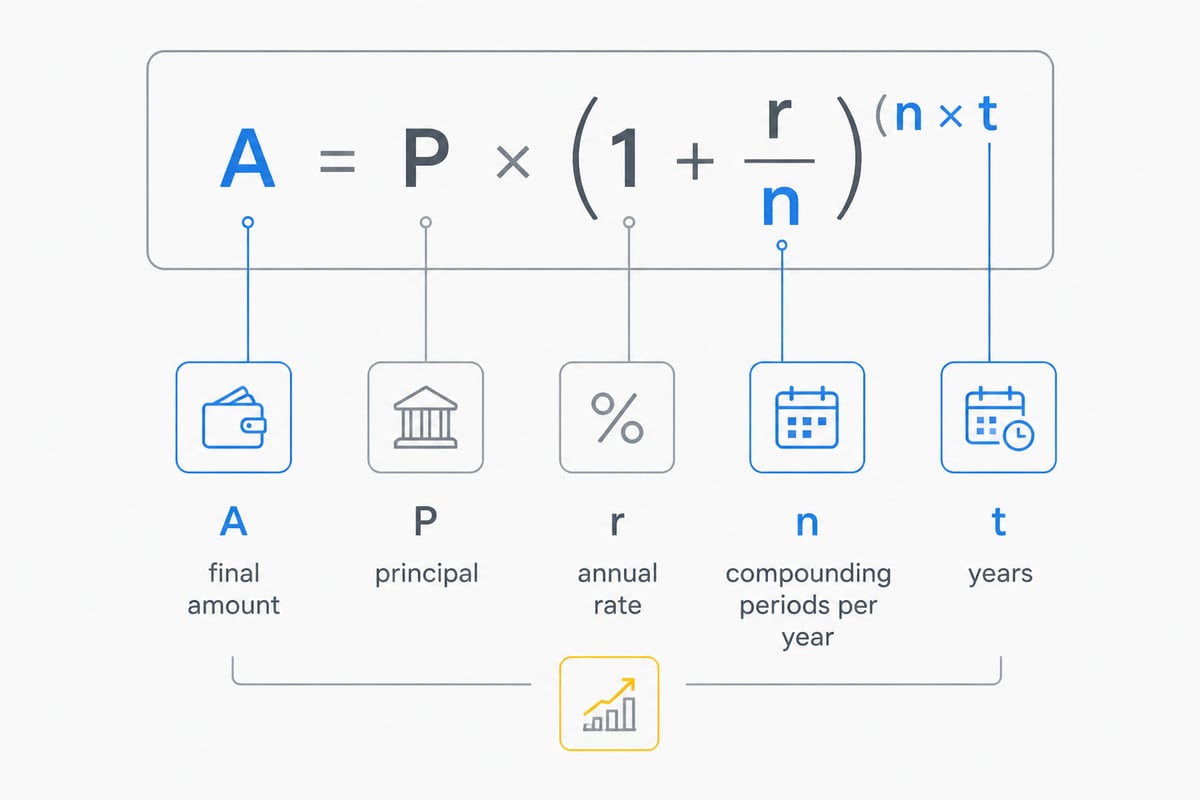
The standard formula for the balance of a loan that receives no payments is:
A = P × (1 + r/n)^(n × t)
- A is the final amount owed
- P is the principal, the amount borrowed
- r is the annual interest rate as a decimal (6% becomes 0.06)
- n is the number of compounding periods per year
- t is the number of years
To find the interest alone, subtract the principal from A.
Why compounding frequency matters
More frequent compounding means interest is added to the balance more often, so a given rate costs slightly more. Using $10,000 at 6% for 10 years with no payments:
| Compounding frequency | Balance after 10 years |
|---|---|
| Annually (n = 1) | $17,908 |
| Monthly (n = 12) | $18,194 |
| Daily (n = 365) | $18,221 |
These figures come directly from the formula above, rounded to the nearest dollar. The jump from annual to monthly is larger than the jump from monthly to daily, which is why frequency matters most when comparing annual against monthly schedules.
Daily compounding in practice
Some credit products compound daily. The CFPB explains that with a daily periodic rate, the rate is generally the APR divided by 360 or 365, depending on the issuer, and that daily interest may be added to the balance, causing daily compounding. The same agency notes that many card issuers use the average daily balance, so paying down a balance sooner can reduce interest when no grace period applies.
How Much Is $10,000 Over 10 Years With Compound Interest?
At 6% compounded annually, $10,000 grows to about $17,908 over 10 years, which means roughly $7,908 in interest when no payments are made. The result changes with the rate and the compounding schedule, so the same $10,000 can reach different totals.
Applying the formula at several rates, with annual compounding:
- At 4%: about $14,802
- At 6%: about $17,908
- At 8%: about $21,589
- At 10%: about $25,937
A related question is what $1,000 becomes after two years at 6% compounded annually. The answer is $1,123.60, using $1,000 × 1.06². That is the same example shown earlier, and it illustrates how even a short period produces interest on interest.
Keep in mind that these figures describe a balance that is left untouched. A regular installment loan is repaid over time, so your balance falls with each payment and the compounding effect is far smaller than these growth figures suggest.
Amortized Loans: Where Compounding Meets Monthly Payments
An amortized loan is repaid in equal installments in which each payment covers the interest accrued since the last payment, with the remainder reducing principal. Most personal and auto loans work this way, and it is why compounding feels less dramatic on installment borrowing than on a lump-sum debt.
The monthly payment is found with this formula:
M = P × [r(1 + r)^n] / [(1 + r)^n − 1]
Here, P is the loan amount, r is the monthly rate (annual rate divided by 12), and n is the total number of monthly payments.
Example: a $100,000 loan at 7%
For the commonly searched question of the monthly payment on a $100,000 loan at 7% interest, the answer depends on the term:
| Term | Monthly payment | Total interest paid |
|---|---|---|
| 10 years (120 payments) | about $1,161 | about $39,300 |
| 15 years (180 payments) | about $899 | about $61,900 |
| 30 years (360 payments) | about $665 | about $139,500 |
All three figures are computed from the formula above and rounded. The pattern is consistent: a longer term lowers the monthly payment but raises total interest substantially.
How early payments are split
In the first months of an amortized loan, most of each payment goes to interest because the balance is at its highest. Over time the share going to principal rises. This front-loading is why extra payments made early in a loan save more than extra payments made near the end.
Simple Interest vs. Compound Interest Loans
The two methods differ in what the interest is calculated on: simple interest uses only the original principal, while compound interest uses principal plus accumulated interest. For a borrower, the practical effect depends on whether you make payments on schedule.
- Simple interest loans charge interest on the current unpaid principal, often daily. Paying early or paying extra reduces the balance and the interest that follows.
- Compound interest loans add unpaid interest to the balance. Missed or reduced payments let that interest start earning more interest.
- Pre-computed interest loans calculate total interest at the start and fold it into the repayment amount, which can limit the savings from early payoff.
Because loan terms vary by lender and by state, read the loan agreement for how interest accrues and how payments are applied before you sign. The disclosure of APR, finance charge, and total of payments is where the real cost is stated.
Capitalized Interest: When Unpaid Interest Joins the Principal
Capitalized interest is unpaid interest that a lender adds to the outstanding principal, and from that point it earns interest itself. This is compounding in its most direct form on a loan.
The Internal Revenue Service describes it in the context of student loans: unpaid interest the lender adds to the principal balance is capitalized interest. The IRS also states that capitalized interest is treated as interest for tax purposes and may be deductible as principal payments are made, and that no deduction for it is allowed in a year with no loan payments.
Capitalization commonly happens after a deferment, a forbearance, or a payment holiday, when interest keeps accruing while payments pause. For anyone borrowing for education or medical expenses and expecting a break in payments, the lesson is the same: a pause in payments is not a pause in interest, and the balance can be higher when payments resume.
What Rates Look Like: Real Benchmarks
Knowing typical market rates helps you judge whether a loan's cost is reasonable and how much compounding will add. The Federal Reserve's G.19 consumer credit release reports, for its 2025 annual data:
- 24-month personal loans at commercial banks averaged 11.50%
- 60-month new-car loans at commercial banks averaged 7.65%
- Credit-card rates averaged 21.22% across all accounts and 22.32% on accounts assessed interest
These are averages for commercial bank borrowers, and your own rate depends on your credit history, income, loan size, and the lender. Borrowers with past credit problems or limited credit history may be offered rates above these averages, which makes the total interest figure even more important to review.
A useful comparison: the same loan costs noticeably less in interest at a lower rate than at a higher one, because the higher rate compounds on a balance for the full term. Always compare offers by APR and by total repayment, not by monthly payment alone.
Why Compound Interest on a Loan Matters to Borrowers
Compounding determines how much a loan actually costs over its life, so it affects every decision about term length, payment size, and early repayment. Three consequences stand out for borrowers in Louisiana, Mississippi, Tennessee, and Georgia and everywhere else.
- Time raises cost. A longer term lowers the payment but gives interest more periods to accumulate, as the $100,000 example showed.
- Rate differences multiply. A few percentage points on a balance carried for years can add thousands of dollars.
- Late or skipped payments compound the problem. Unpaid interest can be added to the balance, so falling behind makes the loan more expensive than the original schedule projected.
Borrowers with past credit issues often face higher rates, so the compounding effect on their loans can be larger. That is a reason to ask about refinancing once payment history improves. Standard Financial works with people who have past credit problems or limited credit, gives customers a chance to explain their credit situation, and builds a tailor-made solution. Its personal loans include refinancing options, which can be relevant when a higher-rate balance could be replaced on better terms.
How to Keep Compound Interest From Costing More
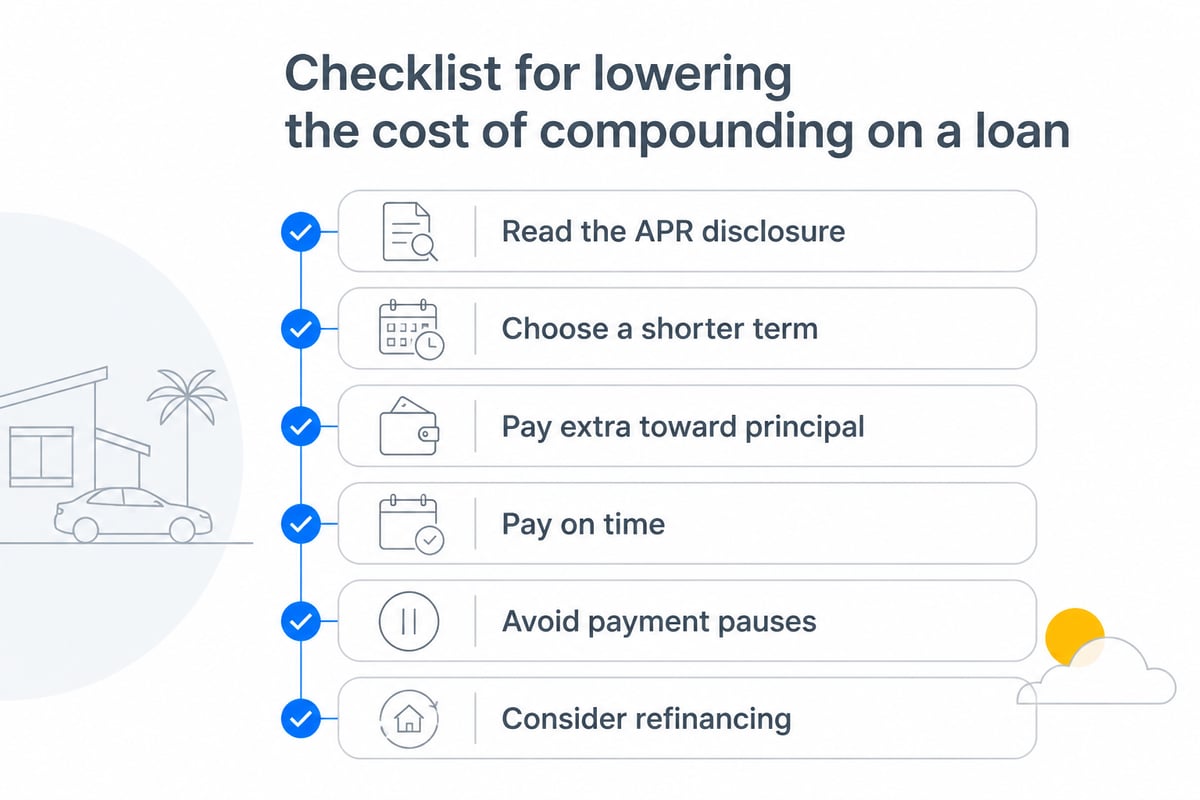
You can limit the cost of compounding by shortening the time interest has to build, reducing the balance faster, and avoiding missed payments. These steps apply to nearly any installment loan.
- Read the disclosure. Confirm the APR, the compounding or accrual method, and the total of payments before you sign.
- Choose the shortest term you can afford. A higher payment over fewer months usually means far less total interest.
- Pay extra toward principal. Ask how the lender applies extra payments, and confirm they reduce principal rather than prepay future installments.
- Pay on time. Late payments can trigger fees and let unpaid interest accumulate.
- Avoid unnecessary payment pauses. If interest accrues during a pause, the balance grows.
- Revisit refinancing. If your credit has improved or rates have dropped, a refinance can lower the rate on the remaining balance.
Related Terms
These terms appear often alongside discussions of compounding:
- APR (annual percentage rate): the yearly cost of borrowing expressed as a rate, including certain fees.
- APY (annual percentage yield): the yearly return on savings after compounding, used for deposits rather than loans.
- Amortization: repayment through scheduled installments that cover interest and principal.
- Principal: the amount borrowed, before interest.
- Capitalization: adding unpaid interest to the principal balance.
- Effective interest rate: the true annual rate after accounting for compounding frequency.
- Rule of 72: a shortcut estimating doubling time by dividing 72 by the annual rate.
FAQ
Is compound interest always bad for borrowers?
Compounding is a feature of how interest is calculated, not a penalty. On a loan repaid on schedule, each payment reduces the balance, so the effect is modest and the cost is stated up front in the loan disclosures. It becomes costly mainly when balances sit unpaid or interest is capitalized.
Can I find out how interest is calculated on my loan?
Yes. Your loan agreement and the required disclosures list the APR, finance charge, and payment schedule. If anything is unclear, ask the lender how interest accrues and how extra payments are applied before you commit.
Does paying off a loan early save money?
On most simple interest and amortized loans, yes, because a lower balance means less interest going forward. Some loans use pre-computed interest, which can reduce the savings, so confirm the lender's payoff terms first.
Before you borrow, take your current loan or offer and calculate the total of payments at two different terms so you can see exactly what compounding adds. If you want help comparing options, Standard Financial offers flexible financing plans and refinancing options through branch offices in Louisiana, Mississippi, Tennessee, and Georgia, and it works with people who have past credit problems or limited credit. You can see its personal loans for details, and when you are ready, Standard Financial makes it simple to apply for a loan that fits your budget.

No comment yet, add your voice below!