
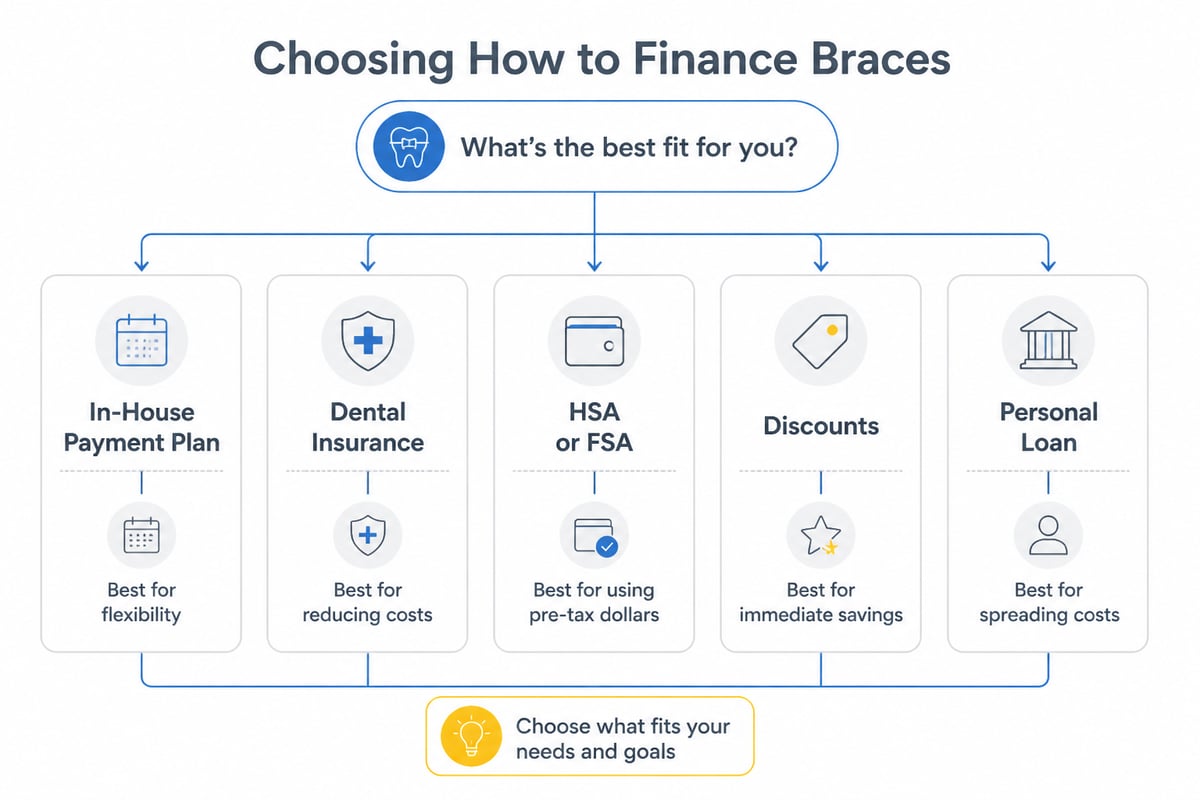
The main financing options for braces are in-house payment plans from the orthodontist, dental insurance benefits, tax-advantaged accounts such as an HSA or FSA, and personal loans. Most families combine two or more of these to spread the cost over the length of treatment and keep monthly payments manageable.
Braces are a significant expense, but they rarely have to be paid for all at once. The right mix depends on your insurance, your credit history, and how much you can comfortably set aside each month. This guide walks through each option, how to compare them, and what to do if money is tight.
What Determines the Cost of Braces?
The cost of braces depends on the type of treatment, how complex your case is, and how long treatment lasts. The American Association of Orthodontists states that costs vary on these factors and does not publish a single price, so any number you see online is only a rough guide.
Several details shape the final quote:
- Treatment type. Traditional metal braces, ceramic braces, and clear aligners are priced differently.
- Case complexity. Mild crowding usually takes less work than a significant bite correction.
- Treatment length. Longer treatment means more appointments and adjustments.
- Retainers and follow-up. Ask whether retainers and post-treatment visits are included in the quoted fee.
- Patient age. Insurance benefits often differ for children and adults.
The most reliable way to learn your actual cost is a consultation. Many orthodontic offices provide an initial exam and a written estimate, which gives you a concrete figure to build a financing plan around.
Is There a Way to Do a Payment Plan for Braces?
Yes, many orthodontists offer in-house payment plans that divide the cost into monthly installments. According to the American Association of Orthodontists, some practices offer monthly plans with minimal or zero interest, so it is worth asking your provider what terms are available.
A typical in-house arrangement works like this:
- The office gives you a total treatment fee after your exam.
- You may be asked to make an initial payment, though some offices set this low or skip it.
- The remaining balance is divided into monthly payments over the expected length of treatment.
- Payments are often set up as automatic withdrawals.
Before agreeing, ask a few direct questions. Is there interest or a financing fee? What happens if treatment runs longer than planned? Is there a penalty for paying the balance off early? A plan with no interest is the least expensive way to spread out costs, but the monthly amount has to fit your budget for the full term.
How Can Dental Insurance Help Pay for Braces?
Dental insurance can reduce the cost of braces if your plan includes orthodontic coverage, which is more common for children than for adults. The American Association of Orthodontists notes that some dental plans cover orthodontic care for children under 18, while adult coverage is less common and varies by plan.
Orthodontic benefits usually work differently from routine dental benefits. Instead of paying a percentage of each visit, many plans set a lifetime orthodontic maximum, a fixed dollar amount that the plan will contribute toward treatment over your lifetime. Once that limit is reached, you pay the rest.
To get a clear picture of your coverage, call your insurer or review your plan documents and confirm:
- Whether orthodontic treatment is covered at all
- The lifetime maximum and any waiting period before benefits begin
- Age limits for dependents
- Whether the plan covers both braces and clear aligners
- Whether you must use in-network providers
Insurance rarely covers the full cost, so treat it as a partial offset and plan to finance the remainder.
Can an HSA or FSA Be Used for Braces?
Yes, in most cases you can pay for orthodontic treatment with money from a health savings account (HSA) or flexible spending account (FSA). Both let you use pre-tax dollars for qualified medical and dental expenses, which effectively lowers what you pay compared with using after-tax income.
The two accounts have different rules:
| Feature | HSA | FSA |
|---|---|---|
| Who qualifies | People enrolled in a high-deductible health plan | People whose employer offers an FSA |
| Unused funds | Roll over year to year | Often must be used within the plan year, subject to employer rules |
| Contribution limits | Set annually by the IRS | Set annually by the IRS and your employer |
| Best use for braces | Pay installments as they come due | Pay a lump sum or installments within the plan year |
Check your plan administrator's list of eligible expenses and ask the orthodontic office whether it can provide the documentation your account requires. Many families time FSA contributions so that the funds cover a down payment or several months of installments.
Are Braces Tax Deductible?
Braces can qualify as a deductible medical expense, but only if you itemize deductions and your total unreimbursed medical costs exceed the percentage of adjusted gross income the IRS sets as a threshold. Because the threshold is substantial, many households do not get a deduction even when they spend thousands on orthodontics.
If you do itemize, keep every receipt, invoice, and payment record from the orthodontist. Dollars paid from an HSA or FSA generally cannot also be deducted, since they were already paid with pre-tax money. Because individual tax situations differ, confirm the details with a tax professional or the current IRS guidance before counting on a deduction.
What Discounts Can Lower the Price of Braces?
Some orthodontists reduce the total fee when you pay in full up front or when more than one family member is treated. The American Association of Orthodontists lists both as discounts that some practices offer, though policies vary from office to office.
Discounts are worth raising during your consultation. Consider asking about:
- A reduced fee for paying the full balance at the start
- A multi-patient discount if siblings or a parent and child are treated
- Seasonal or promotional pricing
- Savings if you pay by a particular date
Paying in full is only wise if you can do so without draining your emergency savings. A small discount is not worth leaving yourself without a cushion for unexpected expenses. If a lump sum is out of reach, this is where a personal loan can bridge the gap, as the next section explains.

When Does a Personal Loan Make Sense for Braces?
A personal loan makes sense when you want to pay the orthodontist in full, capture any pay-in-full discount, and then repay a lender in fixed monthly installments you can plan around. It can also help when an office does not offer an in-house plan, or when the plan it offers requires a larger down payment than you can manage.
The tradeoffs are straightforward. A personal loan usually carries interest, so the total repaid will be higher than the treatment fee. In exchange, you get a predictable payment schedule and the ability to settle the orthodontic bill at once. Before borrowing, compare the loan's annual percentage rate against any in-house plan, and confirm there are no prepayment penalties.
For residents of Louisiana, Mississippi, Tennessee, and Georgia, Personal Loans from Standard Financial are designed for people with limited or impaired credit, and the company offers refinancing options as well. Standard Financial gives customers a chance to explain their credit situation and builds a tailor-made solution, which can matter if past credit problems have made other lenders hesitant. For current terms, amounts, and eligibility, contact a branch or visit its product pages rather than relying on assumptions.
How Do I Get Braces If I Have No Money?
If you have no savings, start by combining low-cost sources: a payment plan with a small or no down payment, a lender that works with limited credit, and any insurance benefits available to you. Few families have the full amount on hand, and orthodontic offices are used to arranging payments around a household budget.
Try these steps in order:
- Request a written estimate. Know the exact fee before you decide how to pay.
- Ask about low or no down payment plans. Some offices will start treatment with a modest initial payment.
- Check for benefits. Review insurance, HSA, or FSA funds you may already have.
- Ask about a longer payment term. Spreading payments over more months lowers each installment, though check that the plan does not add interest.
- Look at lenders that consider your full situation. Past credit problems do not automatically rule out financing.
- Consider community resources. Some dental schools and nonprofit programs offer reduced-cost orthodontic care in certain areas.
If your credit history is limited or damaged, a lender willing to hear your circumstances can make the difference. That is the approach Standard Financial takes with customers who have past credit problems or limited credit.
How Do Financing Options for Braces Compare Side by Side?
Comparing financing options for braces comes down to four questions: what it costs in interest, how large the upfront payment is, how hard it is to qualify, and how predictable the monthly payment will be. The table below summarizes how the main routes differ.
| Option | Typical interest | Upfront cost | Credit requirement | Best for |
|---|---|---|---|---|
| In-house payment plan | Often low or none, per the provider | Varies by office | Usually flexible | Families who can handle fixed monthly payments |
| Dental insurance | Not applicable | Premiums plus remaining balance | Not applicable | Children and adults with orthodontic benefits |
| HSA or FSA | None | Funds must already be set aside | Not applicable | Those with an eligible account |
| Pay-in-full discount | None | Entire fee | Not applicable | Those with savings to spare |
| Personal loan | Yes, varies by lender | Often none | Varies; some lenders work with limited credit | Those who need to pay the office in full or lack other options |
No single route is best for everyone. Many households stack them, for example using insurance and an FSA for part of the fee and a payment plan or loan for the balance.

When Is the Best Time to Start Planning Payment?
The best time to plan is before treatment begins, ideally at the first evaluation. The American Association of Orthodontists recommends that a child have a first orthodontic check-up no later than age 7, and notes that an evaluation does not necessarily mean treatment will start right away.
That early visit gives families time to budget. If the orthodontist advises monitoring a child's development rather than starting immediately, you may have months or years to build savings, increase FSA contributions, or confirm insurance benefits. If treatment is recommended sooner, you will at least know the likely cost and can compare financing before committing.
Practical planning steps include:
- Scheduling consultations with two or more orthodontic offices to compare fees and payment terms
- Reviewing your insurance and any waiting periods well in advance
- Setting a monthly figure you can afford, then asking the office to build a plan around it
- Keeping a small buffer for retainers, repairs, or an extended treatment period
Is $5,000 a Good Price for Braces?
A quote can be reasonable or high depending on what is included and what your local market looks like. Because the American Association of Orthodontists ties cost to treatment type, complexity, and duration, the same figure may be fair for one case and high for another.
To judge a quote, ask what it covers. Confirm whether it includes records and x-rays, all adjustment visits, retainers, and any additional time if treatment runs long. Then get a second estimate from another office so you can compare like with like. A lower quote that excludes retainers, for instance, may cost more in the end than a slightly higher one that includes everything.
FAQ
Can I get braces with bad credit?
Yes. Many orthodontic offices offer in-house plans that do not depend heavily on credit scores, and some lenders specialize in working with people who have limited or impaired credit. Explaining your situation to the office or lender up front can open options that an automated approval would not.
Should I pay for braces up front or finance them?
Paying up front can earn a discount and avoid interest, but only if it does not exhaust your savings. If a lump sum would leave you without an emergency cushion, a payment plan or loan with predictable monthly payments is usually the safer choice.
Does financing braces affect my credit?
An in-house plan with the orthodontist often does not involve a credit report, while a loan from a lender may. Making on-time payments on a loan can support your credit over time, and missed payments can hurt it, so choose a payment you can sustain.
Your next step is to request a written estimate from your orthodontist and add up what insurance, an HSA or FSA, and any in-house plan will cover, so you know exactly how much is left to finance. If a gap remains, Personal Loans from Standard Financial offer a route for people with past credit problems or limited credit, and the company has branch offices across Louisiana, Mississippi, Tennessee, and Georgia. Standard Financial offers flexible financing plans and refinancing options, and you can Apply For A Loan to see how a tailor-made plan could help cover the cost of your orthodontic care.

No comment yet, add your voice below!