

When you borrow money, the sticker price is only part of the story. Understanding what is the finance charge on a loan helps you grasp the true cost of credit and make informed decisions about your financial future. Whether you're considering a personal loan for home improvements, medical expenses, or education, knowing how lenders calculate these charges empowers you to compare offers effectively and budget appropriately. For borrowers across Louisiana, Mississippi, Tennessee, and Georgia, this knowledge is particularly valuable when evaluating financing options from local and regional lenders.
Understanding the Finance Charge Definition
The finance charge represents the total dollar amount you pay to borrow money. It encompasses much more than just interest. According to federal regulations governing consumer credit, the finance charge includes interest, loan fees, points, service charges, and certain other costs that lenders require as a condition of extending credit.
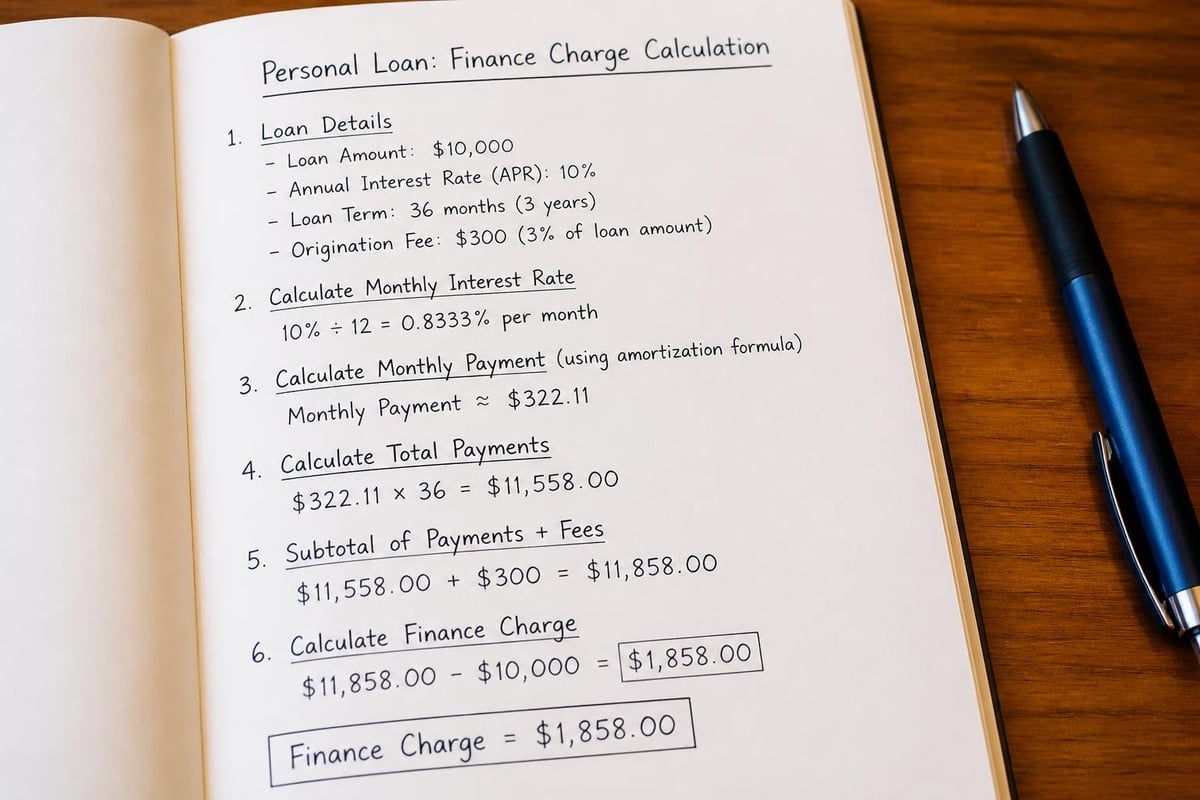
Think of the finance charge as the complete price tag for your loan. If you borrow $10,000 and ultimately pay back $13,500 over the life of the loan, your finance charge is $3,500. This figure captures every penny beyond the principal amount you borrowed.
Legal Framework and Consumer Protection
The Truth in Lending Act established standardized finance charge disclosure requirements to protect consumers. Lenders must clearly state the finance charge in loan documents, allowing borrowers to compare offers on equal footing. The Consumer Financial Protection Bureau’s guidance on finance charges explains these requirements in consumer-friendly language, emphasizing transparency in lending practices.
This regulatory framework serves a critical purpose. Before these rules, lenders could obscure the true cost of credit through confusing fee structures and misleading terminology. Today's standardized approach ensures you can answer "what is the finance charge on a loan" by looking at a single, clearly disclosed number.

Components Included in Finance Charges
What is the finance charge on a loan composed of specifically? The answer includes several distinct elements that lenders combine into one total figure.
Interest charges form the largest component for most loans. This is the cost of using the lender's money over time, calculated as a percentage of your outstanding balance. A $15,000 loan at 8% annual interest accrues different interest amounts depending on the repayment term.
Loan origination fees compensate lenders for processing your application and setting up the loan. These fees typically range from 1% to 5% of the loan amount. On a $10,000 personal loan, a 3% origination fee adds $300 to your finance charge.
Points and prepaid interest apply primarily to mortgages but sometimes appear in other loan products. One point equals 1% of the loan amount. Borrowers sometimes pay points upfront to secure lower interest rates, and these payments count toward the finance charge.
Additional components include:
- Credit investigation fees required by the lender
- Premiums for credit life insurance when required as a loan condition
- Document preparation fees mandated by the lender
- Certain appraisal fees tied to credit approval
- Mortgage insurance premiums (for applicable loans)
What Fees Are Excluded from Finance Charges
Understanding what is the finance charge on a loan requires knowing what's not included. Federal regulations specifically exclude certain costs from the finance charge calculation, even though borrowers must pay them.
| Excluded Fee Type | Examples | Rationale |
|---|---|---|
| Application fees | Credit report fees paid before loan approval | Not a condition of credit extension |
| Late payment charges | Penalties for missed or delayed payments | Contingent on borrower action, not automatic |
| Title and closing costs | Attorney fees, title insurance, recording fees | Third-party charges for services, not lender compensation |
| Optional insurance | Voluntary life or disability coverage | Borrower choice, not required for approval |
| Returned check fees | NSF charges for bounced payments | Penalty for borrower action |
These exclusions matter because they affect comparison shopping. Two lenders might advertise identical finance charges while charging vastly different application or closing fees. Savvy borrowers examine the complete cost picture beyond just the finance charge figure.
The APR Connection
The Annual Percentage Rate (APR) translates the finance charge into an annualized percentage, accounting for both interest and fees. This standardized metric enables apples-to-apples comparison across different loan products and lenders. When evaluating what is the finance charge on a loan, the APR helps you understand the cost relative to the loan amount and term.
A $5,000 loan with a $750 finance charge might seem expensive at first glance. However, if that's spread over five years, the APR reveals a different story than if it's over just one year. The APR calculation factors in the time value of money and payment schedule.
How Lenders Calculate Finance Charges
The mechanics of calculating what is the finance charge on a loan vary by loan type and payment structure. Personal loans typically use one of several standard methods.
Simple Interest Calculation
Most consumer loans use simple interest, where finance charges accrue on the outstanding principal balance. Here's how it works:
- Determine the daily interest rate by dividing the annual rate by 365
- Calculate daily interest by multiplying the current balance by the daily rate
- Accumulate charges for each day until payment
- Apply payments first to accrued interest, then to principal
For example, a $12,000 loan at 9% annual interest has a daily rate of 0.0246% (9% ÷ 365). On day one, interest accrues at $2.96 ($12,000 × 0.000246). As you make payments and reduce principal, future daily charges decrease proportionally.
Add-On Interest Method
Some lenders, particularly for smaller personal loans, use the add-on method. They calculate total interest upfront based on the original loan amount and term, then add it to the principal. This sum is divided by the number of payments.
This method produces higher effective costs than simple interest because you pay interest on the full original amount throughout the loan term, even as principal decreases. A $5,000 loan with $1,000 in add-on interest creates $6,000 in total payments, regardless of your payment schedule.
Precomputed Finance Charges
Precomputed loans establish the total finance charge at loan origination. The lender calculates all interest assuming you'll keep the loan for the full term. Early payoff may earn you a rebate, but the initial finance charge disclosed reflects the complete term.
Finance Charges Across Different Loan Types
What is the finance charge on a loan depends significantly on the loan category. Consumer lending products vary widely in their charge structures.
Personal loans for home improvements, medical expenses, or education typically feature straightforward finance charges. These unsecured loans often include an origination fee (1% to 5%) plus interest over the repayment period. A $8,000 medical expense loan at 10.5% over four years might carry a $200 origination fee plus approximately $1,800 in interest, creating a $2,000 total finance charge.
Auto loans generally have lower finance charges relative to loan amounts because the vehicle serves as collateral. However, the FDIC’s consumer resources on loans note that dealer-arranged financing sometimes includes higher charges than direct bank lending.
Mortgages present the most complex finance charge calculations. The extended terms (15 to 30 years) mean interest dwarfs other fees. Origination points, mortgage insurance, and prepaid interest all contribute to what can be substantial total finance charges.
| Loan Type | Typical Finance Charge Components | Relative Cost Level |
|---|---|---|
| Personal Loan (unsecured) | Origination fee + interest | Medium to High |
| Auto Loan | Interest + possible fee | Low to Medium |
| Mortgage | Points + interest + MI + fees | High (in dollars) |
| Home Equity | Interest + closing costs | Medium |
How Credit History Affects Finance Charges
Your credit profile directly impacts what is the finance charge on a loan you'll receive. Lenders price risk into their offers, meaning borrowers with past credit challenges typically face higher finance charges.
Prime borrowers with strong credit scores (720+) access the lowest advertised rates. A borrower with excellent credit might secure a $15,000 personal loan at 7% interest, generating roughly $2,300 in finance charges over four years.
Subprime borrowers with credit scores below 640 encounter higher rates reflecting increased default risk. The same $15,000 loan might carry a 16% rate for these applicants, creating approximately $5,400 in finance charges over the identical term.
This differential exists because lenders price in the statistical likelihood of non-payment. However, responsible lenders like those serving the Southeast still offer reasonable financing to borrowers rebuilding credit, balancing risk with fair pricing.
Impact of Loan Term Length
Term duration dramatically affects total finance charges while inversely impacting monthly payments. Consider a $10,000 loan at 12% annual interest:
- 24-month term: Monthly payment of $470, total finance charge of $1,300
- 48-month term: Monthly payment of $263, total finance charge of $2,630
- 60-month term: Monthly payment of $222, total finance charge of $3,350
Longer terms reduce payment pressure but substantially increase the total cost of borrowing. Understanding this trade-off helps you answer "what is the finance charge on a loan" for your specific situation and choose the term that balances affordability with cost efficiency.

Reading Loan Disclosures and Documents
Federal law requires lenders to disclose what is the finance charge on a loan clearly before you sign. The Truth in Lending disclosure form presents this information in a standardized format.
Key disclosure elements include:
- Finance Charge: The total dollar cost stated prominently
- Amount Financed: The net loan proceeds after fees
- Total of Payments: All payments combined over the loan life
- APR: The annualized percentage cost of credit
Examine these figures carefully. The relationship between them reveals the loan's true economics. If the finance charge seems disproportionate to the amount financed, investigate which fees the lender included and whether they're competitive.
Questions to Ask Your Lender
Before finalizing any loan, clarify exactly what comprises the finance charge:
- What is the base interest rate and how is it applied?
- Which fees are included in the finance charge calculation?
- Are there fees excluded from the finance charge I'll still pay?
- How does early repayment affect the finance charge?
- Does refinancing in the future incur additional finance charges?
Reputable lenders welcome these questions and provide transparent answers. The Federal Reserve’s guidance on Truth in Lending establishes standards requiring lenders to furnish complete information about all credit costs.
Strategies to Minimize Finance Charges
While finance charges are inevitable when borrowing, you can take steps to minimize them and reduce your total borrowing costs.
Improve your credit score before applying. Even a 50-point increase can qualify you for meaningfully lower rates. Pay down existing debts, correct credit report errors, and avoid new credit inquiries in the months before your application.
Compare multiple offers from different lenders. What is the finance charge on a loan varies significantly across institutions. Banks, credit unions, and consumer finance companies each have different pricing models and target customers. Obtain quotes from at least three lenders to identify the most competitive terms.
Negotiate fees where possible. While interest rates often follow set credit-score tiers, some lenders have flexibility on origination fees and other charges. Simply asking if fees can be reduced sometimes yields savings.
Choose shorter terms when your budget allows. The faster you repay principal, the less interest accumulates. If you can afford $350 monthly instead of $250, the higher payment significantly reduces total finance charges.
Make extra principal payments when permitted. Most consumer loans allow additional principal payments without penalty. Reducing your balance ahead of schedule cuts the interest you'll pay on future payments.
Regional Considerations for Southern Borrowers
Borrowers in Louisiana, Mississippi, Tennessee, and Georgia encounter specific market conditions affecting what is the finance charge on a loan in their regions.
State regulations sometimes impose maximum rates or fee caps beyond federal requirements. Louisiana, for instance, has specific consumer credit laws governing installment loans and maximum finance charges for certain loan sizes.
Economic factors in the Southeast influence lending rates. Regional unemployment levels, median incomes, and local cost of living all factor into lender risk assessment and pricing decisions.
Community lending options are particularly strong in these states. Local consumer finance companies often provide more flexible underwriting than national banks, serving borrowers with non-traditional credit profiles. These lenders understand regional economic patterns and may offer competitive finance charges to local residents.
Working with Regional Lenders
Regional lenders with multiple branch offices across Louisiana, Mississippi, Tennessee, and Georgia often provide advantages over distant online-only competitors. Local presence enables in-person consultation, clearer explanation of what is the finance charge on a loan, and personalized service throughout the borrowing relationship.
These institutions typically offer:
- Flexible financing plans adaptable to irregular income patterns
- Refinancing options as your credit improves or needs change
- Specialized products for home improvements, medical needs, and education
- Credit-building opportunities for borrowers working to improve their profiles
Understanding Total Cost vs. Finance Charge
The finance charge is not the total amount you'll pay-it's one component of your total cost of borrowing. This distinction matters when budgeting and comparing loans.
Total loan cost includes:
- Finance charge (interest + included fees)
- Excluded fees (application costs, certain closing fees)
- Principal repayment (the original borrowed amount)
- Any optional products purchased (insurance, extended warranties)
A comprehensive cost analysis examines all these elements. Two loans might have identical finance charges but vastly different total costs if one has substantially higher excluded fees or requires expensive optional insurance.
| Cost Component | Included in Finance Charge? | Impacts APR? | Your Responsibility |
|---|---|---|---|
| Interest | Yes | Yes | Always paid |
| Origination fee | Yes | Yes | Always paid |
| Late fees | No | No | Only if you pay late |
| Application fee | No | No | Paid before approval |
| Optional insurance | No | No | Your choice |
Finance Charges and Loan Refinancing
Understanding what is the finance charge on a loan becomes especially important when considering refinancing. Refinancing replaces your existing loan with a new one, ideally at better terms.
When refinancing makes sense:
- Your credit score has improved significantly since the original loan
- Market interest rates have fallen substantially
- You need to extend the term to reduce monthly payments
- You want to pay off the loan faster with a shorter term
Calculate whether refinancing saves money by comparing the remaining finance charges on your current loan against the total finance charge on the proposed new loan. Don't forget to factor in any refinancing fees, which become part of the new loan's finance charge.
For example, if you have $3,500 in remaining finance charges on your current loan but can refinance into a new loan with only $2,800 in total finance charges (including a $200 refinancing fee), you save $700. However, if the new loan extends your payoff date significantly, evaluate whether the longer debt obligation is worth the savings.
Finance Charges and Tax Implications
Most personal loan finance charges are not tax-deductible for individual borrowers. This differs from mortgage interest, which often qualifies for deduction.
Home improvement loans present a special case. If you use the proceeds for substantial home improvements and the loan is secured by your residence, the finance charge interest component might be deductible. Consult a tax professional for guidance specific to your situation.
Business-purpose loans follow different rules. If you borrow for legitimate business purposes, even through a personal loan product, the finance charges may be deductible as business expenses. Maintain clear documentation separating business borrowing from personal use.
The tax treatment doesn't change what is the finance charge on a loan, but it affects the after-tax cost of borrowing. A $2,000 finance charge that's tax-deductible costs less in real terms than a non-deductible $2,000 charge for borrowers in higher tax brackets.
Avoiding Predatory Finance Charges
While most lenders operate ethically, understanding what is the finance charge on a loan helps you identify predatory lending practices. Warning signs include:
- Excessive finance charges far above market rates for your credit profile
- Hidden fees not clearly disclosed in initial conversations
- Pressure tactics urging you to sign before reviewing documents
- Balloon payments creating large final payments you can't afford
- Loan flipping where lenders repeatedly refinance loans to generate new fees
Legitimate lenders provide clear, upfront disclosure of all costs. They explain exactly what comprises the finance charge and welcome questions about their calculation methods. They comply with all Truth in Lending Act requirements and state regulations.
If a finance charge seems unreasonably high, shop competing offers. Market competition keeps most lenders honest, and transparent comparison reveals outliers charging predatory rates.
Understanding what is the finance charge on a loan gives you the power to make informed borrowing decisions and accurately compare your options. The finance charge encompasses all costs of credit beyond the principal amount, from interest to required fees, and understanding this total cost is essential for responsible financial planning. If you're exploring personal loans for home improvements, medical expenses, education, or other needs across Louisiana, Mississippi, Tennessee, or Georgia, Standard Financial offers flexible financing solutions with transparent pricing and personalized service designed to meet your unique situation.






No comment yet, add your voice below!