

Computers have become essential tools for work, education, and everyday life. Whether you need a high-performance laptop for remote work, a desktop for college coursework, or a replacement device after an unexpected breakdown, the upfront cost can strain even a well-planned budget. A loan for a computer provides a practical financing solution that spreads the expense over manageable monthly payments, making technology accessible when you need it most. Understanding your borrowing options, comparing terms carefully, and choosing the right lender can help you acquire the device you need without derailing your financial goals.
Understanding Computer Loan Options
When you're seeking a loan for a computer, several distinct financing paths are available. Each comes with different terms, qualification requirements, and cost structures that affect your total repayment amount and monthly budget.
Personal Loans from Banks and Credit Unions
Personal loans represent one of the most straightforward ways to finance a computer purchase. These unsecured loans typically range from $1,000 to $50,000, with repayment periods spanning 12 to 60 months. Because they're unsecured, approval depends primarily on your credit score, income, and debt-to-income ratio.
Key advantages of personal loans include:
- Fixed interest rates that won't change over the life of the loan
- Predictable monthly payments that simplify budgeting
- Funds deposited directly to your account for flexibility in choosing where to buy
- No collateral required beyond your creditworthiness
- Potential to build credit history with on-time payments
Interest rates for personal loans in 2026 generally range from 6% to 36%, depending on your credit profile. Borrowers with excellent credit (scores above 720) typically qualify for the lowest rates, while those with fair or poor credit may face higher costs but can still access financing through specialized lenders.
Retail Point-of-Sale Financing
Many electronics retailers and computer manufacturers offer financing directly at checkout. These arrangements, sometimes marketed as buy now, pay later (BNPL) programs, allow you to split the purchase price into installments without a traditional loan application.
Point-of-sale financing typically falls into two categories:
| Financing Type | Term Length | Interest | Best For |
|---|---|---|---|
| Deferred interest | 6-24 months | 0% if paid in full by deadline, 20-30% retroactive if not | Large purchases when you can pay off quickly |
| Installment plans | 3-12 months | Often 0% APR | Smaller purchases under $1,500 |
| Extended financing | 24-48 months | 10-25% APR | High-cost items when monthly payment matters more than total cost |

The convenience of same-day approval and minimal paperwork makes retail financing attractive, but Consumer Reports warns of significant risks including deferred interest charges that can dramatically increase costs if you miss the payoff deadline by even one day.
Credit Cards and Promotional Offers
Using a credit card to purchase a computer offers immediate access and potential rewards, but carries important considerations. If you already have available credit, this option requires no new application. However, high balances can negatively impact your credit utilization ratio and overall credit score.
Some credit cards offer:
- 0% introductory APR periods (typically 12-21 months in 2026)
- Cash-back rewards or points on electronics purchases
- Extended warranty protection and purchase insurance
- Fraud protection superior to debit cards
The primary risk lies in the promotional period ending. Once the 0% APR expires, standard rates (often 18-29% in 2026) apply to any remaining balance, potentially making an affordable purchase very expensive.
Determining How Much Computer You Actually Need
Before seeking a loan for a computer, carefully assess your actual requirements. Overborrowing for features you won't use wastes money on both the purchase price and interest charges, while underspending may leave you with an inadequate device.
Matching Specs to Use Cases
The Consumer Reports laptop buying guide provides detailed breakdowns of what different users need. Your primary activities should drive your budget:
Basic computing (email, web browsing, streaming): $400-$700
- Chromebooks or budget Windows laptops
- 4-8 GB RAM
- Basic processor (Intel Celeron, AMD Athlon)
Professional work (office applications, video calls, multitasking): $700-$1,200
- Mid-range Windows or MacBook Air
- 8-16 GB RAM
- Intel Core i5/AMD Ryzen 5 or Apple M-series chip
Creative professional (video editing, graphic design, 3D modeling): $1,500-$3,000+
- High-performance laptops or desktop workstations
- 16-32 GB RAM
- Dedicated graphics card
- Large, color-accurate display
Gaming or specialized software: $1,200-$2,500
- Gaming laptops or custom-built desktops
- 16-32 GB RAM
- Powerful graphics card (NVIDIA RTX or AMD Radeon)
- High-refresh-rate display
Understanding these tiers helps you borrow the right amount. If you're financing a $1,800 laptop for basic email and web browsing, you're paying interest on $1,100 of unnecessary features.
Considering Total Cost of Ownership
The sticker price represents only part of your computer investment. When calculating your loan for a computer, factor in:
- Software licenses (Microsoft Office, Adobe Creative Cloud, antivirus)
- Peripherals (mouse, keyboard, monitor, webcam)
- Warranty extensions or protection plans
- Accessories (laptop bag, USB hub, external storage)
These additions can increase your total cost by 15-30%. A $1,000 laptop might require $1,250 in financing when you include essential accessories and software.
Smart Borrowing Strategies
Obtaining a loan for a computer responsibly means more than just getting approved. Strategic borrowers minimize costs while building positive credit history.
Improving Your Approval Odds and Rate
Lenders evaluate several factors when processing your application. Taking steps to strengthen your financial profile before applying can save hundreds of dollars in interest:
- Check your credit reports for errors at AnnualCreditReport.com and dispute any inaccuracies
- Pay down existing debt to lower your debt-to-income ratio below 40%
- Add a co-signer if your credit history is limited or challenged
- Document stable income with recent pay stubs or tax returns
- Compare multiple lenders within a 14-day window to minimize credit inquiry impact
Even a 2-3 percentage point reduction in your interest rate can significantly impact total cost. On a $1,500 loan over 36 months, dropping from 18% APR to 15% APR saves approximately $70 in interest charges.
Understanding True Loan Costs
The advertised interest rate tells only part of the story. When evaluating any loan for a computer, examine the complete cost structure:
Annual Percentage Rate (APR) reflects both interest and fees, providing a more accurate cost comparison than the interest rate alone. A loan advertising "12% interest" might carry a 14% APR once origination fees are included.
Total repayment amount shows exactly how much you'll pay over the loan's life. A $1,200 computer financed at 15% APR over 24 months costs approximately $1,391 total-$191 in interest on top of the purchase price.
Monthly payment must fit comfortably in your budget. Financial advisors typically recommend keeping all debt payments (except mortgage) below 20% of your gross monthly income.
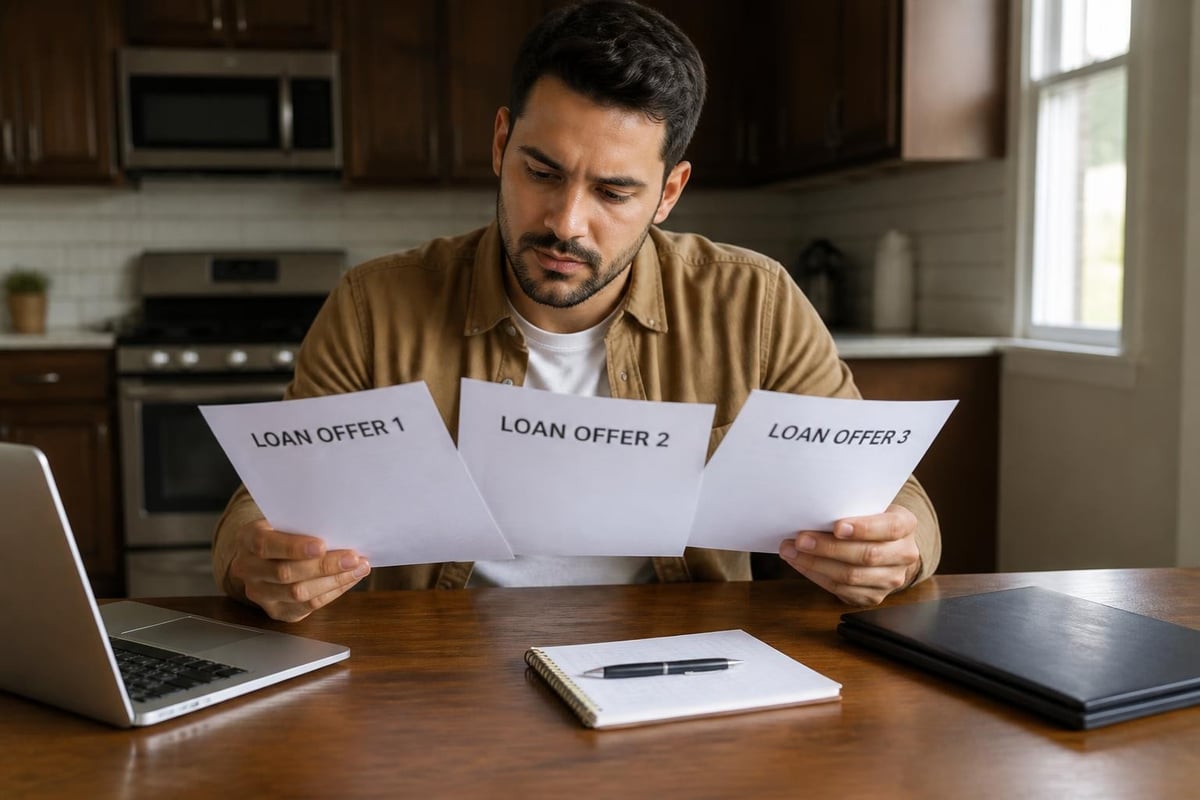
Here's a comparison of how different terms affect a $1,500 computer loan:
| APR | Term | Monthly Payment | Total Interest | Total Paid |
|---|---|---|---|---|
| 10% | 12 months | $132 | $84 | $1,584 |
| 10% | 24 months | $69 | $156 | $1,656 |
| 15% | 12 months | $135 | $120 | $1,620 |
| 15% | 24 months | $73 | $232 | $1,732 |
| 20% | 24 months | $76 | $312 | $1,812 |
The table illustrates that both APR and term length significantly impact your total cost. While longer terms reduce monthly payments, they substantially increase total interest paid.
Special Considerations for Students and Remote Workers
Certain groups face unique circumstances when seeking a loan for a computer, with both challenges and opportunities specific to their situations.
Education-Related Computer Financing
Students often need computers for coursework but have limited income and credit history. Several specialized options exist beyond standard personal loans.
Many colleges and universities maintain emergency loan funds or technology grant programs specifically for computer purchases. Contact your school's financial aid office to learn about:
- Short-term, interest-free loans for enrolled students
- Technology grants that don't require repayment
- Institutional purchase programs offering educational discounts
- Laptop rental or loaner programs
Federal student aid typically doesn't cover computers directly, but the Department of Education’s guidance explains that cost-of-attendance budgets often include technology allowances. Schools may adjust aid packages to account for computer expenses, particularly for programs requiring specific equipment.
When comparing student loan options specifically for technology, consider whether a small personal loan makes more sense than increasing educational debt that won't be forgiven and carries repayment obligations even in financial hardship.
Self-Employed and Home Office Tax Implications
For self-employed individuals, freelancers, and small business owners, a loan for a computer used for business purposes carries potential tax benefits that can offset borrowing costs.
The IRS provides guidance on deducting business equipment. Computers used exclusively or primarily for business may qualify for:
- Section 179 deduction: Immediate expensing of the full purchase price in the year acquired (subject to annual limits)
- Depreciation deductions: Spreading the cost over the computer's useful life (typically 5 years)
- Interest deduction: Business loan interest is generally deductible as a business expense
Consult a tax professional to determine which method provides the greatest benefit for your specific situation. The tax savings can effectively reduce your computer's net cost by 10-30%, depending on your tax bracket and business structure.
The Digital Divide and Access to Technology
The importance of computer access extends beyond convenience to economic opportunity and social participation. Research from Pew shows that while smartphone ownership has reached near-universal levels in the United States, home broadband and computer access remain uneven across income and demographic groups.
Approximately 23% of adults with household incomes below $30,000 lack traditional computer access, relying solely on smartphones for internet activities. This creates significant barriers for:
- Students completing homework and online coursework
- Job seekers submitting applications and attending virtual interviews
- Remote workers participating in video conferences and accessing company systems
- Families managing healthcare, banking, and government services online
Analysis from the Brookings Institution emphasizes that device access represents a critical component of digital equity alongside broadband connectivity. Affordable financing options for computer purchases help bridge this divide, enabling households to invest in technology that unlocks educational and economic opportunities.
Responsible lenders recognize this reality and structure loan products to serve customers across credit profiles, understanding that access to a computer can be transformative for families working to improve their financial circumstances.
Regional Considerations for Borrowers in the Southeast
Consumers in Louisiana, Mississippi, Tennessee, and Georgia face specific economic conditions that influence computer financing decisions. These states show diverse economic profiles, from urban tech hubs to rural communities with limited broadband infrastructure.
Income and Credit Variations
Median household incomes across the Southeast generally run below national averages, making upfront computer purchases particularly challenging. A $1,200 laptop represents a more significant portion of monthly income for many families in these regions compared to high-cost coastal areas.
Credit profiles also vary. Borrowers who have experienced past financial challenges-whether from medical emergencies, job disruptions, or other hardships-may find traditional financing options limited. Specialized consumer lenders who work with individuals rebuilding credit provide essential access to technology financing that mainstream banks might deny.
Local Lending Relationships
Working with lenders who maintain physical branch locations in your community offers distinct advantages:
- Face-to-face consultations to discuss your specific needs and circumstances
- Flexible underwriting that considers factors beyond credit scores alone
- Established presence and accountability within your local market
- Understanding of regional economic conditions and employment patterns
- Relationship-based lending that values long-term customer partnerships
National online lenders offer convenience and sometimes competitive rates, but may apply rigid qualification formulas that don't account for individual situations. Regional lenders with decision-making authority at the local level can often accommodate borrowers who fall outside standard approval parameters.
Avoiding Common Computer Financing Mistakes
Even borrowers with good intentions make costly errors when securing a loan for a computer. Awareness of these pitfalls helps you make better decisions.
Borrowing More Than Necessary
The temptation to upgrade to premium models when financing is available leads many borrowers to purchase more computer than they need. Financing approval for $2,500 doesn't mean you should spend the full amount if a $1,400 model meets your requirements.
Every dollar borrowed accrues interest. On a 24-month loan at 15% APR, each additional $100 financed costs roughly $115 total. That $1,100 upgrade actually costs $1,265 after interest-money that could fund an emergency savings account or reduce other debt.
Ignoring Total Cost
Monthly payment size matters for budgeting, but focusing exclusively on achieving the lowest possible payment often leads to extending loan terms unnecessarily. This increases total interest paid substantially.
Always calculate and compare total repayment amounts across different loan structures. A seemingly attractive $50 monthly payment over 48 months might cost $400 more in total interest than a $75 monthly payment over 24 months.
Defaulting on Deferred Interest Promotions
Retail financing with deferred interest can work well if you maintain strict payment discipline, but proves disastrous otherwise. These programs apply retroactive interest to the entire original purchase price if you carry any balance past the promotional deadline.
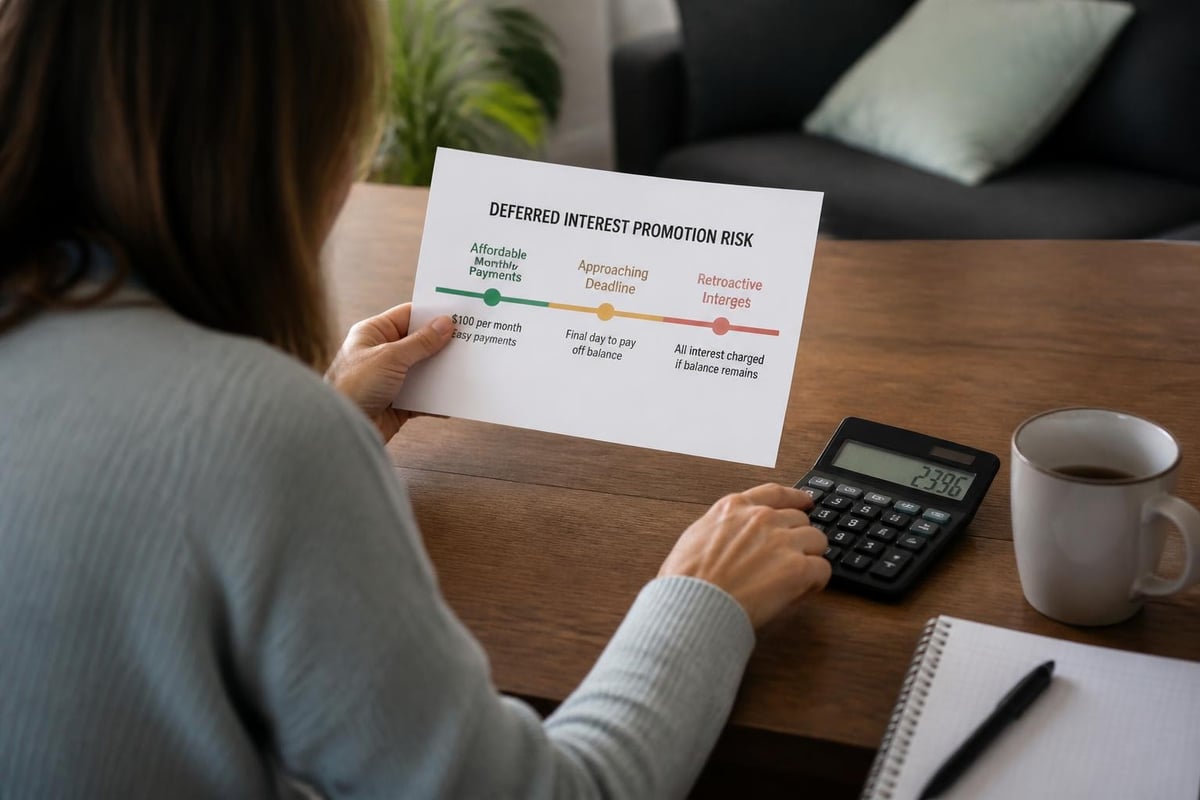
Missing the payoff deadline by a single day can trigger hundreds or thousands of dollars in backdated interest charges. If you choose deferred interest financing:
- Set up automatic monthly payments well above the minimum
- Schedule calendar reminders 60 and 30 days before the deadline
- Confirm final payoff amount and deadline date in writing
- Make your final payment at least one week early to account for processing time
Neglecting to Shop Around
Accepting the first loan offer or retail financing you encounter often costs significantly more than necessary. Interest rates and terms vary widely between lenders, even for borrowers with identical credit profiles.
Obtain quotes from at least three different sources:
- Your primary bank or credit union
- A specialized consumer lender with local branches
- An online lending platform
Multiple credit inquiries within a concentrated period (typically 14-30 days) count as a single inquiry for credit scoring purposes, so shopping around won't damage your credit score when done efficiently.
Alternative Approaches to Computer Acquisition
A loan for a computer represents one path to accessing technology, but not the only option. Depending on your situation, alternatives might better serve your needs.
Refurbished and Certified Pre-Owned
Manufacturer-refurbished computers offer substantial savings-typically 20-40% below new prices-while maintaining reliability through professional reconditioning and warranty coverage. Major manufacturers including Dell, HP, Lenovo, and Apple operate certified refurbishment programs.
Financing a $700 refurbished laptop instead of a $1,200 new model of similar capability reduces both purchase price and total interest paid. On a 24-month loan at 15% APR, you'd pay roughly $805 total for the refurbished unit versus $1,380 for the new model-a $575 difference.
Quality refurbished computers typically include:
- 90-day to one-year manufacturer warranty
- Professional testing and component replacement
- Cosmetic grading (minor scratches versus like-new condition)
- Identical functionality to new models
Employer Technology Programs
Many employers-particularly those with remote workforces-offer technology stipends or equipment purchase programs. These arrangements might include:
- Upfront equipment provision (computer remains company property)
- Reimbursement for employee-purchased equipment
- Subsidized financing through preferred vendors
- Annual technology refresh budgets
Check your employee handbook or consult human resources before financing a computer for work purposes. Your employer may provide funding that eliminates borrowing necessity entirely.
Community and Nonprofit Resources
Families facing financial hardship may qualify for free or low-cost computers through nonprofit organizations and community programs. While availability varies by location, organizations worth researching include:
- PCs for People: Provides refurbished computers to low-income individuals
- Computers with Causes: Offers free computers to qualified applicants
- The On It Foundation: Supplies computers and internet to low-income students
- Local library programs: Many public libraries loan laptops or provide free computer access
These resources particularly benefit students, seniors, and individuals seeking employment who need computer access but cannot afford market-rate financing.
Protecting Your Investment After Purchase
Once you've secured a loan for a computer and acquired your device, protecting that investment ensures you get full value from your purchase and loan repayment.
Insurance and Warranty Considerations
Standard manufacturer warranties typically cover defects for one year but exclude accidental damage, theft, and many common failures. Extended warranty and protection plans cost 10-20% of the computer's price but may provide peace of mind.
Evaluate whether protection plans make sense by considering:
- Your historical device failure rate
- Where and how you'll use the computer (travel risk, household with children)
- Laptop versus desktop (portability increases damage risk)
- Repair cost versus replacement cost for your model
Your homeowners or renters insurance may already cover theft and certain types of damage, potentially eliminating the need for separate device protection.
Proper Maintenance and Care
Basic maintenance extends computer life and protects the investment you're financing:
- Keep operating systems and software updated
- Use reputable antivirus and anti-malware protection
- Clean dust from vents and cooling systems quarterly
- Backup important files to cloud storage or external drives
- Use surge protectors to guard against electrical damage
- Keep liquids away from laptops and keyboards
A well-maintained computer regularly lasts 4-7 years, while neglected devices often fail within 2-3 years. Since most computer loans run 12-36 months, proper care ensures your device outlasts your payment obligation significantly.
Financing a computer through a personal loan provides access to essential technology while spreading costs over manageable monthly payments. By comparing lender options carefully, borrowing only what you truly need, and understanding total repayment costs, you can make informed decisions that support both your immediate technology needs and long-term financial health. Standard Financial serves customers throughout Louisiana, Mississippi, Tennessee, and Georgia with flexible personal loan options designed for real-life situations, including financing for computers, education expenses, and other important purchases-even if past credit challenges have made traditional financing difficult. Visit a local branch or apply online to explore your financing options today.







No comment yet, add your voice below!