

When facing significant expenses-whether home renovations, medical bills, or debt consolidation-choosing between borrowing options can feel overwhelming. Two popular financing solutions stand out: personal loans and home equity loans. Each offers distinct advantages and trade-offs that can significantly impact your financial future. Understanding the personal loan vs home equity loan decision requires careful consideration of your homeownership status, creditworthiness, timeline, and how you plan to use the funds. This comprehensive guide breaks down both options to help you make an informed borrowing decision.
What Defines Each Loan Type
Personal loans and home equity loans operate on fundamentally different principles, starting with collateral requirements and extending through every aspect of the borrowing experience.
Personal Loans: Unsecured Borrowing
A personal loan provides access to funds without requiring collateral. Lenders evaluate your creditworthiness based on income, employment history, credit score, and debt-to-income ratio. Because nothing secures the debt, lenders assume greater risk and typically charge higher interest rates than secured alternatives.
Key characteristics of personal loans include:
- No collateral required
- Faster approval and funding (often 1-7 business days)
- Fixed interest rates in most cases
- Loan amounts typically ranging from $1,000 to $100,000
- Repayment terms usually between 2-7 years
- Accessible to both homeowners and renters
Standard Financial specializes in personal loans for borrowers across the Southeast, including those with past credit challenges. This flexibility makes personal loans particularly valuable for renters or new homeowners who haven't built substantial equity.
Home Equity Loans: Secured Against Your Property
Home equity loans function as second mortgages, allowing homeowners to borrow against the equity they've accumulated. The loan uses your home as collateral, giving lenders security that translates to lower interest rates. You receive a lump sum upfront and repay it over a fixed term with predictable monthly payments.
To qualify, you typically need:
- At least 15-20% equity in your home
- Strong credit history (usually 620+ credit score)
- Stable income documentation
- Low debt-to-income ratio (generally below 43%)
- Recent home appraisal

Interest Rates and Costs: Breaking Down the Numbers
The personal loan vs home equity loan debate often centers on cost differences, where secured lending typically wins on rate but may lose on fees.
Rate Comparisons in Today's Market
Home equity loans generally offer lower annual percentage rates because your property secures the debt. As of 2026, home equity loan rates average between 6.5% and 9%, while personal loan rates range from 8% to 36% depending on creditworthiness.
| Loan Type | Average APR Range | Rate Determinants | Typical Fees |
|---|---|---|---|
| Personal Loan | 8% – 36% | Credit score, income, debt-to-income ratio | Origination fee (1-8%), late fees |
| Home Equity Loan | 6.5% – 9% | Home equity, credit score, loan-to-value ratio | Closing costs ($2,000-$5,000), appraisal, title search |
For borrowers with excellent credit, a home equity loan might cost 2-4 percentage points less than a personal loan. However, upfront costs can offset these savings, particularly for smaller loan amounts or shorter borrowing periods.
Hidden Costs and Fee Structures
Personal loans often include origination fees between 1-8% of the loan amount, deducted from your proceeds. Some lenders charge prepayment penalties, though many have eliminated this practice. Late payment fees typically range from $25 to $50.
Home equity loans involve closing costs similar to your original mortgage: appraisal fees ($300-$600), title search and insurance ($700-$1,000), attorney fees, and recording fees. These costs can total $2,000-$5,000, making home equity loans less economical for borrowing amounts below $15,000.
Speed and Accessibility: Timeline Considerations
When urgency matters, the personal loan vs home equity loan question often resolves quickly in favor of personal loans.
Personal Loan Application Speed
Modern personal loan applications leverage technology for rapid processing. Many lenders, including Standard Financial, offer:
- Online applications completed in minutes
- Instant pre-approval decisions
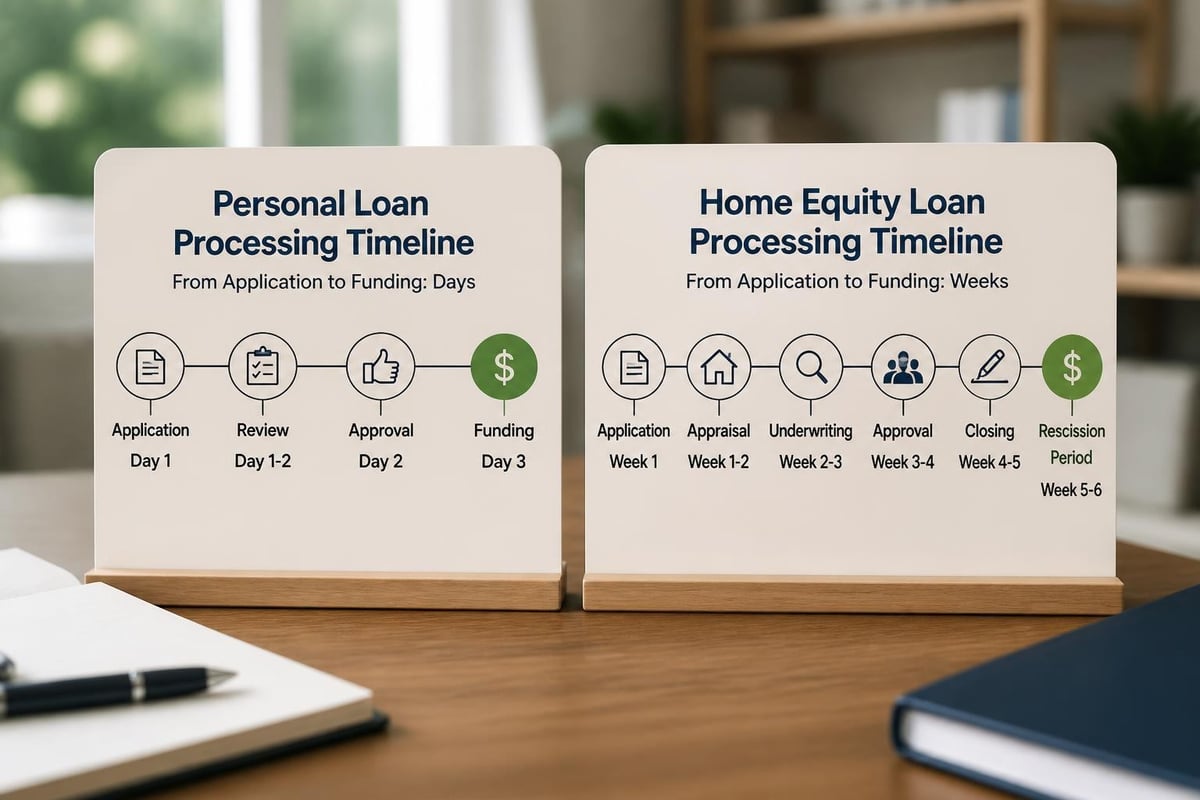
- Funding within 1-3 business days
- Minimal documentation requirements
This speed proves invaluable for medical emergencies, urgent home repairs, or time-sensitive consolidation opportunities. The streamlined process eliminates appraisals, title searches, and extensive underwriting delays.
Home Equity Loan Processing Timeline
Home equity loans require significantly more time due to property-related requirements. Expect this timeline:
- Application and initial review: 1-3 days
- Home appraisal scheduling and completion: 1-2 weeks
- Title search and verification: 3-7 days
- Underwriting and approval: 1-2 weeks
- Closing preparation: 3-5 days
- Mandatory 3-day rescission period: 3 days
Total processing typically spans 30-45 days. The Federal Trade Commission requires a three-day right to cancel after closing, further extending the timeline before funds become available.
Risk Assessment: What You're Putting on the Line
The collateral distinction represents the most significant difference in the personal loan vs home equity loan comparison, creating dramatically different risk profiles.
Unsecured Debt Consequences
Personal loan default damages your credit score and may result in collection actions or lawsuits. Lenders can pursue wage garnishment or bank account levies through court judgments. However, you never risk losing your home directly through personal loan default.
Default consequences include:
- Credit score drops of 100+ points
- Collection calls and letters
- Potential lawsuit and judgment
- Difficulty securing future credit
- Wage garnishment (after court judgment)
These consequences are serious but don't immediately threaten your housing stability.
Secured Debt and Foreclosure Risk
Home equity loans place your property at stake. Default can trigger foreclosure proceedings, potentially resulting in the loss of your home. This risk remains present even if you've paid your primary mortgage on time-the home equity lender holds a second lien position with foreclosure rights.
According to Bankrate’s analysis, borrowers should carefully evaluate their repayment certainty before pledging their homes as collateral. Job stability, emergency fund adequacy, and income reliability all factor into this risk assessment.
Tax Implications: Deductibility Matters
Tax treatment adds another dimension to the personal loan vs home equity loan equation, particularly for specific use cases.
Personal Loan Interest: Generally Not Deductible
Personal loan interest rarely qualifies for tax deductions. Regardless of how you use the funds, the IRS typically classifies personal loan interest as personal interest, which hasn't been deductible since the Tax Reform Act of 1986.
One narrow exception exists: if you use a personal loan exclusively for business purposes and operate as a sole proprietor, you may deduct the interest as a business expense. This requires meticulous documentation and clear business purpose.
Home Equity Loan Interest: Conditional Deductibility
IRS Publication 936 outlines when home equity loan interest qualifies for deduction. Following the Tax Cuts and Jobs Act, you can deduct interest only if you use the proceeds to "buy, build, or substantially improve" the home securing the loan.
Deductible scenarios:
- Kitchen or bathroom remodeling
- Room additions or expansions
- New roof or HVAC system
- Structural repairs
Non-deductible scenarios:
- Debt consolidation
- Vacation expenses
- Vehicle purchases
- Education costs
The deduction applies only if you itemize deductions rather than claiming the standard deduction. With the 2026 standard deduction at $14,600 (single) or $29,200 (married filing jointly), many taxpayers find itemizing doesn't benefit them.
Best Use Cases for Each Loan Type
Matching your specific situation to the appropriate loan type maximizes value and minimizes risk in the personal loan vs home equity loan decision.
When Personal Loans Excel
Personal loans serve borrowers best in these situations:
Renters and non-homeowners who lack property equity have no choice but benefit from unsecured lending's accessibility. Standard Financial's personal loan programs serve this population extensively across Louisiana, Mississippi, Tennessee, and Georgia.
Time-sensitive expenses such as medical procedures, emergency repairs, or limited-time consolidation offers benefit from rapid funding. When you need money this week rather than next month, personal loans deliver.
Smaller borrowing amounts under $15,000 often make more economic sense as personal loans because home equity loan closing costs would consume the interest rate savings.
Borrowers uncomfortable pledging their homes may accept higher interest rates in exchange for peace of mind. Financial advisor recommendations from Consumer Reports suggest this conservative approach for risk-averse borrowers.
| Situation | Why Personal Loans Win | Typical Loan Amount |
|---|---|---|
| Medical emergency | Speed, no appraisal needed | $5,000 – $25,000 |
| Credit card consolidation | Fast approval, fixed payments | $10,000 – $50,000 |
| Education expenses | Available to renters, quick funding | $3,000 – $30,000 |
| Vehicle purchase | No home required, simple process | $15,000 – $40,000 |
When Home Equity Loans Make Sense
Home equity loans provide advantages in specific circumstances:
Major home improvements that increase property value justify using your home as collateral. The tax deductibility of interest further improves economics when you itemize deductions.
Large borrowing amounts exceeding $50,000 benefit most from home equity's lower rates. The percentage-point difference compounds significantly on six-figure loans, potentially saving tens of thousands over the loan term.
Excellent credit homeowners with substantial equity (30%+ of home value) qualify for the best rates and terms. These borrowers can leverage their strong position for maximum savings.
Predictable, long-term expenses such as planned renovations allow time for the extended approval process. The 30-45 day timeline becomes acceptable when funding urgency doesn't exist.

Credit Impact and Qualification Requirements
Understanding how each loan type affects and requires credit helps borrowers set realistic expectations in the personal loan vs home equity loan evaluation.
Personal Loan Credit Considerations
Personal lenders evaluate multiple factors beyond credit scores. Standard Financial considers applicants with past credit challenges, recognizing that credit history doesn't always reflect current financial responsibility.
Minimum requirements typically include:
- Credit score of 580-600 (varies by lender)
- Verifiable income documentation
- Debt-to-income ratio below 50%
- Active checking account
- Valid identification
Credit utilization decreases when you use personal loan proceeds to pay off credit cards, potentially improving your credit score. The Federal Reserve’s research indicates installment loans like personal loans can diversify credit mix, another positive scoring factor.
Home Equity Loan Credit Standards
Home equity lenders maintain stricter requirements because they're underwriting both you and your property. Expect higher thresholds:
- Minimum credit score of 620-640
- Combined loan-to-value ratio below 80-85%
- Debt-to-income ratio below 43%
- Employment verification and income documentation
- Recent property appraisal showing sufficient value
These requirements exclude many borrowers who would qualify for personal loans. According to Experian’s comparison, approximately 30% of homeowners lack sufficient equity or credit scores for home equity borrowing.
Flexibility and Repayment Structures
Beyond rates and approval, the personal loan vs home equity loan choice involves different repayment experiences and flexibility options.
Personal Loan Repayment Terms
Most personal loans feature fixed monthly payments over terms ranging from 24 to 84 months. This predictability simplifies budgeting-you know exactly what you'll pay each month until the loan is satisfied.
Flexibility features often include:
- Early payoff without penalties (check your specific loan terms)
- Autopay discounts of 0.25-0.50%
- Payment date customization
- Occasional skip-payment options (fee-based)
Standard Financial works with borrowers facing temporary hardship to modify payment schedules when life circumstances change. This relationship-based lending approach provides practical flexibility that rigid automated systems cannot match.
Home Equity Loan Structure
Home equity loans mirror traditional mortgages with fixed rates and terms typically spanning 5-30 years. Longer terms reduce monthly payments but increase total interest paid over the loan's life.
Unlike home equity lines of credit (which Consumer Financial Protection Bureau explains work differently), home equity loans disburse as lump sums with immediate repayment starting. You cannot reborrow repaid amounts-each dollar repaid permanently reduces your outstanding balance.
Making Your Personal Loan vs Home Equity Loan Decision
Several key questions guide your choice between these borrowing options, each pointing toward the most appropriate solution for your circumstances.
Ask yourself these determining questions:
-
Do I own a home with significant equity? If no, personal loans represent your only option.
-
How quickly do I need funds? Urgent needs favor personal loans; planned expenses can accommodate home equity timelines.
-
What's my total borrowing amount? Smaller sums (under $15,000) often work better as personal loans; larger amounts may justify home equity's complexity.
-
How will I use the money? Home improvements used as collateral create alignment; general expenses favor personal loans.
-
What's my comfort level with home-secured debt? Risk tolerance matters-some borrowers sleep better without their home pledged as collateral.
-
Will I itemize tax deductions? Home equity interest deductibility only helps itemizers borrowing for qualified improvements.
The personal loan vs home equity loan decision ultimately balances cost against convenience, risk against reward, and speed against savings. CBS News analysis suggests most borrowers benefit from listing their top three priorities-whether lowest rate, fastest funding, or least risk-then choosing the loan type that delivers those priorities.
Choosing between a personal loan and a home equity loan requires careful evaluation of your specific financial situation, timeline, and risk tolerance. Both options provide valuable access to funds, but they serve different borrower needs and circumstances. Standard Financial specializes in flexible personal loan solutions for borrowers across the Southeast, including those with past credit challenges. Whether you need funding for home improvements, medical expenses, education, or debt consolidation, our experienced team can help you explore your options and find financing that fits your unique situation. Contact us today to discuss which loan type makes the most sense for your financial goals.







No comment yet, add your voice below!