
You can get a loan for dental work with bad credit, most often through a personal loan from a lender that reviews your full financial picture rather than relying on a credit score alone. Approval is more realistic when you bring a written treatment estimate, proof of steady income, and a clear monthly budget. This guide explains your options, how lenders evaluate applications with past credit problems, and how to borrow without taking on a payment you cannot sustain.
Can You Really Get Dental Financing With Bad Credit?
Yes, you can, though your choices narrow and the cost of borrowing usually rises as your credit score falls. Lenders treat a low score as a signal of higher risk, so they compensate with higher interest rates, smaller loan amounts, or requirements such as a co-signer.
Some lenders go beyond the score. They look at income stability, how long you have lived and worked in the same place, and whether past problems were isolated events, such as a medical bill or a job loss, or a continuing pattern. This is why a lender that specializes in people with limited or impaired credit often gives a different answer than a large bank or a credit card issuer.
Three situations tend to lead to the best outcomes:
- Steady income. Pay stubs, bank statements, or benefit letters showing consistent deposits carry real weight.
- A defined need. A written estimate from your dentist shows exactly how much you are asking to borrow and why.
- A realistic payment. A loan sized to fit your monthly budget is easier to approve than one that stretches it.
Reduce the Bill Before You Borrow
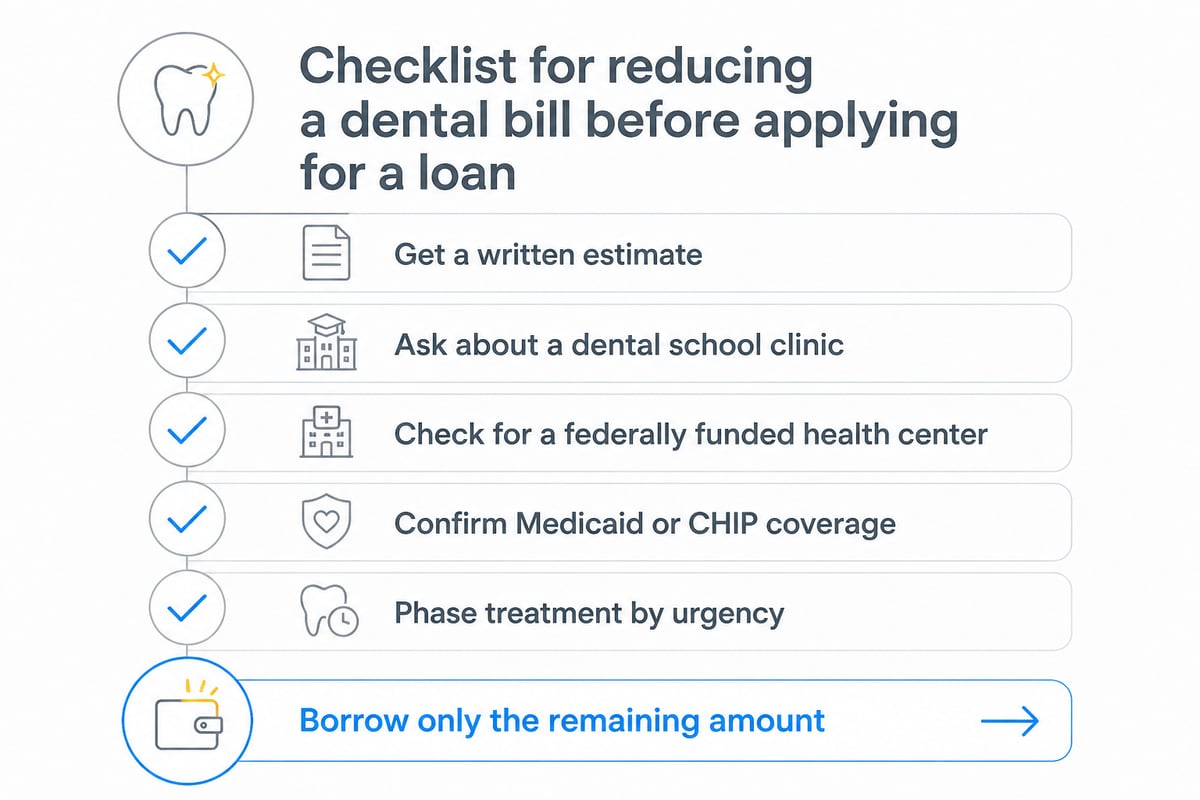
The most affordable loan is the one you borrow in a smaller amount, so lower the cost of treatment before you apply. Several public and low-cost sources of care exist, and they are worth checking first.
According to the National Institute of Dental and Craniofacial Research, dental schools may offer reduced-cost care through clinics where licensed dentists supervise students. The same source notes that federally funded health centers may provide dental care with charges based on what patients can afford and their income. Both are worth a phone call if there is a clinic near you.
Coverage rules also matter, particularly for families:
- States must provide dental benefits to children covered by Medicaid, but adult dental benefits are optional and vary by state, per the NIDCR.
- CHIP provides dental services to children up to age 19, with covered services varying by state.
- Medicare generally does not cover routine dental care such as checkups, cleanings, or fillings, although it covers some dental services tied to certain medical conditions or treatments.
If a child in your household needs care, confirm Medicaid or CHIP coverage before taking on debt. For adults, ask your dentist to separate urgent treatment from procedures that can wait. Phasing work over several months may keep each step small enough to pay with savings or a modest loan.
What Types of Financing Are Available for Dental Care?
Dental financing generally falls into five categories, and each treats poor credit differently. The right choice depends on the size of the bill, how fast you need treatment, and what you can pay each month.
| Option | How it works | Bad credit outlook |
|---|---|---|
| Personal loan | Fixed amount, fixed payments over a set term | Possible with lenders that work with impaired credit |
| Healthcare credit card | Revolving credit, often with promotional periods | Approval often depends heavily on score |
| In-house payment plan | Dentist spreads the bill over several months | Often no credit check, but terms vary by office |
| Third-party dental lender | Financing arranged at the dental office | Mixed; some approve lower scores, rates can be high |
| Dental savings plan | Membership discount, not a loan | No credit check, but you still pay the discounted fee |
A few cautions apply to this list. Promotional "no interest" offers on credit cards often charge deferred interest if the balance is not fully paid by the end of the promotional period, so read the terms closely. In-house plans are useful for small or mid-sized bills but rarely stretch long enough for major work. A savings plan lowers the price but does not provide funds, so you still need a way to pay.
Why a Personal Loan Often Works Best With Bad Credit
A personal loan is often the most dependable route because the amount, rate, and payment are fixed in advance, which makes it easy to budget around. You receive the funds, pay the dentist, and repay on a set schedule. There is no revolving balance that can grow, and no promotional clock that turns into a large interest charge.
Working with a lender that has local branch offices can also help. You can talk through your situation with a person and explain what happened with your credit rather than being sorted by an automated score cutoff.
Standard Financial's Personal Loans are designed for people with limited or impaired credit, and the company gives customers a chance to explain their credit situation and builds a tailor-made solution around it. For specifics such as loan amounts, terms, and rates, contact a branch or review the product pages directly rather than assuming figures from other lenders.
How Lenders Evaluate Applications With Credit Problems
Lenders weigh several factors together, and a low score is only one of them. Understanding the list helps you strengthen the parts you can control. The FDIC describes how credit reports and scores affect loan approval and terms, and it summarizes your rights to access your credit information.
Common factors include:
- Credit history. Late payments, collections, charge-offs, and bankruptcies are reviewed for recency and severity. An account that went delinquent five years ago reads differently than one that did last quarter.
- Income and employment. Consistent earnings matter more than high earnings.
- Debt-to-income ratio. This compares your monthly debt payments to your gross monthly income. A lower ratio signals room in your budget.
- Loan purpose and amount. A documented dental estimate is a clear, limited request.
- Existing relationship. Some lenders consider how you have handled prior loans with them.
Because mistakes on credit reports are common enough to matter, request your free reports before you apply and dispute anything inaccurate. Removing an error can raise your score and reduce your rate.

How to Apply for a Dental Loan, Step by Step
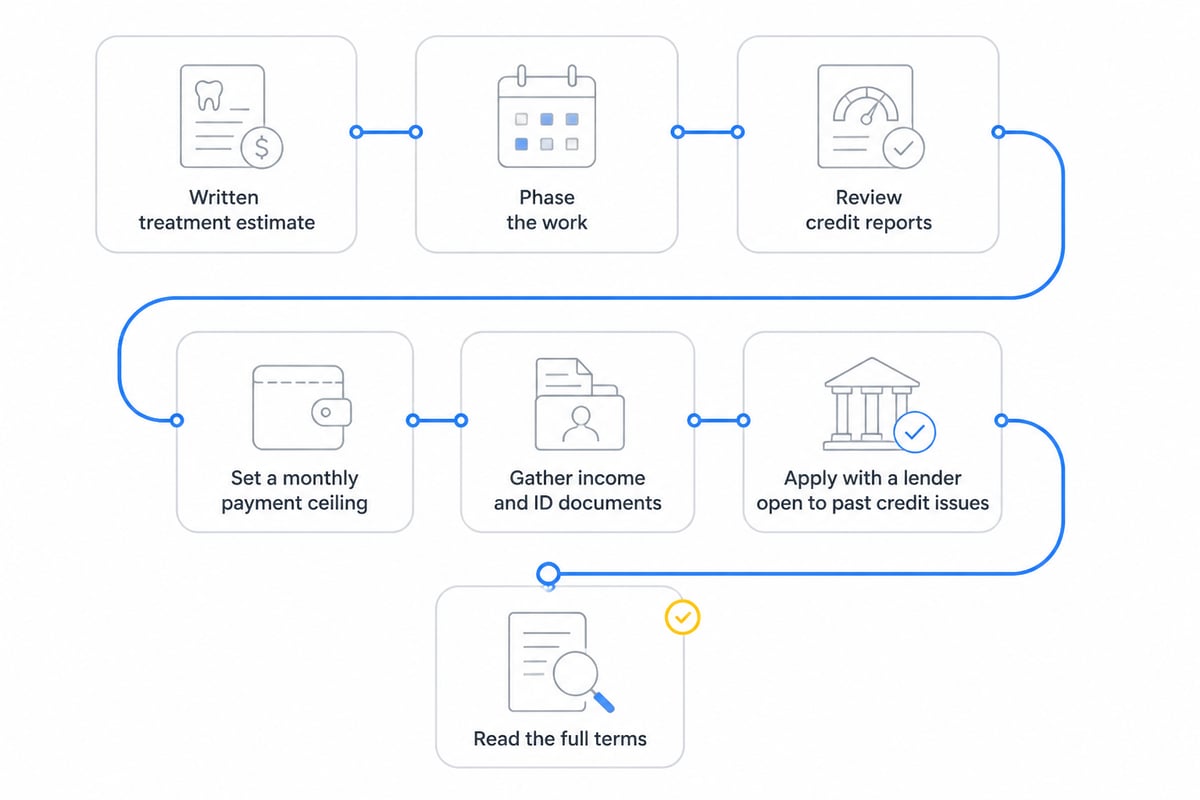
A prepared application moves faster and is more likely to be approved. Follow this sequence.
- Get a written treatment plan. Ask the dental office for an itemized estimate with procedure codes and total cost.
- Ask about phasing. Confirm which treatments are urgent and which can be scheduled later.
- Review your credit reports. Look for errors, and note which accounts are past due.
- Set a payment ceiling. Subtract rent or mortgage, utilities, food, transportation, and existing debts from your monthly income. Decide what is left for a new payment.
- Gather documents. Typical requests include a government ID, proof of income, proof of address, and bank statements.
- Apply with a lender open to past credit issues. Explain any past problems honestly and briefly.
- Read the full terms. Confirm the interest rate, total cost, fees, payment dates, and any prepayment rules before you sign.
Ways to Improve Your Approval Odds
You can improve your chances without waiting months, because several of the factors lenders examine respond quickly to small changes. Focus on the ones within your control.
- Pay down small balances. Lowering credit card balances can reduce your debt-to-income ratio and may improve your score.
- Bring a co-signer if possible. A co-signer with stronger credit can lower your rate, but that person becomes responsible if you miss payments, so discuss it openly.
- Request a smaller amount. Borrowing less, or financing only the first phase of treatment, may turn a decline into an approval.
- Show consistent deposits. Stable bank activity for several months supports your income documentation.
- Avoid multiple applications at once. Each hard inquiry can lower your score slightly, so submit applications selectively.
If you are declined, ask why. The reason, whether income, debt load, or credit history, tells you what to fix before you try again.
Costs and Red Flags to Watch For
Bad credit makes borrowers a target for expensive products, so compare the total cost of a loan, not only the monthly payment. A low payment spread over a long term can cost far more in interest than a slightly higher payment over a shorter term.
Before signing, check for:
- A high annual percentage rate (APR). Compare APRs, which include interest and most fees, across every offer.
- Origination or application fees. Know whether fees are deducted from your loan amount.
- Prepayment penalties. You should be able to pay early without a charge.
- Deferred interest. Common on promotional cards, it can add retroactive interest to your balance.
- Pressure to decide immediately. A legitimate lender allows time to read the agreement.
- Upfront payment demands. Be wary of anyone asking for money before a loan is approved.
If a dentist's office presents a financing plan, you are not obligated to accept it. You can arrange your own loan and pay the office directly.
Is Borrowing for Dental Work the Right Decision?
A loan makes sense when the treatment protects your health or prevents a more expensive problem, and when you can repay it without strain. Dental issues tend to grow more costly over time. An untreated cavity can progress to a root canal, and an infection can become a medical emergency, so delaying care can raise the final bill.
Still, test the decision with a few questions. Is the work necessary now, or can part of it wait? Have you checked lower-cost clinics and coverage options? Will the monthly payment fit your budget even in a tight month? If the answers are yes, borrowing for treatment can be a sound, practical choice.
If the numbers feel tight, refinancing existing higher-cost debt may free up room in your budget, and some lenders offer that alongside new loans. Ask about it when you speak with a loan officer.
Frequently Asked Questions
Can I get a dental loan with no credit history?
Yes, though options are limited. Lenders that work with limited credit often rely more on income and employment than on a score, so documentation of steady earnings becomes your strongest asset.
Will applying for a dental loan hurt my credit?
A formal application may trigger a hard inquiry, which can lower your score by a small amount for a short time. Making on-time payments afterward can help your credit over the long run.
How much can I borrow for dental work?
Amounts vary by lender and by your income, existing debt, and credit profile. Contact Standard Financial directly for current limits.
Is a payment plan from my dentist better than a loan?
It can be, particularly if it carries no interest and the term fits the bill. Compare the plan's total cost against a personal loan before choosing.
What if I am denied?
Ask for the reason, review your credit reports for errors, reduce the amount requested, or consider a co-signer. You can also reapply after addressing the issue.
Start by asking your dentist for an itemized written estimate, since that single document defines how much you actually need to borrow. Once you have it, Standard Financial can help you match that amount to a plan you can afford, and its Personal Loans are built for people with past credit problems or limited credit, with flexible financing plans and refinancing options. If you are ready to move forward, you can Apply For A Loan with Standard Financial and explain your credit situation so a solution can be built around it.

No comment yet, add your voice below!