
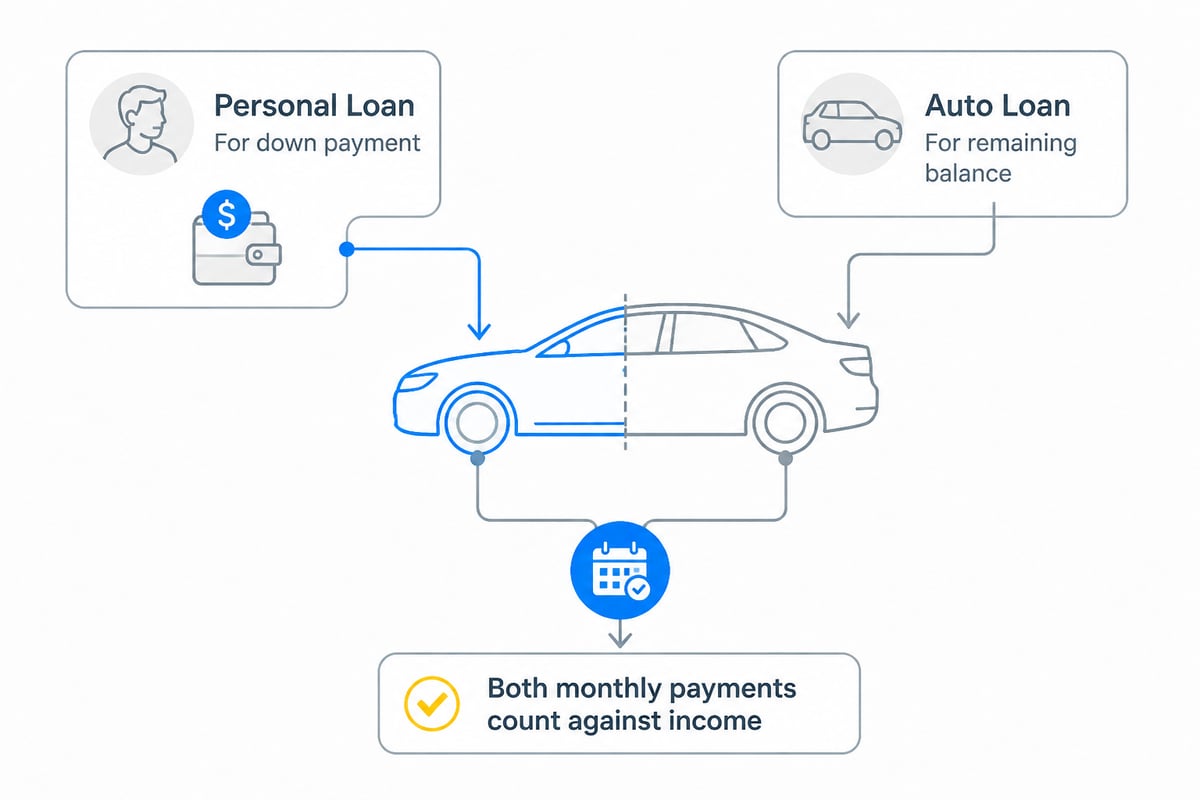
You can get a loan for a car down payment by borrowing through a personal loan, then using those funds as your upfront cash toward a vehicle. Lenders will count that new debt against your budget, so the approach works best when you can afford both the personal loan payment and the auto loan payment together.
For many shoppers in Louisiana, Mississippi, Tennessee, and Georgia, the down payment is the biggest obstacle between approval and driving off the lot. Edmunds reported that the average down payment on financed new-car purchases was $6,020 in Q3 2025. That is a large sum to gather quickly, which is why borrowing part of it deserves a careful look.
Can You Borrow Money for a Car Down Payment?
Yes, you can borrow money for a down payment, but the auto lender may limit how it counts that money. Some auto lenders ask where your down payment comes from, and borrowed funds can raise your debt-to-income ratio, which is the share of your monthly income that goes toward debt.
Two common situations shape the answer:
- The auto lender is not told, or does not ask. Many dealers focus on the amount you put down and your ability to repay, not its source.
- The auto lender requires a source. Some lenders ask for bank statements showing the funds. They may question a deposit that appeared recently or a loan that is not disclosed on your application.
The honest path is to disclose all debt on your application. Hiding a loan can lead to a denied application and complicates your relationship with the lender. A personal loan that is clearly documented and affordable usually causes fewer problems than a surprise discovered late in underwriting.
How a Personal Loan Works for a Down Payment
A personal loan gives you a lump sum that you repay in fixed monthly installments over a set term, and you can generally spend it on a wide range of purposes, including a down payment. The lender reviews your income, existing debts, and credit history, then offers an amount, an interest rate, and a repayment length.
Here is the typical sequence:
- You apply and provide income and identification details.
- The lender reviews your credit and your ability to repay.
- If approved, you receive the funds and begin fixed monthly payments.
- You use the cash toward the vehicle's down payment.
- You apply separately for the auto loan, which finances the remaining balance.
The key point is that you end up with two loans and two monthly payments. Before you commit, add both payments together and compare the total to your take-home pay.
Is Borrowing for a Down Payment a Good Idea?
It can be a good idea when the combined payments fit comfortably in your budget and the down payment meaningfully improves your auto loan terms. It is a poor idea when you are stretching to afford the car at all, because you would be financing the entire purchase and adding a second interest charge on top.
Consider the potential benefits:
- Lower auto loan balance. A larger down payment means you finance less of the vehicle's price.
- Better approval odds. Some lenders approve more readily when a borrower puts money down, since the vehicle secures more of the debt.
- Less negative equity. Cars lose value quickly, and a bigger down payment helps keep you from owing more than the car is worth.
And the potential costs:
- Two interest charges. You pay interest on the personal loan and on the auto loan.
- A heavier monthly load. Two payments can strain a tight budget.
- Possible lender pushback. Some auto lenders scrutinize borrowed down payments.
A simple test helps. If the personal loan payment would push you into skipping other bills or draining your emergency savings, the plan is too aggressive.
What Does a Car Cost to Finance Right Now?
Financing costs vary widely between new and used vehicles, and current figures show why the size of your down payment matters. According to Experian, the average new-vehicle loan in Q4 2025 was $43,582 at an average rate of 6.37%, with an average monthly payment of $767. For used vehicles, the average loan was $27,528 at 11.26%, with an average payment of $537.
| Vehicle type | Average loan amount | Average interest rate | Average monthly payment |
|---|---|---|---|
| New | $43,582 | 6.37% | $767 |
| Used | $27,528 | 11.26% | $537 |
These are national averages, not quotes, and your own rate depends on your credit and the lender. The comparison still makes one useful point: the used-vehicle rate is notably higher than the new-vehicle rate, so a larger down payment can reduce the amount exposed to that higher rate.
Loan length matters as much as rate. Experian found that nearly 30% of new-vehicle loans in Q4 2025 had terms of 73 to 84 months, up from 26.03% a year earlier. Longer terms lower the monthly payment but generally raise total interest costs, which is another reason to avoid stacking a long auto loan on top of a personal loan.
How Much Should You Put Down on a Car?
A common guideline is a meaningful down payment, with your situation determining the exact figure. The guideline exists because vehicles depreciate fastest in the first year or two, and a meaningful down payment cushions you against owing more than the car is worth.
You do not need to hit those numbers exactly. What matters is whether the amount you put down brings your auto loan payment into a range you can sustain. A smaller down payment is not a failure if the monthly cost still fits comfortably. A larger one is not automatically wise if reaching it requires expensive borrowing.
A useful way to think about it: compare the interest you would pay on a personal loan against the interest you would save on the auto loan by financing less. If the personal loan costs more than it saves, you are better off putting less down or waiting.
Should You Buy a $40,000 Car on a $60,000 Income?
Buying a $40,000 car on a $60,000 annual income is usually a stretch, because the vehicle would cost a large share of your gross yearly pay. Keeping total vehicle expenses, including payment, insurance, and fuel, to a modest share of your take-home income is a sound budgeting approach, and a car priced at that level often strains it.
Run the numbers before you shop:
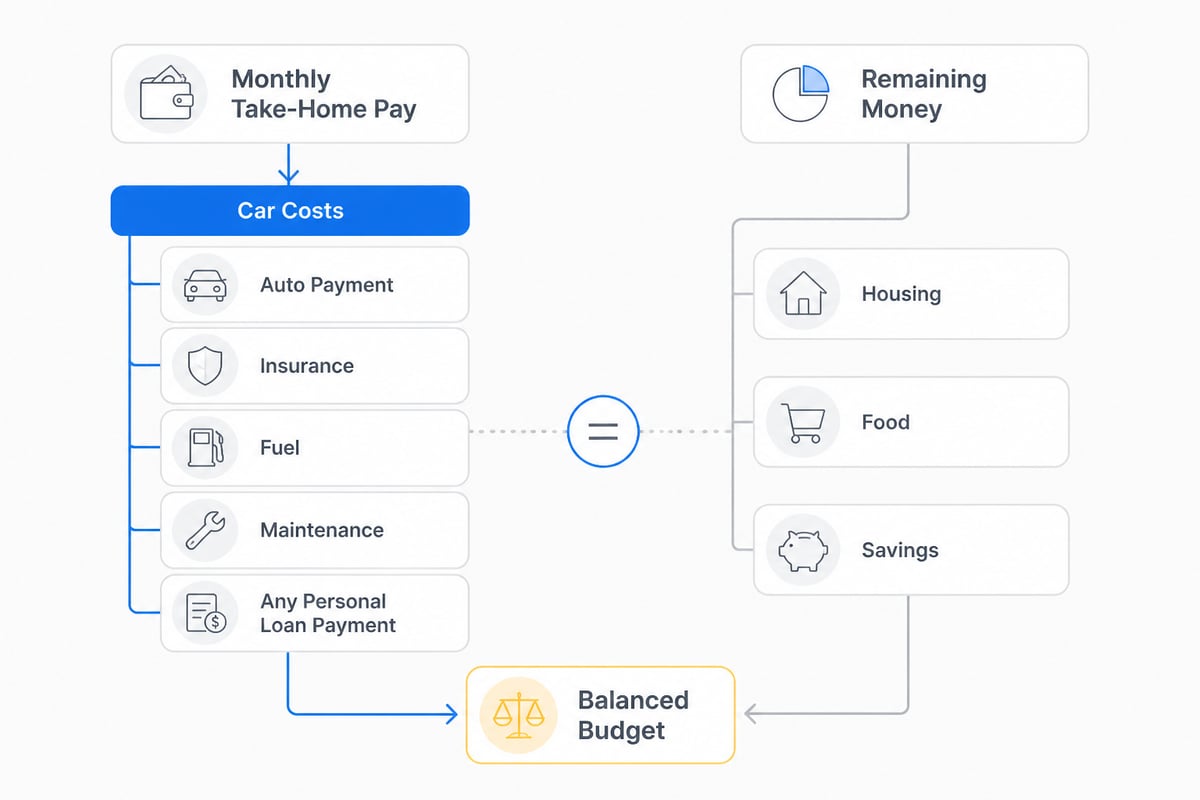
- Estimate your monthly take-home pay.
- Add the expected auto payment, insurance, fuel, and maintenance.
- Add any personal loan payment if you plan to borrow the down payment.
- Check that the total leaves room for housing, food, and savings.
If the math is tight, a less expensive vehicle often solves the problem more cleanly than any loan structure. Borrowing for the down payment on a car that already strains your income compounds the risk rather than reducing it.
What Are the Best Ways to Cover a Down Payment?
The best way to cover a down payment is usually the cheapest source that you can reach in your timeframe, and a loan is one option among several. Compare these approaches before borrowing:
- Savings. No interest and no added monthly payment, but it can take months to build.
- Trade-in equity. If you own a vehicle worth more than you owe on it, that equity can serve as part or all of the down payment.
- Selling something you no longer need. A second vehicle, equipment, or other valuables can raise cash without debt.
- Waiting and saving for a short period. Even two or three extra months of saving can reduce what you need to borrow.
- A personal loan. Fastest when you need cash now, but it carries interest and adds a payment.
- Dealer or lender incentives. Some dealers offer rebates or promotions that can lower the amount you need upfront. Confirm the terms in writing.
Often the strongest plan combines two of these. For example, you might use trade-in equity for most of the down payment and borrow only the gap, which keeps the personal loan small and the payment manageable.

Leasing Versus Financing: Which Needs a Smaller Upfront Payment?
Leasing often requires a lower upfront payment than buying with financing, but you do not own the vehicle at the end of the term. With financing, you borrow to buy the car and build ownership as you repay. With a lease, you pay for the portion of the vehicle's value you use over the term, then return it or buy it.
The tradeoffs look like this:
- Financing: Higher monthly payments in many cases, no mileage limits, and you own the car once the loan is paid off.
- Leasing: Often lower monthly payments and smaller upfront costs, but mileage caps, wear charges, and no ownership at the end.
If your main goal is to avoid a large down payment, a lease can reduce the cash needed at signing. If you drive a lot or want to keep a vehicle for many years, financing usually fits better. Neither option removes the need to check the total cost over time.
How to Qualify With Past Credit Problems or Limited Credit
You can still qualify with past credit problems or limited credit, though you may face higher rates and tighter terms. Lenders look at more than a score. Steady income, a reasonable debt load, and a clear explanation of what happened in your credit history all carry weight.
A few steps improve your position:
- Review your credit reports. Check for errors and dispute anything inaccurate before you apply.
- Gather proof of income. Pay stubs, bank statements, or other documentation show your ability to repay.
- Keep your debt low. Paying down balances before you apply helps your debt-to-income ratio.
- Apply for only what you need. Borrow the smallest down payment amount that makes the car purchase workable.
- Be ready to explain your situation. Context about past difficulties can matter to lenders that review applications individually.
That last point is where lender choice matters. Standard Financial works with people who have past credit problems or limited credit, and it gives customers a chance to explain their credit situation so it can build a tailor-made solution. That approach differs from a purely score-driven decision.
Where Standard Financial Fits In
If you are buying a vehicle, Standard Financial's Vehicle Loans are designed for car purchases and may be worth reviewing alongside a personal loan. To learn about current terms, amounts, and eligibility, check the product page or contact a local branch rather than relying on general assumptions. Standard Financial offers flexible financing plans and refinancing options, which can matter if your needs change after the purchase.
What Is the Best Way to Get a Loan for a Car?
The best way to get a car loan is to prepare before you shop, then compare offers from more than one lender. Start by knowing your credit standing and your budget, since both shape the rate you can expect.
Follow these steps:
- Set a payment ceiling. Decide the most you can pay monthly for the loan, insurance, and fuel together.
- Check your credit. Review your reports and fix errors.
- Get pre-approved. A pre-approval shows your likely rate and amount before you negotiate at a dealership.
- Compare terms, not just payments. A low monthly payment on a long term can cost far more in interest.
- Choose the shortest term you can afford. Shorter terms reduce total interest.
- Read the full agreement. Confirm the rate, fees, and any penalties before you sign.
Pre-approval also strengthens your position at the dealership, because you know your limit and can focus on the vehicle's price rather than the financing pitch.
FAQ
Do car lenders know if my down payment is borrowed?
They may, particularly if your bank statements show a recent deposit or if you list a new personal loan on your application. You should disclose all debts accurately, since an undisclosed loan can cause a denial or create problems later.
Can I get a car loan with no down payment?
Some lenders approve auto loans with little or no money down, but you will typically finance more of the vehicle's price and may pay a higher rate. A zero-down approach also raises the chance of owing more than the car is worth early in the loan.
How do personal loans work?
A personal loan provides a lump sum that you repay in fixed monthly installments over an agreed term, with interest. Lenders set the rate and amount based on your income, debts, and credit history, and the funds can generally be used for many purposes, including a down payment.
Your next step is to add up what you can comfortably pay each month for a personal loan and an auto loan combined, then borrow only up to that limit. From there, Standard Financial can help you review your options through its Vehicle Loans and personal loans, with branches in Louisiana, Mississippi, Tennessee, and Georgia and a willingness to hear your credit story, including past credit issues. When you are ready to move forward, you can apply for a loan with Standard Financial and talk through a plan built around your situation.

No comment yet, add your voice below!