

Getting a loan for a motorcycle opens the door to ownership for millions of riders who cannot pay the full purchase price upfront. Whether you are eyeing a sleek sport bike, a dependable cruiser, or a versatile touring model, understanding your financing options can save you thousands of dollars and help you avoid common pitfalls. With interest rates, loan terms, and lender requirements constantly shifting in 2026, borrowers need a clear roadmap to navigate the motorcycle lending landscape. This guide walks you through every step of securing a motorcycle loan, from comparing lenders and understanding loan structures to improving your approval odds and avoiding predatory alternatives.
Understanding the Basics of Motorcycle Financing
A loan for a motorcycle works similarly to an auto loan, with the motorcycle itself serving as collateral. If you fail to make payments, the lender can repossess the bike to recover their losses. Most motorcycle loans are installment loans with fixed monthly payments spread over a set term, typically ranging from 24 to 84 months.
The total cost of your loan depends on three primary factors: the principal amount borrowed, the annual percentage rate (APR), and the loan term. A lower APR or shorter term reduces the total interest paid over the life of the loan, but shorter terms mean higher monthly payments. Borrowers must balance affordability with total cost when selecting loan terms.
Types of Motorcycle Lenders
You can obtain a loan for a motorcycle from several sources, each with distinct advantages and requirements:
- Banks and credit unions: Traditional financial institutions often offer competitive rates, especially for borrowers with strong credit histories. Credit unions may provide more flexible terms for members.
- Dealer-arranged financing: Many motorcycle dealerships partner with lenders to offer on-the-spot financing. The dealer-arranged financing process can be convenient but may include higher markups on interest rates.
- Online lenders: Digital-first lenders have streamlined application processes and may approve borrowers who fall outside traditional lending criteria.
- Consumer finance companies: These lenders specialize in personal loans and often work with borrowers who have less-than-perfect credit.
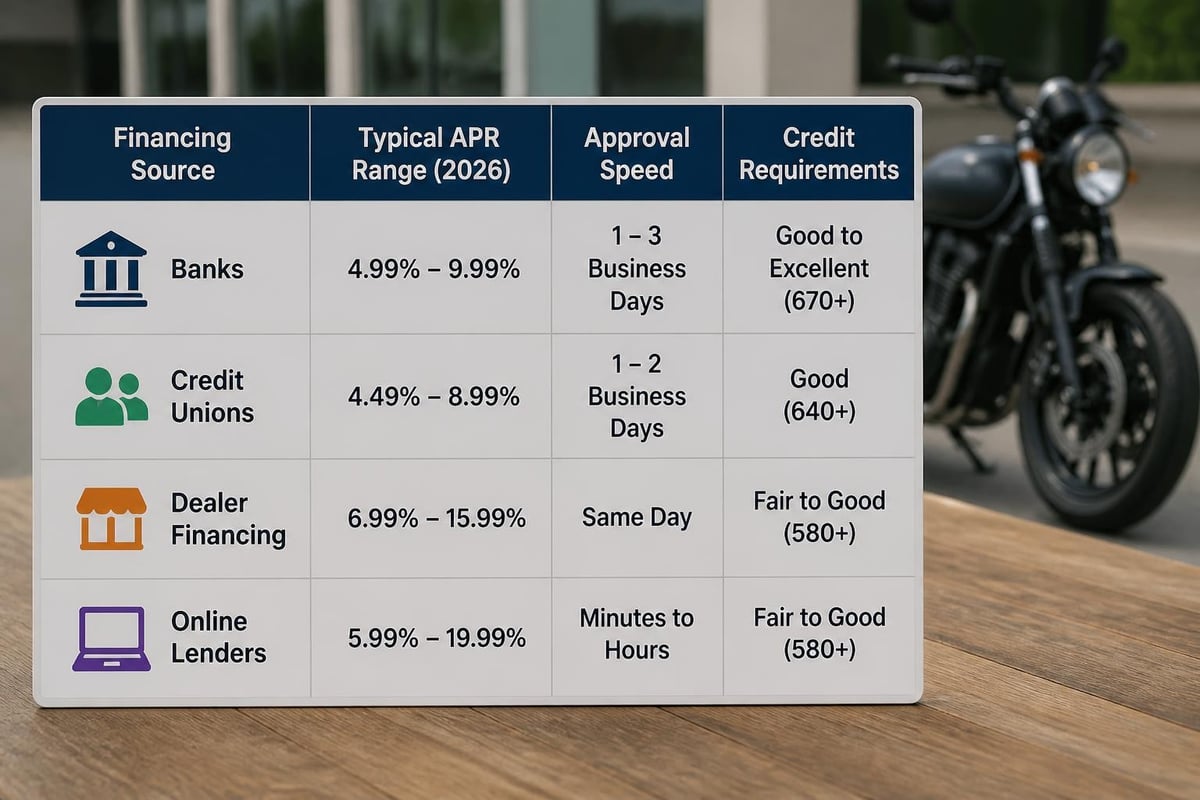
Each lender type has different underwriting standards, fee structures, and customer service models. Shopping around and comparing offers from at least three lenders helps ensure you get the best available terms for your situation.
How to Qualify for a Motorcycle Loan
Lenders evaluate several key factors when deciding whether to approve your loan for a motorcycle. Your credit score sits at the top of this list, with scores above 700 generally qualifying for the most favorable rates. Borrowers with scores between 600 and 700 can still qualify, but at higher interest rates. Those below 600 may face limited options or require a cosigner.
Key Qualification Criteria
| Factor | Preferred Range | Impact on Approval |
|---|---|---|
| Credit Score | 700+ | Prime rates, highest approval odds |
| Debt-to-Income Ratio | Below 40% | Demonstrates ability to manage payments |
| Employment History | 2+ years stable | Shows income reliability |
| Down Payment | 10-20% | Reduces lender risk, may lower APR |
| Motorcycle Age/Condition | New or 5 years old or newer | Affects loan-to-value ratio |
Your debt-to-income ratio (DTI) measures your monthly debt obligations against your gross monthly income. Lenders prefer DTI ratios below 40 percent, meaning your total monthly debt payments should not exceed 40 percent of your pre-tax income. If your DTI is higher, paying down existing debts before applying can improve your approval chances.
Employment stability matters too. Lenders want to see at least two years of consistent employment or income, whether from a job, self-employment, or retirement benefits. Frequent job changes or gaps in employment can raise red flags.
The Application Process
Applying for a loan for a motorcycle typically requires gathering several documents:
- Proof of identity: Driver's license or state ID
- Proof of income: Recent pay stubs, tax returns, or bank statements
- Proof of residence: Utility bill or lease agreement
- Motorcycle details: VIN, make, model, year, and purchase price
- Insurance quote: Many lenders require proof of planned insurance coverage
Most lenders now accept online applications, which can generate pre-approval decisions within minutes. Pre-approval gives you a conditional offer based on preliminary information, allowing you to shop for motorcycles within your budget. Final approval comes after the lender verifies your documentation and the motorcycle details.
Calculating the True Cost of Your Loan
The sticker price of the motorcycle represents just one component of your total financing cost. When you take out a loan for a motorcycle, you must account for interest, fees, insurance, and taxes to understand your real financial obligation.
Breaking Down Total Ownership Costs
Interest charges accumulate based on your APR and loan term. A $15,000 motorcycle financed at 6 percent APR for 60 months costs approximately $2,400 in total interest. Extending that same loan to 72 months increases interest to around $2,900, even though monthly payments drop.
Origination fees, document fees, and prepayment penalties vary by lender. Some charge flat origination fees of $100 to $500, while others build costs into the interest rate. Always ask for a complete fee schedule before committing.
Insurance represents a significant ongoing expense. Motorcycle crash and injury trends show that bikes have higher accident rates than cars, leading insurers to charge more for comprehensive and collision coverage. Young riders or those with powerful sport bikes face the steepest premiums, sometimes exceeding $2,000 annually.

Sales tax and registration fees add thousands to your upfront costs. Most states assess sales tax on the full purchase price, typically between 4 and 9 percent. Registration and title fees vary by state and motorcycle value but generally range from $50 to $300 annually.
Comparing Loan Terms and Interest Rates
Finding the best loan for a motorcycle requires comparing offers across multiple dimensions. APR represents the most important comparison metric because it includes both the interest rate and certain fees, giving you a standardized cost measure.
APR Ranges by Credit Tier (2026)
| Credit Score Range | Typical APR Range | Monthly Payment on $15,000 (60 months) |
|---|---|---|
| 750+ (Excellent) | 4.5% – 6.5% | $280 – $292 |
| 700-749 (Good) | 6.5% – 9.5% | $292 – $311 |
| 650-699 (Fair) | 9.5% – 14.5% | $311 – $349 |
| 600-649 (Poor) | 14.5% – 20% | $349 – $398 |
| Below 600 (Very Poor) | 20% – 30%+ | $398 – $475+ |
These ranges reflect current market conditions, but individual offers vary based on lender policies, loan amount, and the specific motorcycle being financed. Recent trends in consumer credit show that interest rates have remained elevated compared to the previous decade, making rate shopping especially important in 2026.
Loan terms directly affect both your monthly payment and total interest paid. Shorter terms mean higher monthly payments but lower total cost. Longer terms reduce monthly obligations but significantly increase total interest. A 36-month loan for a motorcycle builds equity faster and costs less overall, while a 72-month loan keeps payments manageable but extends your debt obligation.
Secured vs. Unsecured Motorcycle Loans
Most motorcycle loans are secured, meaning the bike serves as collateral. Secured loans typically offer lower interest rates because the lender can repossess the motorcycle if you default. However, some borrowers use unsecured personal loans to purchase motorcycles, especially for older bikes or private-party sales.
Unsecured loans carry higher interest rates, sometimes 5 to 10 percentage points above secured rates for the same borrower. They also typically have shorter maximum terms, usually capped at 60 months. The advantage is that the lender cannot repossess your motorcycle if you default, though they can still sue you for the debt and damage your credit.
Avoiding Predatory Lending Practices
Not all financing options serve borrowers' best interests. When searching for a loan for a motorcycle, watch out for predatory products that trap you in cycles of debt or charge excessive fees.
Red Flags and Warning Signs
Title loans represent one of the most dangerous alternatives. These short-term, high-interest loans use your motorcycle title as collateral and typically charge APRs exceeding 100 percent. The FTC warns consumers about title loan risks, noting that many borrowers lose their vehicles after failing to repay these loans within 30 days.
Avoid these predatory features:
- Triple-digit APRs: Any loan charging more than 36 percent APR should raise serious concerns
- Balloon payments: Large final payments that force refinancing or default
- Prepayment penalties: Fees for paying off your loan early
- Mandatory add-ons: Required products like extended warranties or insurance bundled into the loan
- Yo-yo financing: Dealer tactics where they let you take the bike home, then call days later demanding a higher interest rate or larger down payment
The indirect lending model used by many dealers creates opportunities for rate markup. Dealers submit your application to multiple lenders, receive wholesale rates, then add percentage points as profit. While legal, this practice means you might qualify for better rates by applying directly to lenders.
Special Considerations for Different Bike Types
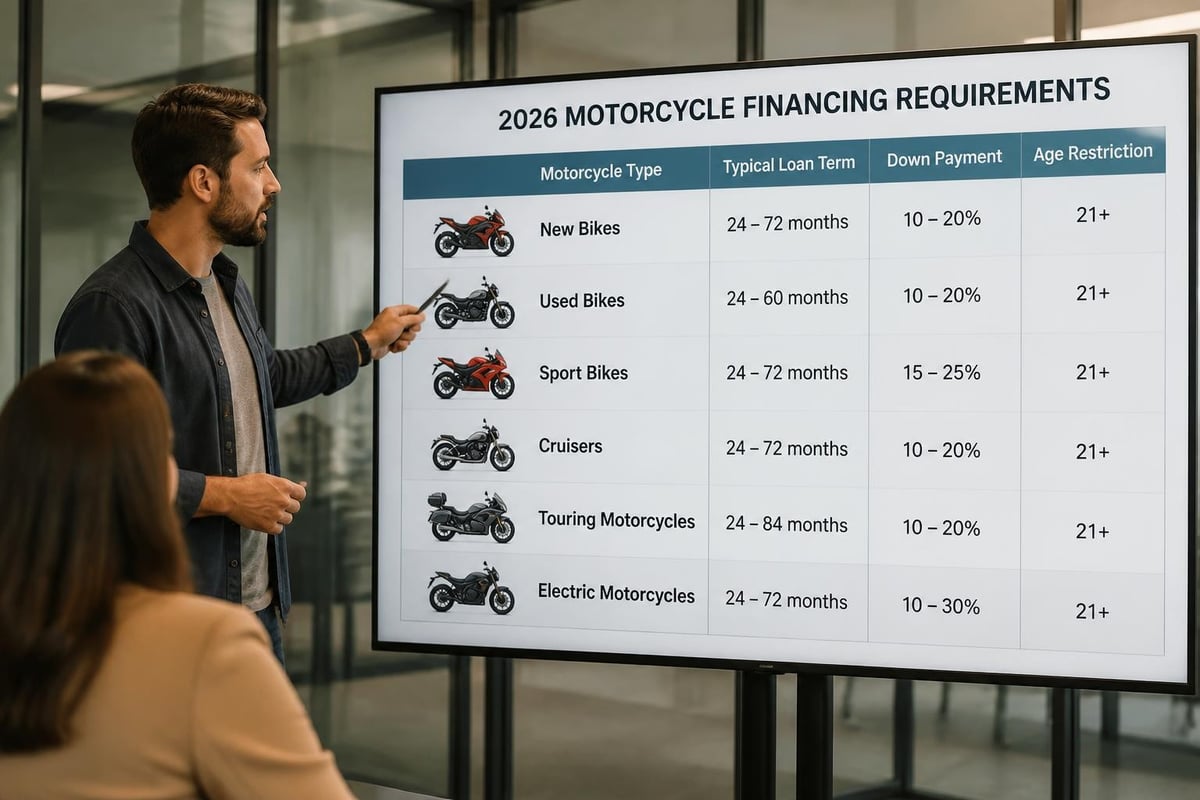
The type of motorcycle you purchase affects your loan for a motorcycle in several ways. Lenders classify bikes into categories, each with different risk profiles and lending requirements.
How Motorcycle Type Affects Financing
New motorcycles qualify for the best rates and longest terms because they have clear titles, known condition, and higher resale values. Lenders readily finance new bikes for up to 84 months, though 60 months is more common.
Used motorcycles face stricter lending criteria. Most lenders cap financing at 72 months for used bikes and may require they be less than 10 years old. Older bikes might not qualify for secured loans at all, forcing you toward unsecured personal loans at higher rates.
Sport bikes and high-performance models sometimes face higher interest rates or require larger down payments due to their elevated accident and theft rates. Some lenders specifically exclude certain models or require borrowers to be at least 25 years old.
Cruisers and touring bikes generally receive more favorable treatment because they attract older, more experienced riders with better credit profiles and lower accident rates.
Electric motorcycles are newer to the lending market. While rates have become competitive with gas bikes, some smaller lenders do not yet have established policies for electric models.
Improving Your Approval Odds
If you do not currently qualify for favorable terms on a loan for a motorcycle, several strategies can strengthen your application over the next few months.
Credit Improvement Strategies
Raising your credit score delivers the most significant impact on your loan terms. Focus on these high-impact actions:
- Pay down revolving debt: Reducing credit card balances below 30 percent of your limits boosts your credit score quickly
- Dispute errors: Review your credit reports for inaccuracies and dispute any errors with the credit bureaus
- Avoid new credit inquiries: Multiple recent credit applications can temporarily lower your score
- Make all payments on time: Payment history accounts for 35 percent of your FICO score
- Keep old accounts open: Length of credit history matters, so avoid closing your oldest credit cards
Increasing your down payment reduces the amount you need to borrow and demonstrates financial discipline to lenders. Saving 20 percent of the motorcycle's purchase price can qualify you for better rates and eliminates the risk of being underwater on your loan if the bike depreciates.
Alternative Approval Paths
Cosigners can help borrowers with limited credit history or lower scores qualify for better terms. A cosigner with strong credit essentially guarantees your loan, reducing the lender's risk. However, cosigners become fully responsible for the debt if you default, potentially damaging their credit and finances.
Some lenders offer secured credit cards or credit-builder loans designed to help borrowers establish or rebuild credit. Using these products responsibly for six to twelve months can improve your profile enough to qualify for better motorcycle loan terms.
Refinancing Your Existing Motorcycle Loan
If you already have a loan for a motorcycle with unfavorable terms, refinancing might reduce your interest rate or monthly payment. Refinancing replaces your current loan with a new one, ideally at better terms.
When Refinancing Makes Sense
Refinancing delivers the most value when interest rates have dropped since your original loan, your credit score has improved significantly, or you need to adjust your monthly payment. Generally, refinancing makes financial sense if you can reduce your APR by at least 2 percentage points and plan to keep the motorcycle for at least another year.
Calculate whether refinancing saves money after accounting for any fees. Some lenders charge origination fees or prepayment penalties that can offset interest savings. A refinance calculator helps you compare your current loan cost against potential new terms.
The best time to refinance is typically 12 to 18 months into your original loan, after you have established a payment history but before you have paid down most of the principal. Refinancing very early might trigger prepayment penalties, while refinancing late provides limited savings.
Tax and Legal Considerations
Understanding the tax treatment of your loan for a motorcycle helps you plan your overall budget and potentially identify deductions.
Sales Tax and Registration
Most states collect sales tax on motorcycle purchases, calculated as a percentage of the purchase price. Some lenders allow you to roll sales tax into your loan, while others require you to pay it upfront. Rolling tax into your loan increases your total borrowing cost because you pay interest on the tax amount.
Registration fees and title transfer costs vary by state. Some states assess annual registration fees based on the motorcycle's value, meaning newer, more expensive bikes cost more to register each year.
Potential Deductions
The IRS allows certain deductions related to vehicle ownership, though most apply only to business use. If you use your motorcycle exclusively for business purposes, you might deduct loan interest and depreciation. However, personal-use motorcycles do not qualify for interest deductions the way mortgage interest does for homes.
State and local tax deductions for vehicle purchases changed under recent tax law. While you could previously deduct state sales tax on vehicles as an itemized deduction, current rules make this beneficial only for taxpayers who itemize and live in states without income taxes.
Managing Your Motorcycle Loan Successfully
Once you secure a loan for a motorcycle, managing it properly protects your credit and saves money. Set up automatic payments to ensure you never miss a due date. Even one late payment can damage your credit score and trigger late fees.
Payment Strategies
Making extra principal payments whenever possible reduces your total interest cost and shortens your loan term. Most lenders accept additional principal payments without penalty, but verify this before committing. When making extra payments, specify that the additional amount should apply to principal, not future interest.
If you receive a bonus, tax refund, or other windfall, consider putting part of it toward your motorcycle loan. Every $500 in extra principal can save you hundreds in interest over the loan term.
Protecting Your Investment
Comprehensive insurance remains essential throughout your loan term. Most lenders require borrowers to maintain full coverage that includes collision and comprehensive protection. Letting your insurance lapse violates your loan agreement and can trigger repossession.
Regular maintenance preserves your motorcycle's value and ensures it remains reliable. Well-maintained bikes have higher resale values, which matters if you decide to sell before paying off the loan. Keep detailed service records to demonstrate proper care to potential buyers.
Securing a loan for a motorcycle requires careful research, comparison shopping, and honest assessment of your financial situation, but the right financing makes bike ownership accessible and affordable. Whether you have excellent credit or face challenges from past credit issues, understanding your options empowers you to make informed decisions. Standard Financial works with borrowers throughout Louisiana, Mississippi, Tennessee, and Georgia to provide flexible financing solutions tailored to individual circumstances, including options for those rebuilding credit. Contact a local branch today to explore how their consumer lending expertise can help you get on the road with terms that fit your budget.






No comment yet, add your voice below!