
Loan refinancing means replacing an existing loan with a new one, usually to get a lower interest rate, a lower monthly payment, a different repayment length, or a combination of those. The new loan pays off the old balance, and you then repay the new lender under the new terms. Whether it saves you money depends on the rate, the fees, and how long you keep the loan.
For borrowers in Louisiana, Mississippi, Tennessee, and Georgia, the decision often comes down to a practical question: will the new payment help my budget without costing me more in the long run? The sections below walk through how the process works, what it costs, how to calculate your break-even point, and how to tell when waiting is the better choice.
What Happens When You Refinance a Loan?
When you refinance a loan, a new lender (or your current one) issues a new loan, and the proceeds pay off your existing balance in full. You then owe the new lender, with a new interest rate, a new term, and a new monthly payment.
Three things can change:
- The interest rate. A lower rate reduces the cost of borrowing, assuming the rest of the terms stay similar.
- The term. Stretching payments over more months lowers each payment but usually raises total interest. Shortening the term does the reverse.
- The loan structure. Some borrowers move from a variable to a fixed rate, or combine several debts into a single payment.
Refinancing applies to many kinds of debt, including mortgages, auto loans, student loans, and personal loans. The mechanics are similar across all of them: you apply, the lender reviews your credit and income, and if approved, the old loan is paid off at closing.
Why Do People Refinance?
People refinance mainly to reduce cost or relieve monthly pressure, and sometimes to simplify their finances. The most common reasons are:
- Lowering the interest rate. If market rates have fallen or your credit has improved since you first borrowed, a new loan may carry a cheaper rate.
- Reducing the monthly payment. A longer term or lower rate can free up room in a tight budget.
- Paying the loan off sooner. A shorter term raises the payment but cuts total interest.
- Consolidating debts. Rolling several balances into one loan can replace multiple due dates with a single payment.
- Changing the loan type. Moving from a variable rate to a fixed rate gives predictable payments.
- Releasing a co-signer or changing lenders. Some borrowers refinance to remove a co-signer once they qualify on their own.
Each reason carries a tradeoff. A lower payment achieved by extending the term, for example, can increase the total you pay even when the rate is lower. Always compare the full cost, not only the monthly figure.
How Does Loan Refinancing Work Step by Step?
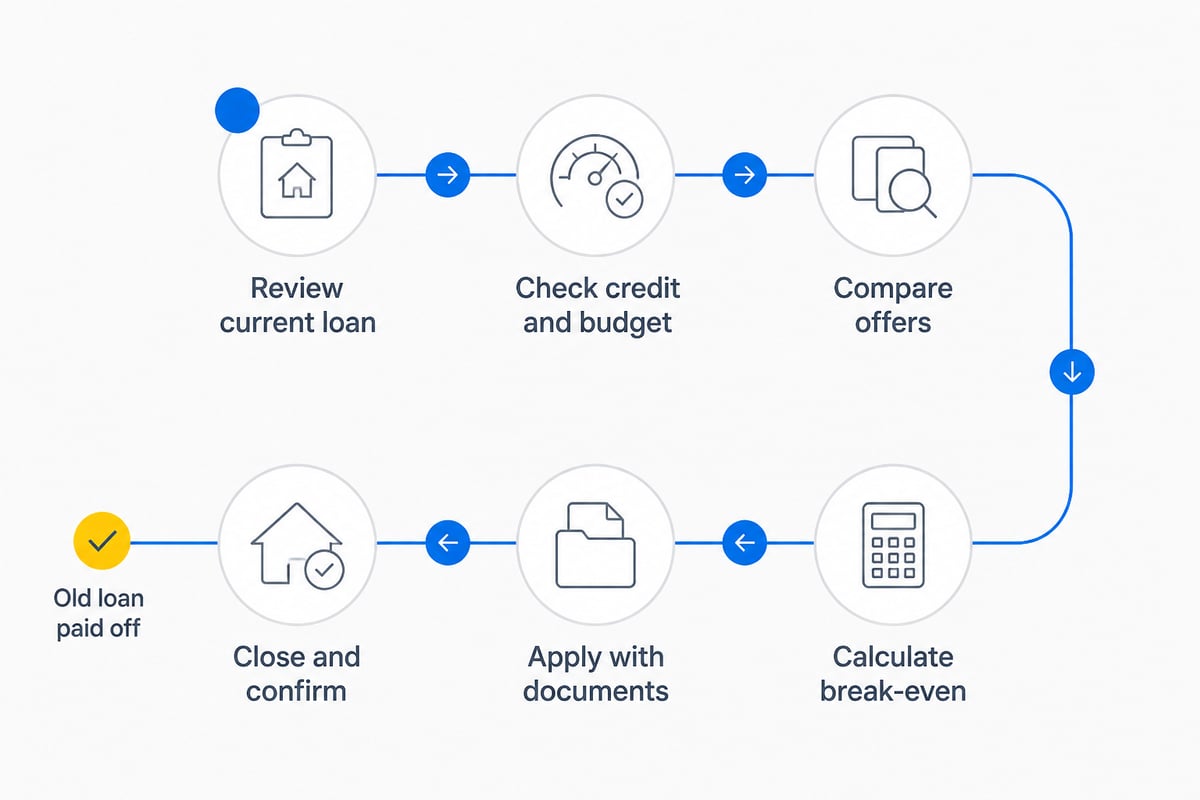
The refinancing process follows a predictable sequence, and moving through it in order helps you avoid surprises at closing.
- Review your current loan. Find your remaining balance, interest rate, monthly payment, and months left. Check whether the loan carries a prepayment penalty or payoff fee.
- Check your credit and budget. Your credit history and income shape the rate you are offered. If you have past credit problems, a lender that reviews your full situation, rather than a score alone, may give you better options.
- Compare offers. Request terms from several lenders and compare the interest rate, fees, term, and total repayment cost side by side.
- Calculate your break-even point. This tells you whether the savings outweigh the costs (explained in the next section).
- Apply and submit documents. Expect to provide identification, proof of income, and details of the loan you are replacing.
- Close the new loan. The lender pays off the old balance. Confirm in writing that the old account is closed with a zero balance, and keep making payments on the old loan until you have that confirmation.
How Do You Calculate Whether Refinancing Pays Off?
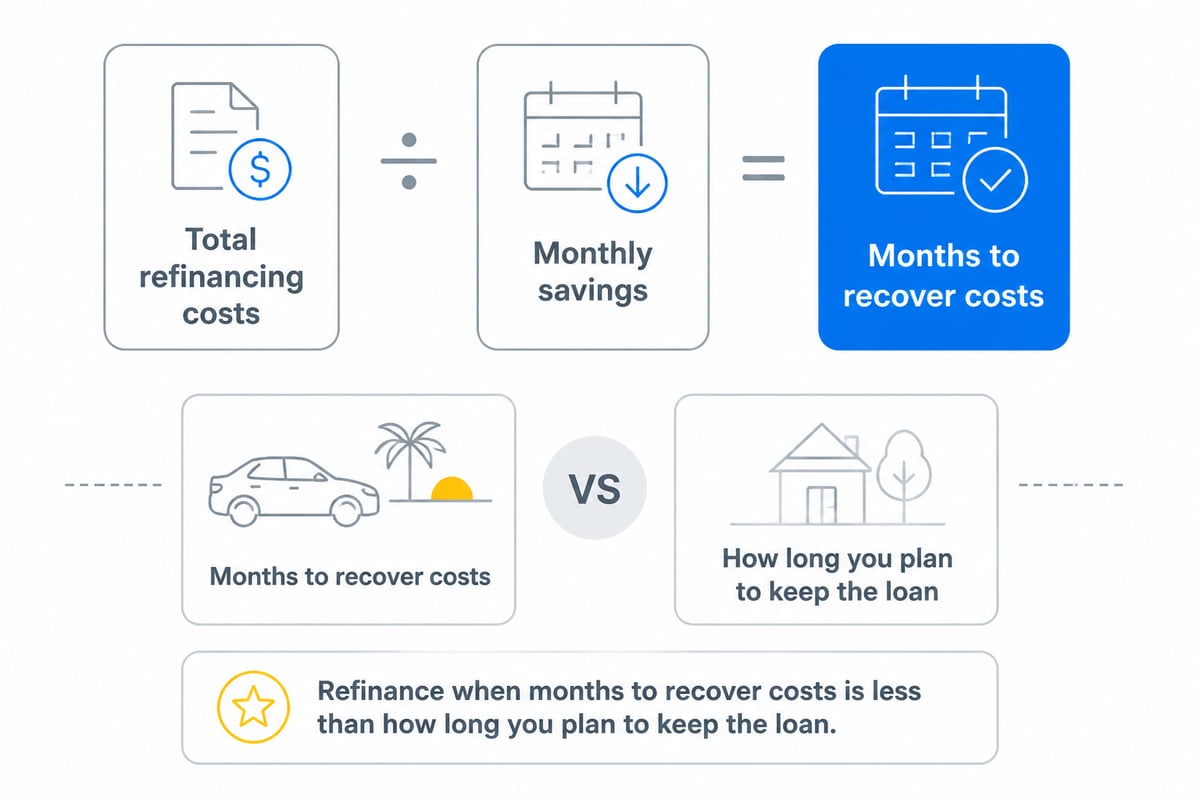
You calculate it with a break-even point: divide the total cost of refinancing by your monthly savings, and the result is the number of months it takes to recover those costs. If you expect to keep the loan longer than that, refinancing generally saves money. If not, it likely does not.
The Federal Reserve Board describes this same basic estimate and notes that refinancing fees are commonly 3% to 6% of the outstanding mortgage principal, in addition to any prepayment penalties or other payoff costs. Personal and auto loans usually involve smaller dollar amounts, but the logic is identical.
Here are real examples of how much the numbers can vary:
- In the Federal Reserve's example, refinancing a $200,000, 30-year fixed mortgage from 6% to 5% with $2,500 in fees produces an estimated break-even period of 27 months after tax.
- A 2025 Bankrate analysis reported by WKYT found that a $200,000 mortgage dropping from 7.5% to 6.5% cut monthly principal-and-interest payments from $1,398 to $1,264. With $5,000 in costs, break-even was 37 months.
- The same analysis showed that a $600,000 mortgage with the same one-point drop cut payments from $4,195 to $3,792, and break-even came in at just 12 months.
Notice how the loan size changes the outcome. The same rate drop pays for itself much faster on a larger balance, because the monthly savings are larger relative to the fixed costs.
A simple break-even example
Suppose a refinance costs $600 in fees and lowers your payment by $30 per month. Divide $600 by $30 and you get 20 months. If you plan to hold the loan for three more years, you come out ahead. If you expect to pay it off or sell the financed asset in a year, you do not.
Is It Worth Refinancing From 7% to 6%?
A one-point drop, such as 7% to 6%, is often worth pursuing, but it depends on the loan balance, the fees, and how long you will keep the loan. A rate cut that looks meaningful can still take years to pay back on a small balance.
The Bankrate figures above show why. A half-point drop on a $200,000 mortgage saved $67 per month and took 75 months to recover $5,000 in costs. On a $600,000 mortgage, the same half-point saved $203 per month with a 25-month break-even.
Use these checks before deciding:
- Compare the savings to the fees. If the monthly savings are small and the fees are high, the payback period grows long.
- Look at the term. Resetting a loan that is nearly paid off to a fresh long term can raise total interest even at a lower rate.
- Consider how long you will keep the loan. The break-even only matters if you stay past it.
A rule of thumb that "you need a full point" is a starting guide, not a law. The calculation is what decides it.
What Does It Cost to Refinance a Loan?
Loan refinancing costs vary by loan type, but the main categories are origination or application fees, appraisal or valuation fees where collateral is involved, title and recording charges on secured loans, and any prepayment penalty on the old loan.
Before you sign, ask each lender for a written list of every fee. Compare these items:
| Cost to check | What to ask |
|---|---|
| Origination or application fee | Is it a flat amount or a percentage of the loan? |
| Prepayment penalty on your current loan | Does your existing loan charge for early payoff? |
| Collateral or title fees | Are there appraisal, title, or recording charges? |
| Rolled-in costs | Are fees added to the new balance, which means you pay interest on them? |
Paying fees in cash at closing keeps the new balance smaller. Rolling them into the loan avoids an upfront payment but adds interest over time. The Federal Reserve's worksheet example assumes a $2,500 fee paid in cash at closing, with an estimated $91 in monthly after-tax savings, which shows how upfront costs are weighed against ongoing savings.
When Is Refinancing a Good Idea?
Refinancing makes sense when the new loan lowers your total cost or improves your monthly cash flow in a way you can sustain, and when you will keep the loan past the break-even point.
Good signs include:
- Market rates have dropped since you took out the loan.
- Your credit has improved since you borrowed, so you may now qualify for a better rate.
- Your income is steadier and you can handle a shorter term.
- You are carrying several high-rate balances that a single lower-rate loan could replace.
- Your current payment strains your budget, and a new structure gives you breathing room without a major rise in total cost.
Credit improvement deserves attention. Many borrowers took their original loan during a period of damaged or thin credit and paid higher rates as a result. A stretch of consistent on-time payments can change the offers available to you.
When Should You Wait or Avoid Refinancing?
You should wait when the savings are too small to cover the fees, when you plan to pay off the loan soon, or when the new terms would cost more overall despite a lower payment.
Watch for these warning signs:
- A long break-even period. If recovering costs takes longer than you will hold the loan, you lose money.
- A term extension that inflates total interest. A lower payment can hide a higher lifetime cost.
- A prepayment penalty on your current loan. The penalty can erase the savings.
- Pressure to borrow more than you need. Taking extra cash through a refinance increases what you owe.
- Teaser or variable rates. An introductory rate that resets higher can undo the savings.
Also consider the borrowing environment. The Federal Reserve publishes consumer credit data that gives broader context on borrowing trends, which can help you judge whether current conditions favor taking on a new loan.
What Disqualifies You From Refinancing?
Common disqualifiers include a very low credit score, income that is too low or unstable to support the new payment, a debt load that is too high relative to income, and, for secured loans, collateral worth less than what you owe.
Some lenders also decline applicants with recent missed payments, recent bankruptcy, or an incomplete application. Being turned down by one lender does not mean every lender will say no. Standards differ, and some lenders look beyond the credit score to your whole situation, including steady employment, recent payment history, and your explanation of past difficulties.
If you are declined, ask for the specific reason. It tells you what to fix, whether that means paying down other balances, correcting an error on your credit report, or building a few more months of on-time payments before applying again.
Should You Refinance With the Same Lender?
Refinancing with your current lender can be faster and simpler, but it is not always cheaper, so you should still compare at least one outside offer.
Your existing lender already has your payment history, which can speed approval and reduce paperwork. Some lenders also waive certain fees for existing customers. On the other hand, loyalty rarely earns the lowest rate automatically. Getting a competing quote gives you leverage and a benchmark. If your current lender matches or beats it, you save time. If not, you have a better option in hand.
Loan Refinancing for Borrowers With Past Credit Problems
Borrowers with past credit problems or limited credit can still refinance, but they should expect lenders to weigh their full financial picture and should shop for one that is willing to listen.
If your original loan carried a high rate because of credit issues, refinancing after a stretch of consistent payments may reduce it. Standard Financial, which has branch offices across Louisiana, Mississippi, Tennessee, and Georgia, works with people who have past credit problems or limited credit, and gives customers a chance to explain their credit situation so it can build a tailor-made solution. Its Personal Loans include refinancing options, and its flexible financing plans are designed with the customer in mind. For specific terms, eligibility, and rates, contact a branch or visit the product pages directly.
How to Prepare Before You Apply
Preparing before you apply improves your odds of approval and helps you get a better offer. Work through this short checklist:
- Pull your credit reports and dispute any errors.
- Gather recent pay stubs, identification, and your current loan statement.
- Calculate your debt payments against your monthly income.
- Decide your goal: lower payment, lower total cost, or a faster payoff.
- Request written quotes with all fees listed.
- Run the break-even calculation for each offer.

FAQ
Does refinancing hurt your credit score?
A refinance typically causes a small, temporary dip because the lender checks your credit and a new account is opened. The effect usually fades within a few months of on-time payments, and a lower balance or better terms can help your credit over time.
Can you refinance a personal loan?
Yes, you can refinance a personal loan by taking a new loan that pays off the old one. It makes the most sense when you qualify for a lower rate, need a different payment size, or want to consolidate several debts.
How soon can you refinance after taking out a loan?
Timing depends on the lender and the loan terms. Some loans carry a waiting period or a prepayment penalty, so check your loan agreement and ask the new lender about any restrictions before you apply.
Start by pulling your current loan statement and calculating your break-even point so you know exactly what a new loan must save you. If you want a lender that listens to your situation, Standard Financial offers refinancing options through its Personal Loans for people with past credit issues or limited credit, with branches across Louisiana, Mississippi, Tennessee, and Georgia. When you are ready to see what a refinance could do for your budget, Standard Financial makes it simple to apply for a loan and talk through a plan built around your circumstances.

2 Comments
[…] to your original loan. For a full walkthrough of costs and break-even math, see our guide to loan refinancing […]
[…] weighing the personal loan vs 401k loan decision, several critical factors deserve examination. Your specific circumstances, financial […]