
Hardship loans are personal loans taken out to cover urgent, unexpected expenses such as medical bills, car repairs, job loss gaps, or housing costs when savings fall short. There is no single government or bank product with that name; the term describes any loan used to get through a financial emergency, and the right choice depends on your credit, your income, and how quickly you can repay.
If you live in Louisiana, Mississippi, Tennessee, or Georgia and have past credit problems or a thin credit file, you still have options. This guide explains how these loans work, what lenders look for, which alternatives to consider first, and how to avoid costly mistakes.
What Counts as a Financial Hardship?
A financial hardship is any event that sharply reduces your income or raises your costs so that you cannot meet basic obligations on schedule. Lenders and assistance programs define it loosely, so the qualifying situations are broad.
Common examples include:
- Job loss, reduced hours, or a gap between paychecks
- A medical emergency or an unexpected hospital bill
- A major car or home repair needed to keep working or living safely
- A death or illness in the family that creates sudden costs
- Storm damage, which is a real concern for Gulf Coast and Southeastern households
- Divorce or separation that splits one income across two homes
Most lenders do not require you to prove a specific type of hardship. They care less about the label and more about whether you can repay the loan from your current income.
Many households are one bill away from this position. In the Federal Reserve's 2024 survey, most adults said they would cover a hypothetical $400 emergency expense with cash or its equivalent, which means a significant share would need another way to pay, such as borrowing or putting it on a credit card.
How Do Hardship Loans Work?
Hardship loans work like other installment loans: you borrow a fixed amount, receive the funds in one payment, and repay with interest in equal monthly installments over a set term. The difference is purpose and speed. Borrowers usually need the money within days, and lenders who serve this need often review applications with more flexibility than a large bank would.
The typical process has four steps:
- Define the amount. Add up the exact cost of the emergency, plus a small buffer for fees.
- Gather documents. Expect to provide identification, proof of income, and proof of address.
- Apply and review terms. Compare the interest rate, total repayment cost, fees, and monthly payment.
- Receive funds and repay. Payments are fixed, so you can plan your budget around them.
Terms vary widely by lender and by your credit profile. Always ask for the annual percentage rate (APR) and the total amount you will repay, not just the monthly payment.
Who Qualifies for Hardship Loans?
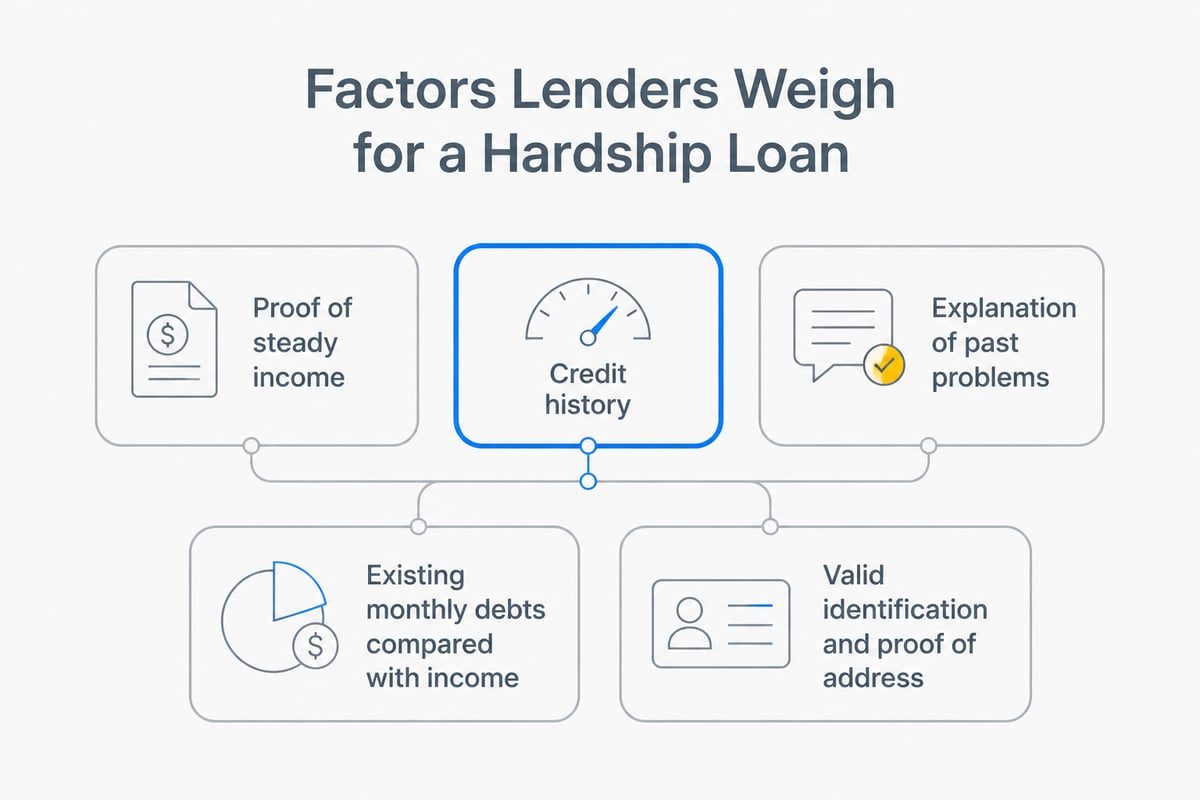
Qualification depends mainly on proof that you can repay, not on a perfect credit score. Lenders typically review several factors together.
Income and Employment
Steady income is the strongest signal. Pay stubs, bank statements, benefit letters, or other documented income all count with many lenders. Self-employed applicants can often use bank deposits or tax records.
Credit History
A low score does not automatically disqualify you. Traditional banks often set firm score minimums, but lenders that specialize in consumer credit commonly look at the whole picture, including recent payment behavior and how long ago the problems occurred. Standard Financial, for example, offers personal loans for people with limited or impaired credit and lists options for clients with past credit issues.
Debt Load
Lenders compare your monthly debts to your monthly income. If a new payment would leave too little room for rent, food, and utilities, you may be offered a smaller amount or a longer term.
Basic Requirements
Most lenders require that you are at least 18, have a valid ID, and have a way to verify where you live and how you earn. Contact the lender directly to confirm its specific requirements.
What Is the Easiest Loan to Get With Poor Credit?
The easiest loans to obtain with poor credit are generally small installment loans from lenders that review income and circumstances rather than relying only on a credit score. Easy to get does not mean cheap, so the goal is to find the lowest-cost option that still approves you.
Here is how the common options compare for borrowers with weak credit:
| Option | Credit Requirement | Typical Cost | Main Risk |
|---|---|---|---|
| Installment loan from a consumer lender | Flexible; income-focused | Moderate to high APR | Higher total cost than prime loans |
| Credit union loan | Often more forgiving for members | Usually lower APR | Membership and processing time |
| Loan with a co-signer | Based on co-signer's credit | Lower APR possible | Co-signer is liable if you miss payments |
| Secured loan (collateral) | Easier approval | Lower APR than unsecured | You can lose the asset |
| Payday or title loan | Minimal | Extremely high APR | Debt cycles and repossession |
For most people, a fixed-rate installment loan with a clear payoff date is the safest of the easy options. Payday and title loans can carry triple-digit APRs and short repayment windows, and they are the most common way a short-term problem becomes a long-term one.
What Can You Do When No One Will Give You a Loan?
If no lender will approve you, the best move is to reduce what you need to borrow, add support to your application, or replace the loan with another form of help. A denial is information, not a verdict.
Try these steps in order:
- Ask why you were denied. Lenders must give you a reason, and it may point to a fixable issue such as an error on your credit report.
- Check your credit reports. You can review them for free at AnnualCreditReport.com and dispute inaccuracies.
- Request a smaller amount. A lower loan may fit your income when a larger one does not.
- Add a co-signer. A trusted person with stronger credit can improve your terms.
- Offer collateral. A secured loan lowers the lender's risk, though you must be certain you can repay.
- Talk to a lender that works with credit challenges. Some lenders will hear your explanation and design a plan to fit.
Avoid applying to many lenders in a short span, since each hard inquiry can lower your score slightly. Ask whether a lender can pre-qualify you with a soft check first.

What Should You Try Before Borrowing?
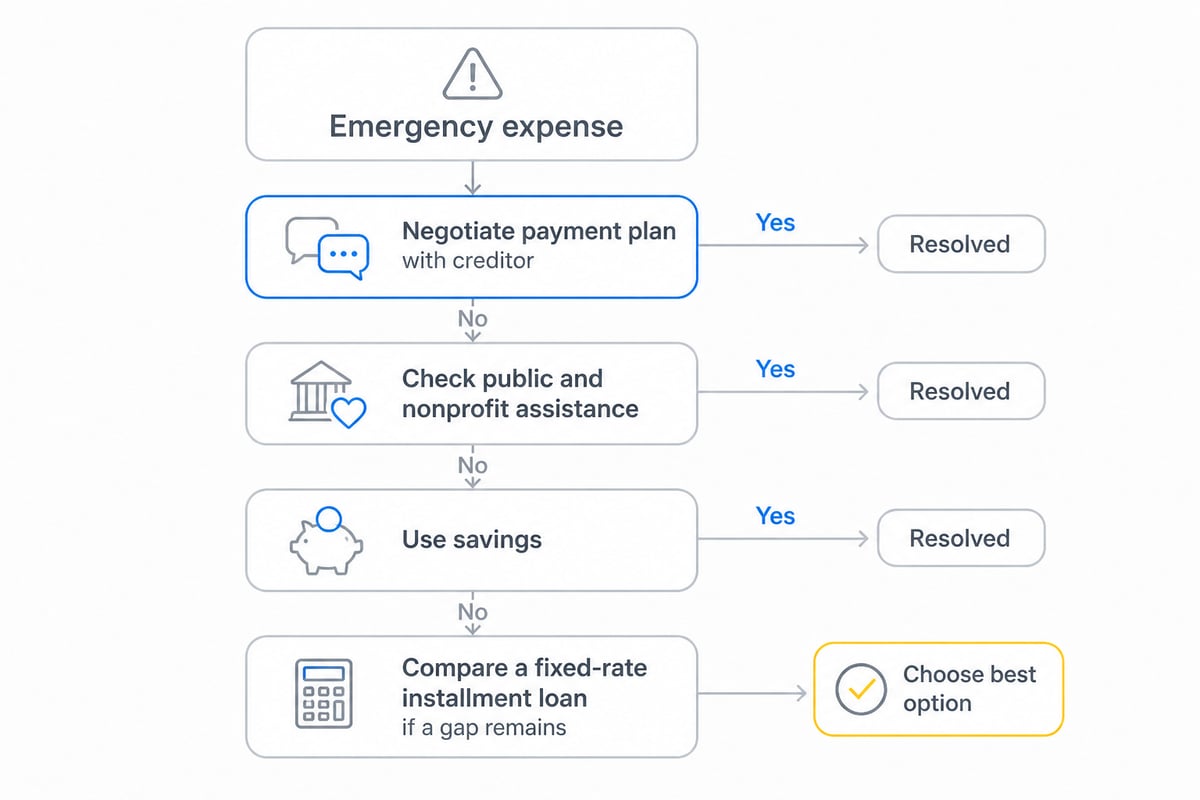
Before taking on new debt, check whether the expense can be reduced, delayed, or covered by assistance, because the cheapest loan is the one you do not need. Many people never ask, and several of these routes cost nothing.
- Call your creditors. Utilities, landlords, and medical providers often offer payment plans, extensions, or reduced bills when you explain the situation early.
- Use hospital financial assistance. Many hospitals have charity care or sliding-scale programs. The federal guide on help with medical bills outlines options such as credit-counseling payment plans.
- Look into public assistance. The official government hardship resource covers help with food, housing, utilities, and unemployment.
- Check family benefits. Eligible families may qualify for cash, housing, and energy support through TANF assistance.
- Ask your employer. Some employers offer paycheck advances or hardship funds.
- Contact local nonprofits and churches. Community organizations in all four states often provide one-time help with rent or utilities.
Be cautious of anything advertised as a personal hardship grant from the government. Offers that ask for an upfront fee or your bank details are a warning sign.
How Do You Compare Hardship Loans Safely?
Compare offers by total repayment cost, not by the size of the monthly payment, and read every term before signing. A low payment stretched over a long term can cost far more in interest.
Use this checklist when reviewing any offer:
- APR. This includes interest and most fees, so it is the fairest side-by-side number.
- Total repayment amount. Multiply the payment by the number of months and compare it to the amount borrowed.
- Origination or processing fees. Ask whether they are deducted from your funds.
- Prepayment terms. Confirm you can pay early without a penalty.
- Late fees and consequences. Know the cost of a missed payment.
- Reporting. Ask whether on-time payments are reported to the credit bureaus, since that can help rebuild your credit.
- Licensing. Confirm the lender is licensed in your state.
Walk away from any lender that guarantees approval without reviewing your income, pressures you to sign immediately, or asks for payment before releasing funds. Legitimate lenders explain their terms in writing and answer questions.
Can Refinancing Help During a Hardship?
Refinancing can help by replacing existing debt with a loan that has a lower payment, a longer term, or a lower rate, which frees up monthly cash flow. It is most useful when you already carry several high-cost balances and need breathing room.
Consider refinancing if you are juggling multiple payment dates, paying high interest on credit cards or short-term loans, or struggling with a monthly payment that no longer fits your budget. The tradeoff is that a longer term lowers the payment but can raise the total interest paid, so run the numbers first.
Standard Financial offers flexible financing plans and refinancing options for borrowers with limited or impaired credit, and its personal loans are designed with the customer's situation in mind. To learn what terms apply to your circumstances, review the product pages or contact a branch directly rather than relying on general figures.
How Can You Avoid Needing Hardship Loans Again?
You can reduce the chance of repeat borrowing by building even a small cash cushion and keeping debt payments manageable. Progress is possible without large sums.
Start small. Setting aside a modest amount each pay period, even before you reach a formal goal, makes the next surprise less disruptive. Federal Reserve data shows that a majority of adults reported emergency savings sufficient to cover three months of expenses in 2024, a benchmark worth aiming toward over time, though a single month's expenses is a meaningful first target.
Other habits that help:
- Pay every bill on time, since payment history is the largest factor in most credit scores.
- Keep credit card balances well below their limits.
- Automate a small transfer to savings on payday.
- Review your budget quarterly and cancel unused subscriptions.
- Use a loan for its stated purpose only, and repay it on schedule so the account supports your credit.
Many households report feeling financially stable overall. The Federal Reserve found that most adults said they were doing okay or living comfortably in 2024, but stability can change quickly with one emergency, which is why a plan matters even when things feel fine.
FAQ
What are the details of a Standard Financial loan?
Loan amounts, terms, rates, and eligibility depend on your situation and your state, so they are not listed here. Visit Standard Financial's product pages or contact a branch in Louisiana, Mississippi, Tennessee, or Georgia for current details.
Do hardship loans hurt your credit score?
A loan application can cause a small, temporary dip from the hard inquiry. Over time, on-time payments can help your score if the lender reports to the credit bureaus, while missed payments can damage it.
How fast can you get money from a hardship loan?
Timing varies by lender and by how quickly you provide documents. Having identification, proof of income, and proof of address ready usually speeds the process, so ask the lender about its typical turnaround.
Your next step is to write down the exact amount you need and gather your ID, proof of income, and proof of address so you can compare offers quickly. If you want a lender that listens to your credit history and builds a plan around it, Standard Financial offers flexible financing and refinancing through its personal loans for borrowers with past credit issues or limited credit. With branch offices across Louisiana, Mississippi, Tennessee, and Georgia, you can talk with someone near you, and you can Apply For A Loan online to start the conversation about what fits your budget.

2 Comments
[…] The reality is that situations genuinely requiring payday loans are rare. Most financial emergencies are better addressed through emergency funds, credit cards, personal loans, or assistance programs. […]
[…] every fee, before accepting any amount. If your credit history makes borrowing harder, our guide to hardship loans explains the options for poor or limited credit and how to borrow […]