
Financial security starts with one fundamental tool: an emergency fund. This dedicated savings cushion protects you when life throws unexpected expenses your way, whether it's a medical bill, car repair, or job loss. According to research from the Federal Reserve, nearly 40% of American households would struggle to cover an unexpected $400 expense using cash or savings. Understanding how to build an emergency fund is essential for anyone seeking financial stability and peace of mind, especially for households across the South managing everyday expenses alongside unexpected costs.
Why an Emergency Fund Matters
An emergency fund serves as your financial shock absorber. When unexpected expenses arise, you won't need to rely on high-interest credit cards, payday loans, or drain your retirement accounts. Instead, you'll have liquid cash ready to deploy immediately.
The benefits extend beyond just covering emergencies. Financial resilience improves mental health, reduces stress, and gives you the freedom to make better long-term decisions. Research from the JPMorgan Chase Institute demonstrates that households with even modest cash buffers weather financial shocks significantly better than those living paycheck to paycheck.
Common Emergencies That Drain Savings
Life delivers surprises when you least expect them:
- Medical and dental emergencies not fully covered by insurance
- Major car repairs or transmission replacements
- Home repairs like HVAC failures, roof leaks, or plumbing issues
- Unexpected job loss or reduced work hours
- Emergency travel for family situations
- Veterinary care for pets
Each of these situations requires immediate cash. Without an emergency fund, families often turn to expensive borrowing options that create long-term financial stress. Learning how to build an emergency fund protects you from this cycle.

Setting Your Emergency Fund Goal
The standard recommendation suggests saving three to six months of essential expenses. However, your personal target depends on several factors unique to your situation.
| Factor | Smaller Fund (3 months) | Larger Fund (6+ months) |
|---|---|---|
| Job Stability | Salaried with strong job security | Freelance, commission, or seasonal work |
| Income Sources | Dual-income household | Single income earner |
| Dependents | No children | Multiple dependents |
| Health Status | Good health, young | Chronic conditions or older age |
| Home Ownership | Renter | Homeowner with maintenance costs |
Calculating Your Target Amount
Start by listing your monthly essential expenses:
- Housing costs: Rent or mortgage, property taxes, insurance
- Utilities: Electricity, water, gas, internet, phone
- Food: Groceries and essential household items
- Transportation: Car payment, insurance, gas, maintenance
- Insurance: Health, life, disability premiums
- Minimum debt payments: Student loans, credit cards, personal loans
- Child care: If applicable
Notice what's missing? Entertainment, dining out, subscriptions, and discretionary spending don't count toward your essential expenses. Your emergency fund covers survival, not lifestyle.
For a household spending $3,500 monthly on essentials, a three-month emergency fund equals $10,500. Six months would require $21,000. These numbers might seem daunting, but the journey of how to build an emergency fund starts with a single dollar.
Starting Small and Building Momentum
The Consumer Financial Protection Bureau emphasizes that starting with achievable goals creates sustainable habits. Instead of fixating on the final number, focus on your first milestone.
Initial Milestones to Celebrate
- $500: Covers most minor emergencies like car repairs or urgent home fixes
- $1,000: Provides breathing room for most common financial shocks
- One month of expenses: First major milestone showing serious progress
- Three months of expenses: Minimum recommended safety net
- Six months of expenses: Gold standard for financial security
Each milestone deserves recognition. Hitting $500 in savings represents real progress and builds the confidence to continue.
The FDIC recommends starting with whatever you can manage, even $5 or $10 per week. Small, consistent deposits compound over time. Saving just $25 weekly adds up to $1,300 annually without requiring dramatic lifestyle changes.
Where to Keep Your Emergency Fund
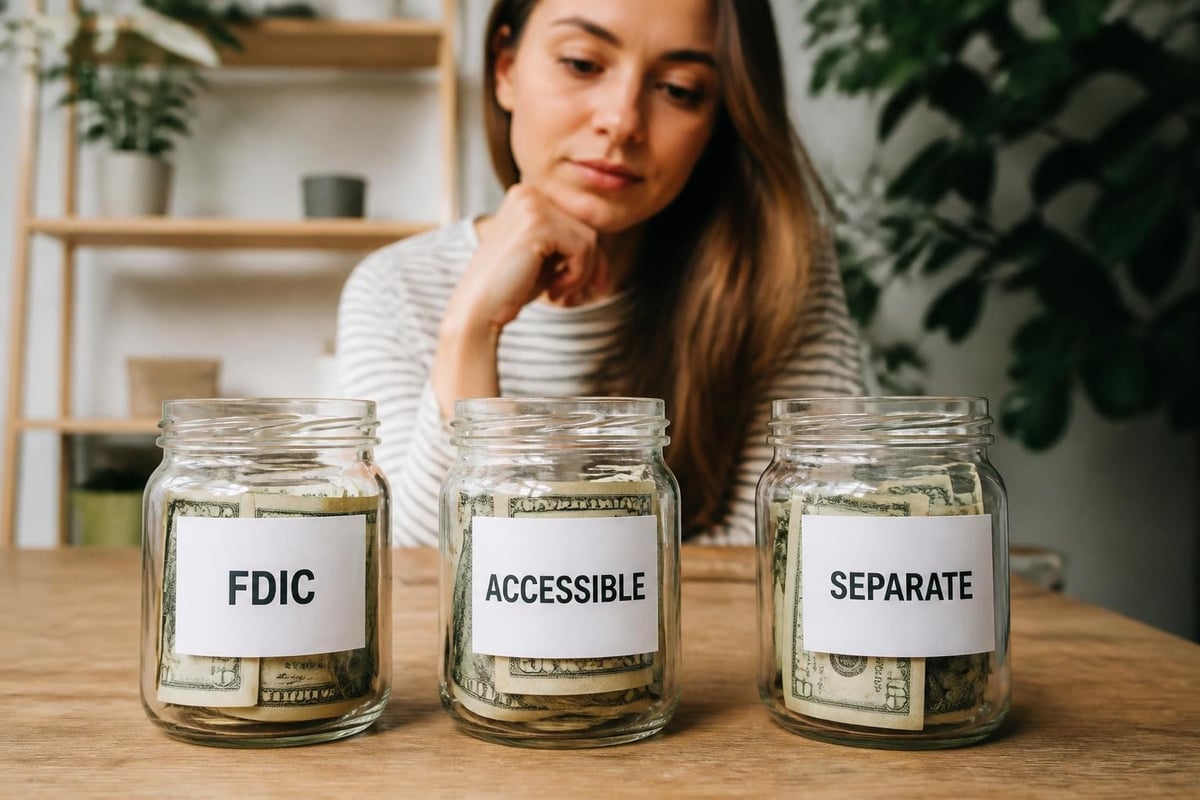
Your emergency fund needs three characteristics: safety, liquidity, and accessibility. This eliminates most investment options.
The best home for emergency savings is a federally insured savings account separate from your everyday checking account. This separation prevents accidental spending while keeping funds available within 24-48 hours when emergencies strike.
Account Options Comparison
| Account Type | Pros | Cons | Best For |
|---|---|---|---|
| High-Yield Savings | FDIC-insured, earns interest, liquid | Interest rates fluctuate | Most people |
| Money Market Account | FDIC-insured, potential check-writing | May require higher minimums | Larger balances |
| Traditional Savings | FDIC-insured, widely available | Very low interest rates | Getting started |
| Certificate of Deposit | Higher rates, FDIC-insured | Early withdrawal penalties | Not recommended |
Avoid keeping emergency funds in checking accounts (too tempting to spend), investment accounts (subject to market losses), or anywhere that charges fees eating into your balance. The account should be at a different institution than your primary bank, creating a helpful barrier between daily spending and emergency reserves.
Automating Your Savings Strategy
The single most effective method for how to build an emergency fund is automation. When savings happen automatically, you remove willpower from the equation.
Research from the CFPB on consumer savings strategies found that automated saving rules significantly increase success rates compared to manual transfers. People who automate their savings build larger balances faster.
Effective Automation Strategies
Direct deposit splitting: Ask your employer to deposit a fixed amount or percentage directly into your emergency fund with each paycheck. Start with 5-10% of your net income if possible.
Scheduled transfers: Set up automatic transfers from checking to savings the day after payday. This "pay yourself first" approach ensures savings happen before discretionary spending.
Round-up programs: Some banks and apps automatically round up purchases to the nearest dollar and transfer the difference to savings. Buying $3.50 coffee triggers a $0.50 transfer to your emergency fund.
Windfall routing: Tax refunds, bonuses, and other unexpected income should automatically route to your emergency fund until you hit your target. A single tax refund might fund your entire initial $1,000 milestone.
The key is making it automatic and treating emergency fund contributions like any other non-negotiable monthly expense.
Finding Money to Save
Many households believe they can't afford to save. Yet extension research from UConn demonstrates that most families can find $50-100 monthly through simple adjustments.
Practical Ways to Free Up Cash
- Track spending for 30 days: Awareness alone often reveals $100+ in wasteful spending
- Eliminate one subscription: Cancel unused streaming services, gym memberships, or apps
- Reduce dining out: Cook three additional meals at home weekly
- Lower insurance premiums: Shop for better rates on auto and home insurance
- Sell unused items: Clear clutter while building your fund
- Redirect current debt payments: Once a debt is paid off, continue the payment into savings
- Bank any raises: Deposit salary increases directly to your emergency fund before lifestyle inflation hits
Challenge yourself to a no-spend month on non-essentials. Route every saved dollar directly to your emergency fund. This intensive approach can jump-start your savings dramatically.
For those managing tight budgets, even $10 weekly makes a difference. The Urban Institute’s research on household financial vulnerability shows that low-income families benefit tremendously from even small cash buffers, which prevent cascading financial crises when unexpected costs arise.
Overcoming Common Obstacles
The path to building an emergency fund rarely runs smooth. Anticipating challenges helps you push through them.
When Emergencies Happen During Saving
Real emergencies will occur while you're building your fund. That's exactly why you need one. If you must tap your emergency savings, don't give up.
After using emergency funds:
- Address the immediate crisis first
- Resume contributions as soon as possible
- Rebuild to your previous level before continuing toward your ultimate goal
- Reflect on whether the expense was truly an emergency or discretionary
Redefine setbacks as proof the system works. Using your emergency fund for an actual emergency demonstrates its value, not failure.
Managing Irregular Income
Freelancers, commission earners, and seasonal workers face unique challenges in how to build an emergency fund. Variable income makes automation harder but increases the importance of cash reserves.
Strategies for irregular income:
- Save a higher percentage during peak earning months
- Establish a "zero-based" monthly salary by saving excess in good months
- Prioritize emergency savings before business expenses when possible
- Aim for 6-9 months of expenses rather than the standard 3-6 months

When to Use Your Emergency Fund
Not every unexpected expense qualifies as an emergency. Understanding the difference prevents depleting your fund for non-emergencies.
Use emergency funds for:
- Sudden job loss requiring living expenses
- Medical emergencies and urgent healthcare needs
- Essential car repairs needed for work commute
- Critical home repairs affecting safety or habitability
- Emergency travel for family crises
Don't use emergency funds for:
- Planned expenses like annual insurance premiums or property taxes
- Predictable costs such as holiday gifts or back-to-school shopping
- Wants disguised as needs (upgrading a working phone)
- Investment opportunities or "can't miss" deals
- Helping others when it jeopardizes your own stability
Creating separate sinking funds for predictable irregular expenses (car maintenance, holiday spending, home repairs) protects your emergency fund for true emergencies.
Growing Beyond the Basics
Once you've reached your initial emergency fund goal, you're not finished with how to build an emergency fund. Financial security requires ongoing maintenance and strategic growth.
Adjusting for Life Changes
Your emergency fund target should increase when:
- You buy a home (maintenance costs increase)
- You have children (dependents increase expenses)
- You start a business (income becomes less predictable)
- You change careers (transition periods require buffers)
- You approach retirement (replacing income becomes harder)
Review your emergency fund target annually. Income growth, expense increases, and lifestyle changes all affect the appropriate savings level.
What Comes After Six Months
Reaching six months of expenses represents significant achievement. Data from the FINRA Foundation’s National Financial Capability Study shows that households with this level of savings demonstrate dramatically better financial outcomes across all measures.
After fully funding your emergency reserves, redirect automatic savings toward:
- High-interest debt payoff: Credit cards and personal loans
- Retirement contributions: Maximize employer matches and IRA contributions
- Mid-term goal funds: Down payment savings, education funds
- Additional investment accounts: Building long-term wealth
Your emergency fund remains in its safe, liquid account earning modest interest. Meanwhile, new contributions flow toward higher-return opportunities appropriate for longer time horizons.
Special Considerations for Southern Households
Families in Louisiana, Mississippi, Tennessee, and Georgia face unique financial circumstances requiring tailored emergency fund strategies.
Hurricane and weather preparedness: Coastal and Southern households need additional reserves for evacuation costs, temporary housing, and storm-related repairs often not immediately covered by insurance. Consider a weather-specific emergency fund supplement.
Property considerations: Higher homeownership rates in these states mean more households face potential maintenance emergencies. Homeowners should lean toward six months of expenses rather than three.
Healthcare access: Rural areas in these states sometimes face limited immediate healthcare access, potentially requiring travel to specialists or facilities. Medical emergency funds should account for travel and lodging costs.
Seasonal employment: Tourism, agriculture, and construction sectors create income variability for many Southern workers, making emergency funds even more critical during off-seasons.
Maintaining Momentum and Discipline
The psychological aspect of how to build an emergency fund often determines success more than the mathematical elements.
Staying Motivated Over Months
Visual tracking makes abstract progress concrete. Create a simple chart showing your journey from zero to your target amount. Update it weekly or monthly as your balance grows.
Milestone rewards celebrate progress without derailing your plan. When you hit $1,000, treat yourself to a modest reward (under $25). Reaching one month of expenses might justify a special meal out.
Accountability partnerships increase follow-through. Share your emergency fund goal with a trusted friend or family member who will check your progress and encourage you during difficult months.
Avoiding Common Pitfalls
The biggest threat to emergency funds is mental accounting errors that justify inappropriate withdrawals. Families sometimes raid emergency savings for "opportunities" that feel urgent but aren't emergencies.
Create decision rules before emergencies strike. Write down specific criteria that qualify as legitimate emergency fund uses. When temptation strikes, consult your pre-decided rules rather than making emotional decisions.
Replenish immediately after use. The moment you withdraw emergency funds, establish a repayment plan treating it like any other debt. This prevents the fund from permanently shrinking after the first use.
Advanced Strategies for Faster Growth
Once you've mastered basic emergency fund building, several advanced techniques can accelerate your progress.
The Envelope System Integration
Combine digital emergency fund savings with a physical cash envelope for discretionary spending. When you restrict yourself to cash for categories like entertainment and dining out, leftover envelope money at month-end goes straight to emergency savings. This creates a variable contribution boosting your baseline automated savings.
Percentage-Based Contributions
Rather than saving fixed dollar amounts, commit to saving a percentage of all income. Start with 10% of gross income flowing automatically to emergency savings. This scales with raises and bonuses, accelerating your fund growth as income increases.
Challenge Months
Dedicate specific months to emergency fund super-charging. During your challenge month, cut all non-essential spending and live as minimally as possible, routing every spare dollar to savings. One intensive month can add $500-1,000 to your fund while proving you can live on less than you think.
Building a robust emergency fund requires patience, discipline, and consistent action, but the financial security it provides is invaluable. By starting small, automating your savings, and staying focused on your goal, you'll create a safety net that protects your family from life's unexpected challenges. If you're working to strengthen your financial foundation and need support along the way, Standard Financial offers flexible personal loan solutions across Louisiana, Mississippi, Tennessee, and Georgia to help bridge gaps while you build your emergency reserves, even if you've faced credit challenges in the past.

No comment yet, add your voice below!