
Starter loans are small, entry-level personal loans designed for people with limited credit history or past credit problems who need to borrow responsibly and begin building a record of on-time payments. They typically come with modest amounts, fixed payments, and a repayment schedule that lets a first-time borrower show consistent behavior. For residents of Louisiana, Mississippi, Tennessee, and Georgia, the right first loan can cover a pressing expense today and strengthen future borrowing options tomorrow.
This guide walks through what these loans are, which types exist, what lenders review, how much they cost, and how to apply with confidence.
What Are Starter Loans and Who Are They For?
Starter loans are personal loans sized and structured for borrowers who have little or no established credit, or whose credit was damaged by past missed payments, collections, or other setbacks. The loan itself is usually an installment loan: you receive a lump sum and repay it in equal monthly payments over a fixed term.
They suit several kinds of borrowers:
- Adults who have never held a credit card, auto loan, or mortgage
- People rebuilding after a late payment, charge-off, or medical collection
- Borrowers whose credit file is thin because they have mostly paid in cash
- Households facing a single, defined expense, such as a car repair or a medical bill
The word "starter" describes the borrower's position more than a specific product. Banks, credit unions, and consumer finance companies each label these products differently, so focus on the features rather than the name.
How Do Starter Loans Work?
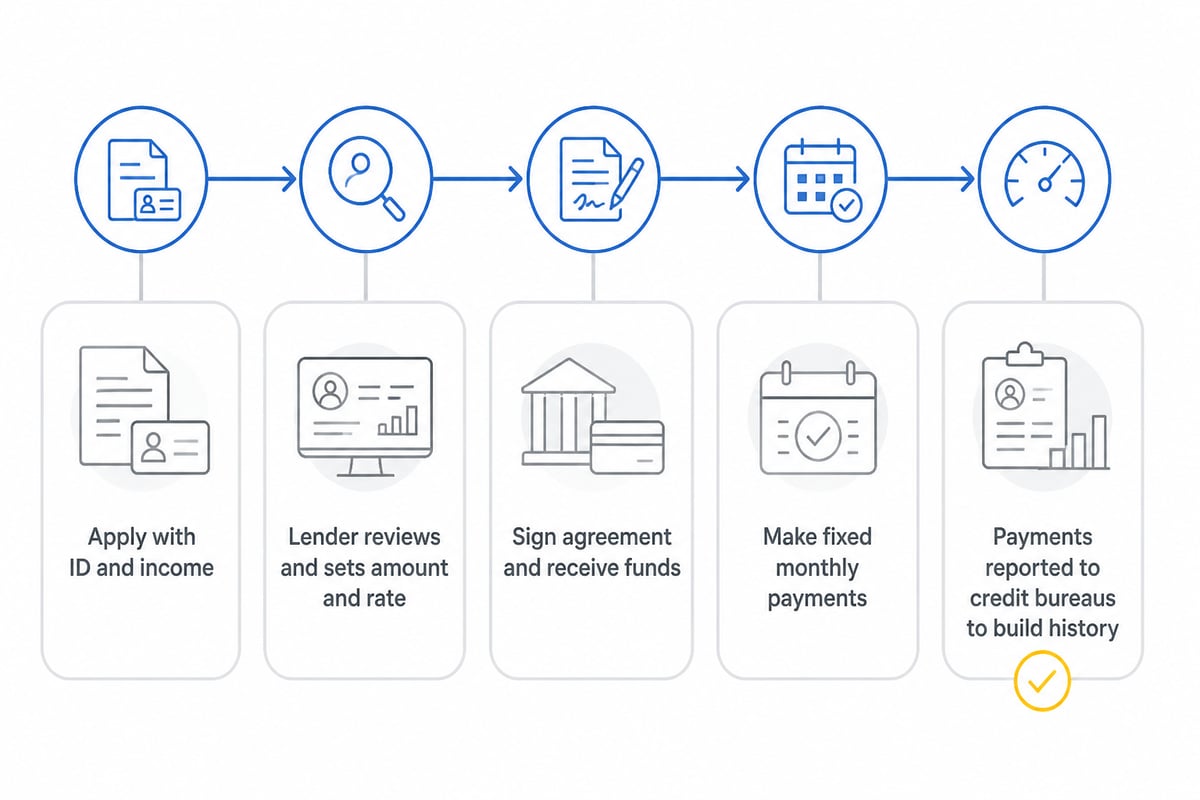
A first loan works as a fixed-term installment agreement: a lender advances a set amount, you repay it in scheduled payments with interest, and the lender typically reports your payment history to the credit bureaus. That reporting is what turns a loan into a credit-building tool.
The basic sequence looks like this:
- You apply and provide identity, income, and residence details.
- The lender reviews your application and decides on an amount, rate, and term.
- You sign the agreement and receive the funds.
- You make scheduled payments, ideally by automatic withdrawal.
- The lender reports your payments, and your credit profile grows with each on-time month.
Because the loan is small and the term is defined, you can see the full cost before you commit. That predictability is a major advantage over revolving credit, where balances and interest can shift from month to month.
What Types of First Loans Are Available?
The most common first-loan options are unsecured personal loans, secured loans, credit-builder loans, and loans with a co-signer. Each trades off risk, cost, and access differently.
| Loan type | How it works | Main benefit | Main drawback |
|---|---|---|---|
| Unsecured personal loan | No collateral; approval based on income and credit profile | Funds available for many purposes | Higher rates when credit is limited |
| Secured loan | Backed by a deposit or asset | Easier approval, often lower rate | You can lose the collateral if you default |
| Credit-builder loan | Funds are held in an account until the loan is repaid | Builds history with low risk | You do not receive cash up front |
| Co-signed loan | A second person shares responsibility | Can improve approval odds | The co-signer's credit is also at risk |
If you need cash now for a specific purpose, an unsecured or secured personal loan fits best. If your only goal is building history, a credit-builder loan keeps the amount and risk small.
Can You Get a Starter Loan With Bad Credit?
Yes, you can get a starter loan with bad credit, although the amount, rate, and terms will reflect the lender's view of your risk. Many consumer lenders review more than a score, including your income, job stability, and current obligations.
Lenders that specialize in this area often look at the full picture rather than a single number. Standard Financial, for example, works with people who have past credit problems or limited credit, and it gives customers a chance to explain their credit situation so it can build a tailored solution. That approach matters if a medical bill, job loss, or divorce caused a gap in an otherwise reasonable history.
A few steps improve your odds:
- Pull your free credit reports at AnnualCreditReport.com and correct any errors
- Gather recent pay stubs and proof of address
- Request only the amount you truly need
- Be ready to explain what caused past problems and what has changed
Approval is never guaranteed, and a lender that promises it before reviewing your application deserves caution.
Can I Get a Loan With Extremely Bad Credit?
You can still find options with extremely bad credit, but they narrow, and cost and structure become more important than speed. Secured loans, co-signed loans, and smaller amounts are the most realistic paths, because they reduce the lender's risk.
Before you accept any offer, check these points:
- Total cost: Compare the APR and the total repayment amount, not only the monthly payment.
- Reporting: Confirm the lender reports on-time payments to the credit bureaus, or the loan will not help your score.
- Fees: Ask about origination fees, late fees, and any prepayment penalty.
- Fit: A payment that strains your budget raises the odds of another missed payment.
If your credit is severely damaged, a smaller loan repaid on time can matter more than a larger loan that stretches your budget. A lender willing to hear your story and design a plan around it, as Standard Financial describes doing, is generally a better partner than one who relies solely on automated scoring.
What Do You Need to Qualify?
To qualify for a first loan, you generally need to show who you are, where you live, and how you will repay. Requirements vary by lender, so confirm specifics with the branch or on the lender's application page.
Commonly requested items include:
- A government-issued photo ID
- Proof of income, such as recent pay stubs, benefit letters, or bank statements
- Proof of residence, such as a utility bill or lease
- Your Social Security number
- Bank account details for deposit and payments
Lenders also consider your debt-to-income ratio, which compares your monthly debt payments to your monthly income. A lower ratio signals more room in your budget. Even a modest income can support a small loan if your existing obligations are light.
What Does a Starter Loan Cost?
The cost of a first loan depends on your credit profile, the amount, and the term, and for borrowers with limited credit it usually runs higher than the market average. As a reference point, the Federal Reserve reported that the average APR on 24-month personal loans at commercial banks was 11.90% in August 2026. That figure is a bank average, not a quote for any individual, and borrowers with thin or damaged credit should expect different pricing.
The Federal Reserve also notes that its personal-loan rate figures are simple, unweighted averages of each bank's most common rate during the first calendar week of the quarter's middle month. In plain terms, the number describes typical bank pricing, so treat it as a benchmark rather than a promise.
Compare that benchmark with revolving credit. The same Federal Reserve release shows the average APR on commercial-bank credit-card accounts assessed interest was 22.36% in August 2026. A fixed-rate installment loan can cost noticeably less than carrying a card balance, and it comes with a firm payoff date.
When you compare offers, look at:
- The APR, which includes interest and certain fees
- The monthly payment and the number of payments
- The total amount repaid over the life of the loan
- Whether you can make extra payments without penalty

How Much Can You Borrow?
How much you can borrow depends on the lender's policies, your income, your existing debts, and your credit profile. First-time loans are often smaller than seasoned-borrower loans, because lenders limit risk until you show a payment record.
Some borrowers search for a large amount quickly. A sum that size is generally difficult to obtain on a first loan with limited credit, and speed rarely pairs well with favorable terms. A smaller loan repaid on schedule usually opens the door to larger amounts later.
For exact limits, terms, and timelines at Standard Financial, contact a local branch or review the product information on its website rather than relying on general estimates.
How Do You Apply Step by Step?
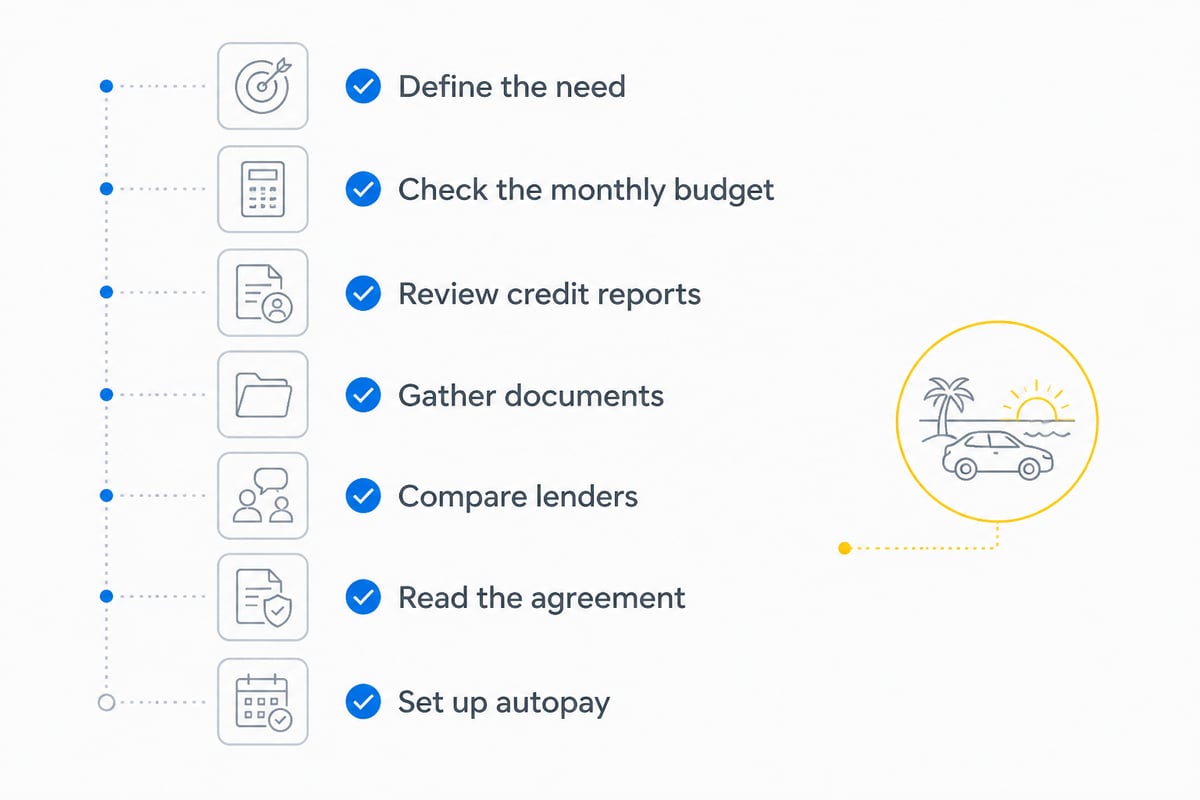
You apply by choosing a purpose and amount, checking your credit, gathering documents, comparing lenders, and submitting an application. Following an order keeps you from borrowing more than you need.
- Define the need. Write down the exact expense and the smallest amount that covers it.
- Check your budget. Calculate a monthly payment you can pay even in a tight month.
- Review your credit reports. Dispute errors before you apply.
- Gather documents. Collect ID, income proof, and residence proof.
- Compare lenders. Look at APR, fees, reporting practices, and customer service.
- Apply and read the agreement. Confirm the rate, term, fees, and total repayment before signing.
- Set up autopay. Automatic payments protect your record from accidental misses.
A branch visit can help if you prefer to talk through your situation in person. Standard Financial operates branch offices across Louisiana, Mississippi, Tennessee, and Georgia, so many residents can speak with a lender nearby.
How Can Standard Financial Fit Into Your First Loan?
Standard Financial offers Personal Loans for people with limited or impaired credit, including refinancing options, which makes it one place to start when traditional banks decline an application. The company builds its products around the customer and offers flexible financing plans.
Loans are available for common needs such as home improvements, medical expenses, and education. If you already carry a higher-cost loan, ask about refinancing, since a better-structured payment can free room in your monthly budget. For specific amounts, rates, and requirements, speak with a branch or consult the product pages directly.
How Do You Use a First Loan to Build Credit?
You build credit with a first loan by paying on time, keeping the balance manageable, and allowing the account to age. Payment history is a major factor in most scoring models, so every on-time payment counts.
Practical habits that help:
- Pay by autopay or set calendar reminders three days before each due date
- Avoid taking on additional debt during the loan term
- Keep credit card balances low relative to their limits
- Check your credit reports every few months to confirm the loan is being reported
- Consider paying a little extra when your budget allows, if no prepayment penalty applies
With a sustained record of on-time payments, many borrowers find they qualify for better terms on future credit. Treat the first loan as the first line of a longer financial record.
What Mistakes Should You Avoid?
The most costly mistakes with a first loan are borrowing too much, ignoring fees, and choosing a lender that does not report to the credit bureaus. Each can erase the benefit you were seeking.
Watch for these warning signs:
- Pressure to sign immediately or to borrow more than you requested
- Upfront fees charged before any loan is approved
- Vague answers about the APR or total repayment cost
- Payments that consume more of your income than you can sustain
- No mention of credit reporting
Reading the full agreement takes a few minutes and can save hundreds of dollars. If a term is unclear, ask for it in writing before you sign.
FAQ
What do I need to get a start-up loan?
A start-up loan for a new business is a different product from a personal first loan, and it usually requires a business plan, projected cash flow, and personal credit review. If you are seeking a personal loan instead, you typically need ID, proof of income, proof of residence, and bank details. Confirm the exact list with your lender.
Does paying off a first loan early help my credit?
Paying early saves interest, but it does not always raise your score faster, because the benefit comes from months of reported on-time payments. Ask whether your lender charges a prepayment penalty, and consider whether keeping the account open a little longer suits your credit goals.
Should I choose a co-signer for my first loan?
A co-signer can improve approval odds and sometimes lower your rate, but that person becomes equally responsible if payments are missed. Choose someone who understands the risk, and only commit to a payment you can manage on your own.
Your next step is to write down the exact amount you need and the monthly payment you can comfortably afford, then gather your ID, proof of income, and proof of address. From there, Standard Financial can help you review your options through its Personal Loans, where its team listens to your credit story and builds flexible financing or refinancing around it, even if your credit history has bumps. When you are ready to move forward, you can Apply For A Loan with Standard Financial, a consumer lender with branch offices in Louisiana, Mississippi, Tennessee, and Georgia that offers personal loans for home improvements, medical expenses, and education.

1 Comment
[…] payment history across different credit types. For a first loan with a clear plan, our guide to Starter Loans explains how they work and how to […]