
Credit builder loans are small, secured loans designed to help you establish or repair your credit history by reporting on-time payments to the credit bureaus. Instead of receiving the money upfront, you make fixed monthly payments while the lender holds the funds in a savings account or certificate of deposit, and you receive the money once the loan is repaid. For residents of Louisiana, Mississippi, Tennessee, and Georgia who have limited credit or past credit problems, this product offers a structured way to show lenders a pattern of reliable repayment.
What Is a Credit Builder Loan?
A credit builder loan is a small installment loan in which the lender holds the borrowed amount as collateral until you finish paying it off. According to the Federal Reserve, these are secured small-dollar products, with typical origination amounts of $300 to $1,000.
The name can be misleading. Unlike a traditional personal loan, a credit builder loan is not meant to put cash in your hands on day one. Its purpose is the payment history it creates. Each on-time payment is reported to one or more credit bureaus, and payment history is the most influential factor in most credit scoring models.
The product has grown into a recognized part of the credit landscape. The Federal Reserve reported that the credit-building sector held $845 million in outstanding balances across 3 million accounts, held by 2.8 million individuals.
How Does a Credit Builder Loan Work?
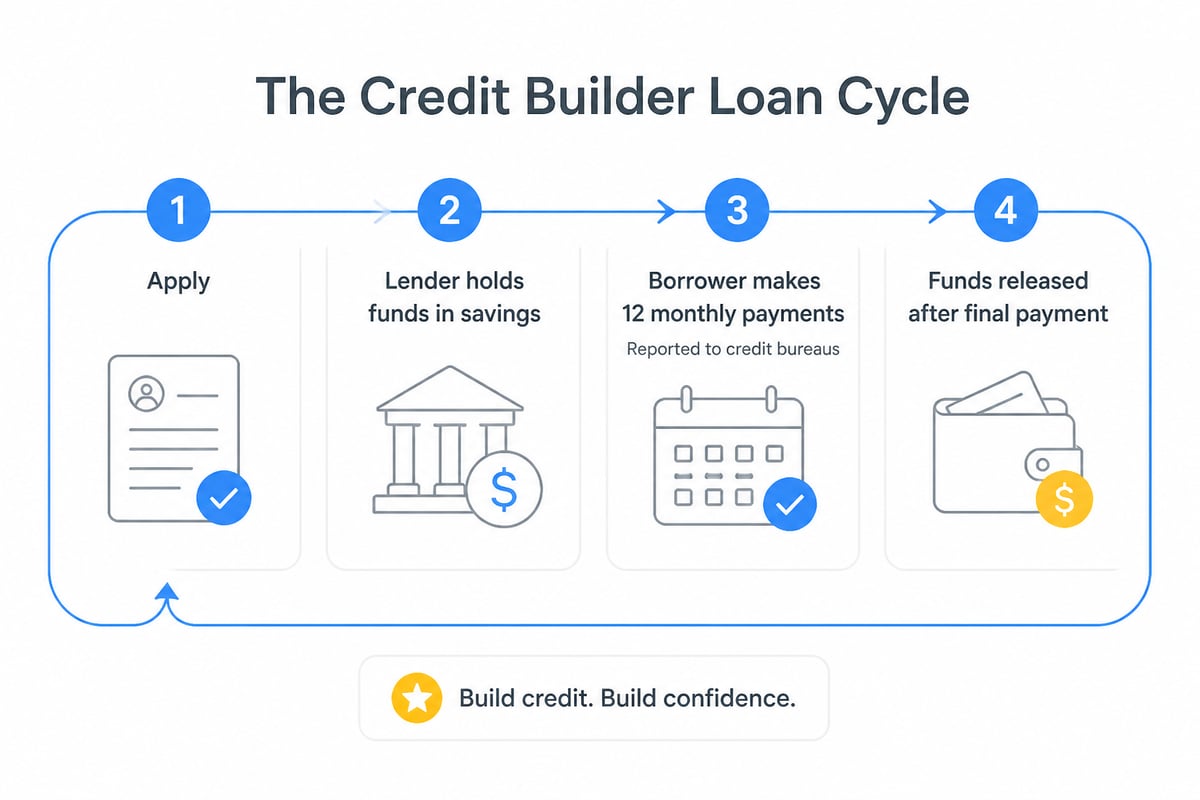
A credit builder loan works in reverse of a standard loan: you pay first and receive the funds later. The lender approves a small amount, places it in a locked savings account or certificate of deposit, and you repay it in equal monthly installments. When the final payment posts, the lender releases the held funds to you, sometimes minus interest or an administrative fee.
The Consumer Financial Protection Bureau notes that payments are usually made over six to 24 months, after which the borrower receives the full amount paid.
The process follows a predictable sequence:
- Application. You apply for a set loan amount and term, and the lender reviews your information. Many programs do not require a high credit score because the loan is secured by the held funds.
- Funds held as collateral. The lender deposits the loan proceeds into a restricted account. You cannot access them during the term.
- Monthly payments. You pay a fixed amount each month. The lender reports each payment, on time or late, to the credit bureaus.
- Final payment and release. After the last payment, the lender releases the funds to you, less any interest or fees.
A Simple Example
Suppose you borrow $600 over 12 months. The lender holds the $600 in a savings account, and you pay roughly $50 per month plus any interest or fees. After 12 on-time payments, you receive the balance held for you. The cost to you is the interest and administrative fee, and the benefit is a year of positive payment history.
How Do Credit Builder Loans Help Your Credit?
Credit builder loans help your credit by adding a new installment account with a record of on-time payments, which strengthens the two largest scoring categories: payment history and credit mix. Because the account is open and active, it also begins building the length of your credit history, even if the amount is small.
Research supports the effect. In a CFPB study summarized by the Federal Reserve, participants without existing debt who opened a credit-builder loan were more likely to have a credit score, and their scores increased relative to peers with debt. Results vary by person, and the outcome depends on making every payment on time.
Credit builder loans may help in these situations:
- You have no credit file, so lenders cannot score you.
- Your file is thin, with only one or two accounts.
- You are recovering from missed payments, collections, or a past default.
- You need a different type of account to diversify your credit mix.
If your history includes serious past problems, a credit builder loan alone will not erase them. It does give you new, positive information that can start to outweigh older negative items over time.
Are Credit Builder Loans a Good Idea?
Credit builder loans are a good idea for people who have limited or damaged credit, can afford a small fixed payment, and want a low-risk way to build a repayment record. They are a weaker fit for people who already have strong credit or who need cash immediately.
The tradeoffs are straightforward.
Advantages
- Approval is often easier than for unsecured credit, since the lender holds the funds.
- The loan amount is small, which limits how much you can owe.
- You end up with savings once the loan is repaid.
- Payments build a documented history with the bureaus.
Drawbacks
- You pay interest and fees even though you do not use the money during the term.
- A missed payment can lower your score, which defeats the purpose.
- Not every lender reports to all three bureaus, so the benefit depends on where you borrow.
- The funds are locked, so this does not solve an urgent cash need.
Before you commit, confirm that the lender reports to the credit bureaus and ask for the total cost in writing. A loan that never reports your payments builds savings but not credit.
Can You Get a Loan Just to Build Credit?
Yes, you can take out a loan specifically to build credit, and a credit builder loan is the product made for that purpose. You do not need a stated reason like a purchase or a project, because the point of the loan is the payment record it creates.
The CFPB advises consumers to ask a bank, credit union, or local nonprofit credit counseling agency about loans and cards that may help establish or rebuild credit. Community-based lenders are often a good place to start, since they may be willing to consider your full situation rather than only a score.
A standard installment loan can also serve this purpose if you have a genuine need for the funds. The key is borrowing only what you can repay comfortably. Taking on debt solely to chase a higher score, without a plan for the monthly payment, can leave you worse off.
What Is the Best Loan to Build Credit?
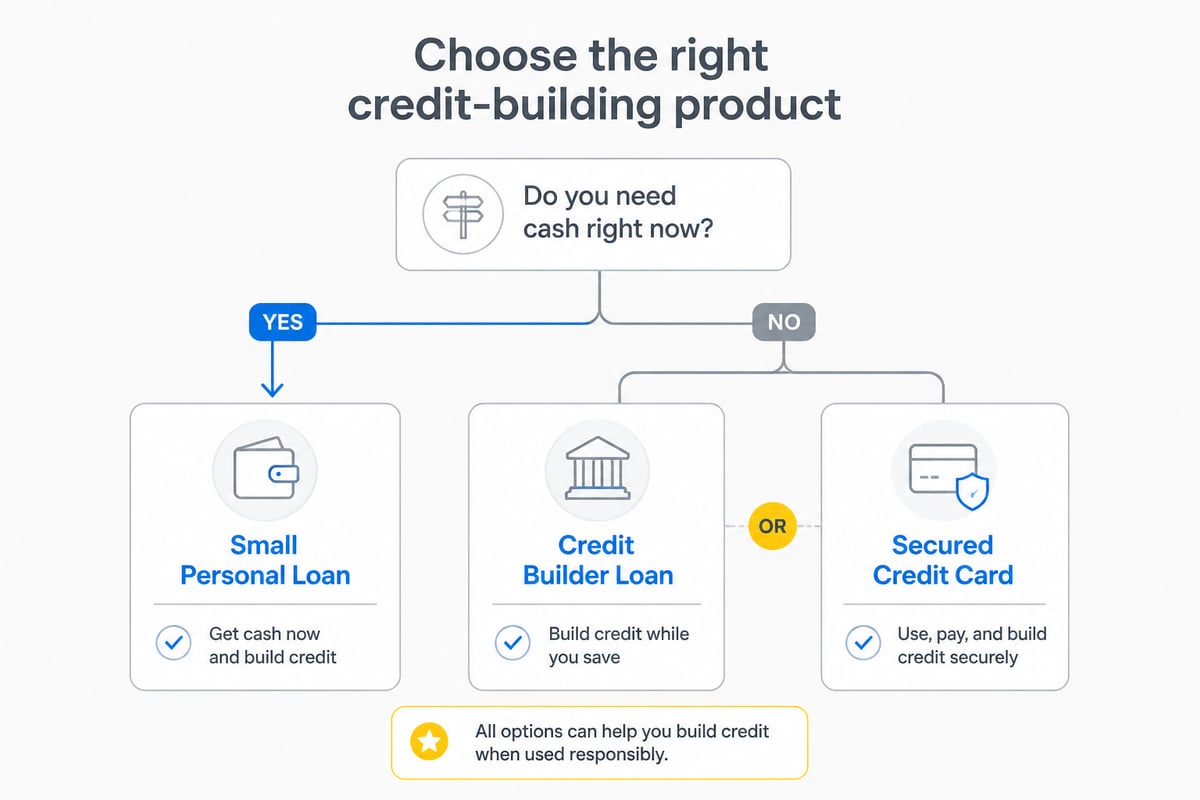
The best loan to build credit is one that reports to all three major bureaus, carries a payment you can afford, and costs little in fees and interest. For many first-time or returning borrowers, that is a credit builder loan. For others, a small personal loan with a manageable term does the same work while also giving access to the funds.
Compare options on the same attributes:
| Option | Funds received | Typical size | Reports to bureaus | Best use |
|---|---|---|---|---|
| Credit builder loan | After repayment | $300 to $1,000 | Usually yes | Establishing a first record |
| Small personal loan | Upfront | Varies | Usually yes | A real expense plus credit building |
| Secured credit card | Credit line after deposit | Matches deposit | Usually yes | Building revolving credit |
The right choice depends on whether you need the money now. If you do not, a credit builder loan is a disciplined, low-risk route. If you do, a small personal loan from a lender that works with past credit problems can cover the expense and build history at the same time.
Costs, Fees, and Risks to Check Before You Apply
Before you sign, the costs that matter most are the interest rate, any administrative or origination fee, and the total you will pay over the term. Because you cannot use the money while you repay, these charges are the real price of the credit history you are buying.
Review these points with any lender:
- Total cost. Ask for the full amount you will pay, not just the monthly figure.
- Reporting. Confirm which bureaus receive your payment data, and whether positive and negative activity are both reported.
- Early payoff. Ask whether you can close the loan early and what happens to the held funds.
- Late payment policy. Learn the grace period and fee for a late payment.
- Where the funds are held. Understand whether interest on the held account offsets part of your cost.
The Federal Reserve also publishes an overview of credit-building products, which gives useful context on how common these loans are.
A practical safeguard is to set up automatic payments from your checking account. Since a single late payment can reverse the progress you are paying for, automation protects the whole purpose of the loan.

Other Ways to Build or Rebuild Credit
If a credit builder loan does not fit, several other methods can also add positive history to your file. None of them require a perfect record, and some can be used together.
- Secured credit card. You place a refundable deposit that typically sets your limit, then use the card lightly and pay the balance on time.
- Authorized user status. A trusted family member adds you to a well-managed account, and its history may appear on your report.
- Rent and bill reporting. Some services report on-time rent or utility payments, which can add data to a thin file.
- A small installment loan. If you have a legitimate need, such as a home repair, a medical bill, or tuition, a personal loan repaid on schedule builds history while solving a real problem.
Whatever you choose, the habits are the same: pay on time, keep balances low, and avoid opening several accounts at once.
Getting Credit Builder Loans in Louisiana, Mississippi, Tennessee, and Georgia
Residents of Louisiana, Mississippi, Tennessee, and Georgia can find credit-building options through banks, credit unions, community lenders, and consumer finance companies with local branches. Working with a lender that has an office near you can make the process easier, since you can talk through your situation face to face.
Lenders that look at the whole picture, rather than a score alone, tend to be more useful for people with past credit problems. Standard Financial, for example, has branch offices in Louisiana, Mississippi, Tennessee, and Georgia and offers flexible financing plans, refinancing options, and personal loans, including for clients with past credit issues.
When you compare lenders, bring a short list of questions: Do you report to the credit bureaus? What is my total cost? What happens if I pay early or miss a payment? A clear answer to each tells you whether the product will build your credit or only cost you money.
FAQ
How long does it take for a credit builder loan to improve my credit?
Many borrowers begin to see changes within a few months of consistent, reported payments, though the timeline depends on your starting file. Most programs run six to 24 months, so the full benefit builds over the entire term.
What happens if I miss a payment on a credit builder loan?
A late payment can be reported to the credit bureaus and may lower your score, which works against the goal of the loan. Contact the lender before the due date if you expect trouble, since some will work out a short extension.
Do I need good credit to qualify for a credit builder loan?
No. Because the lender holds the funds as collateral, approval standards are often lower than for unsecured loans. Lenders may still check your income and verify your identity.
What happens after I finish paying off the loan?
The lender releases the held funds to you, minus any interest or fees. The account then shows as paid and closed, and the positive payment history stays on your credit report for years.

1 Comment
[…] Credit-builder loans are designed specifically for individuals looking to establish or rebuild credit. These loans hold the borrowed amount in a savings account while you make monthly payments. Once you complete all payments, you receive the funds and have built a positive payment history. […]